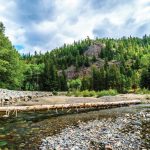
Salmon people are celebrating success and renewing their commitment to restore historic salmon runs in the headwaters of one of the world’s greatest rivers, the Columbia.
The Columbia River flows into the Pacific Ocean just south of the Oregon-Washington border. Until 1939, when the United States government completed the massive Grand Coulee Dam hydroelectric project, the river’s headwaters in BC’s Kootenay region were the spawning grounds of the world’s largest salmon runs. Dams have blocked the river to returning salmon for 86 years.
“Our peoples have never stopped working together across colonial borders to call the salmon back,” says kalʔlùpaɋʹn Chief Keith Crow, Lower Similkameen Indian Band, Syilx Okanagan Nation. “The salmon belong here, and with ceremony [and] Indigenous knowledge, combined with western science and determination, we are bringing them home.”https://columbiariversalmon.ca/the-salmon-are-coming-home-historic-return-to-the-columbia-river/
The Bringing the Salmon Home Initiative, part of the Columbia River Salmon Reintroduction Initiative, is an Indigenous-led collaboration of the Syilx Okanagan Nation, Ktunaxa Nation, Secwépemc Nation, Canada, and British Columbia. The goal is restoring the upper Columbia’s incredible salmon runs that sustained the region for thousands of years.
The release and the return
In 2023, volunteer “salmon warriors” near Castlegar, well upstream from the Grand Coulee Dam, released tagged sockeye fry into the upper Columbia River with songs and ceremony. The young fish thrived in their former habitat and swam downstream over the dams all the way to the Pacific Ocean. This year, volunteers were elated to find the same tagged fish, now adults, returning from the sea and swimming upstream as far as they could – a remarkable accomplishment that confirms reintroduction initiatives can succeed.
“This proves that, given the chance, the salmon know where they need to go,” says Mark Thomas, Shuswap Indian Band Councillor, Secwépemc Nation, and Chair of the Bringing the Salmon Home Executive Working Group. “This moment is cause for celebration, reflection, and renewed commitment. We do this work for our grandchildren, for the river, and for all of our relations.”
“Given the chance,the salmon know where they need to go.”
Despite their incredible strength and homing instinct, the returning salmon couldn’t get upstream past the dams to their home waters in BC. That’s where future work will focus. In recent years, the Colville Tribal Fish and Wildlife Department has been trapping and hauling adult salmon past the dams and releasing them to spawn in upstream channels.
BC’s Minister of Water, Land and Resource Stewardship Randene Neill says: “This result confirms the success of collaborative reintroduction studies and the resilience of salmon life cycles once thought lost from these waters.”
In 2024, Canada and the US agreed to new measures to restore salmon and ecosystems under the modernized Columbia River Treaty Agreement-In-Principle, supporting the Bringing the Salmon Home Initiative’s mandate to return salmon to the upper Columbia in Canada.
Jason Andrew, ʔaq̓am Councillor, Ktunaxa Nation, adds: “Our ancestors taught us that salmon are part of who we are. Their return signals hope, healing, and responsibility. We will continue advocating for the necessary resources until ultimate fish passage is secured and salmon once again thrive in the upper Columbia.”
Every year, the Columbia River initiative recruits volunteer Salmon Warriors and gives them hands-on training with juvenile and adult salmon.
More info at Bringing the Salmon Home Initiative.