The steep flanks of Tsitika Mountain on northern Vancouver Island are scarred with clearcuts and slash piles almost to the boundary of the Tsitika Mountain and Robson Bight ecological reserves.
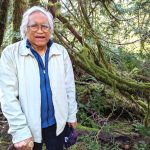
When we visited in early November, we were greeted by whiskey jacks whistling, swooping, and peering at us from nearby bushes as we climbed up into the mist, marvelling at the mammoth hemlocks and silvery cedars.
High above the Tsitika River, 34 hectares of towering conifers, cliffs, and waterfalls are on the auction block. This grove, labelled TA 1375 by BC Timber Sales, was recommended for deferral by BC’s advisory panel. That would have suspended logging, possibly permanently. But instead, BCTS – a provincial agency – is putting TA 1375 up for sale.
For some reason, the timber auction was postponed. A new auction date has come and gone, but as of mid-November, we have no news about the fate of this forest.
Murrelets can’t nest anywhere else
The steep, rugged terrain would challenge any prospective logger, but that’s only the most obvious obstacle. A tiny seabird may turn out to be the most formidable adversary. Independent researchers led by retired UBC professor Royann Petrell made a surprising discovery this year: they recorded over 300 marbled murrelets flying through the Tsitika forest in a single day. These elusive seabirds spend their days feeding on fish and marine life, returning each night to nest in high, mossy treetops far from the ocean. The numbers are all the more stunning because the species is listed as threatened.
Despite that designation, murrelets have no protection from the logging companies that continue to clearcut their coastal old-growth habitat. And murrelets can’t nest anywhere else.
Petrell and her research group are alarmed at the rate of habitat loss. Petrell estimates that logging has destroyed one-quarter of murrelet nesting habitat, including parts of the Fairy Creek watershed and thousands of acres of other primary forest.
“The forestry company said in its own forestry management plan that the [old-growth] forest will be gone in 15 years. They’ll cut it all down except for these few wildlife habitat areas,” Petrell told CBC News. “It’s not going to last. It’s not sustainable.”

Marbled Murrelet – Photo by Martin Raphael, US Forest Service (Wikipedia)
Asserting land rights
Ernest Alfred, elected councillor of the ‘Namgis First Nation, told Canadian Press that he visited the Tsitika forest in July and found that it’s “surrounded by clearcuts.”
“To take out what has already been sort of left alone, to me is just criminal,” Alfred told Canadian Press. “Who’s benefiting, and at what cost? Because the environmental damage is far more reaching than monetary value for our people.”
The Ma’amtagila Nation is asserting its land rights in the Tsitika Valley and other watersheds on northern Vancouver Island. After decades of being erased and subsumed by the neighbouring Tlowitsis Nation, the Ma’amtagila Declaration served notice this summer to logging companies and other First Nations that old growth logging on its territory will not be tolerated.
But on paper, the land rights belong to the Nanwakolas Council, a union of six Kwakwaka’wakw nations that include the Tlowitsis Nation. “I think the development of natural resources always has to be sustainable. Should we be cutting all the old growth? No,” Dallas Smith, Nanwakolas Council’s board president, told Canadian Press. “But there is still old growth that has some values that are replicated in other places that we’re comfortable with the development of.”
Over ninety per cent of the forest is hemlock and balsam fir.
Denman Island forest activist Eartha Muirhead is calling for volunteers and donations to challenge the timber sale in the courts. “I formed a group called Vancouver Island Forest Focus and we are ready to roll,” she wrote. With the backing of West Coast Environmental Law and a Tsitika Defense Fund crowdfunding campaign, the group intends to compel the government to live up to its commitments to protect ecosystems, migratory birds, and old-growth forests.
Those commitments include establishing protected habitat under the federal Migratory Bird Convention Act and implementing recommendations from BC’s Old Growth Strategic Review. Five years after its report was released, a key recommendation — protecting biodiversity and ecosystem health in law — is “languishing,” WCEL notes, “while BC moves to fast-track resource development.”

Marbled Murrelet chick by Pengo (Wikipedia)
Worth more standing
BCTS doesn’t guarantee any profit will be gained from logging this mountainside, especially given the collapse of log exports and Trump’s punishing tariffs on Canadian wood. Tsitika Mountain boasts giant yellow cedars, but BCTS documents show over ninety per cent of the forest is hemlock and balsam fir, species that are “the lowest value wood of all the species,” according to one industry expert.
On the expense side of the balance sheet, the added cost of community opposition – lawyers, security teams, downtime – can be ruinous. Logging companies run on slim profit margins at best. Teal Jones, the company responsible for logging marbled murrelet nesting trees at Fairy Creek, found itself paying heavy penalties: it was forced to petition for creditor protection in 2024 after a massive civil disobedience campaign paralyzed operations for weeks. The company is trying to stay afloat by selling off its US holdings.
Industry insiders have seen this scenario before. They have a special term for places where logging isn’t feasible because public protests outweigh profits. The term is “socially inoperable.”

Tsitika Mountain forest – Photo by Hazel Volk
Feature image by Joshua Wright