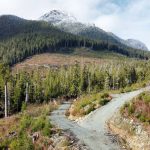
On July 24, 2025, in collaboration with the Awi’nakola Foundation, Ma’a̱mtagila hereditary leaders and descendants welcomed Forestorium — an on-site opera by University of Victoria artist Paul Walde that invited the audience to bear witness to art and ceremony braided together on Ma’a̱mtagila ancestral territory, on Vancouver Island’s Adam River south of Sayward.
Ten kilometres down a dusty forest road with panoramic views of the devastating impact of forestry, guests were welcomed by the silence of one of the few remaining old-growth groves in the once-abundant forests of the Ma’a̱mtagila. Viewers sprawled across the forest floor, tucked between fallen trees and undergrowth, to listen to a libretto encapsulating five years of interviews with activists, scientists, and Indigenous knowledge keepers.
The performance portrayed the many sides of the forest industry, from the perspectives of loggers to the pleas of protesters and the Indigenous community denied access to their homelands. Following the opera, Ma’a̱mtagila Hereditary Chief Makwala (Rande Cook) addressed the spectators. “Ceremonies come in all forms, and this is a ceremony right now.” Cook reminded the listeners of their responsibilities as witnesses, as the Ma’a̱mtagila people were officially declaring the site as protected, “to reclaim not only our space, but our identity.”
On paper, the Ma’a̱mtagila were erased.
“We’re forest people. Our whole culture comes from the forest,” Cook says. “We cared about our land so much that if you were disruptive and harmed it … the penalty was death.” He explains how forests were the setting for historic rituals that led to the songs, dances, masks, and other prerogatives held by chieftain families in the present day. “Our role as chiefs is to protect our land,” he says. When he stepped into his grandfather’s chieftainship, he started walking his traditional territory and witnessing firsthand the clearcut logging destruction of Ma’a̱mtagila territory.
Cook notes the ancient practice of the Kwakwaka’wakw to “bury” their deceased in treetops. “When the remains would fall later, our DNA would be absorbed into the tree.”
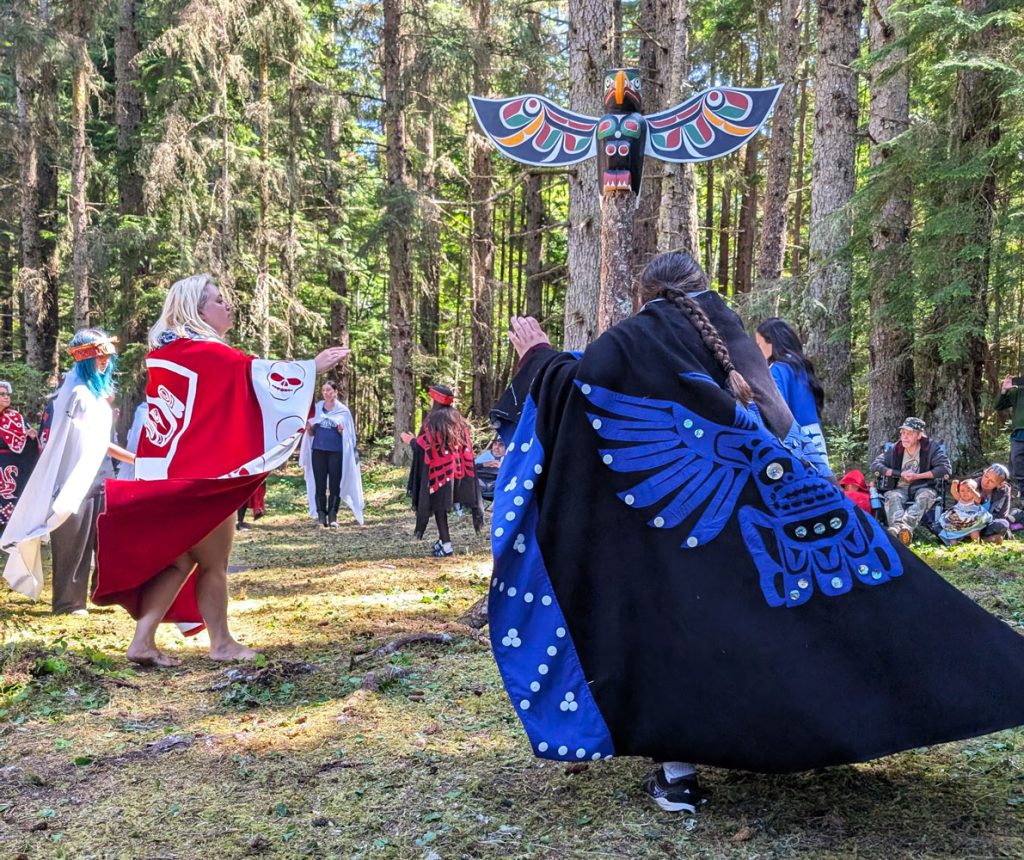
The Women’s Dance
Stolen land, erased peoples
Cook walks us through the colonized history of the Ma’a̱mtagila. In June of 1948, the head families of the Tlowitsis and Matilpi (Ma’a̱mtagila) Bands agreed that the head hereditary chiefs of the Matilpi and Tlowitsis would hold equal power and responsibility for the amalgamated Nation, and members of both tribes would hold equal rights to all amalgamated lands. “The whole reason for the amalgamation … our elders were worried about losing our land because all the kids were being taken to residential school.”
The children were placed in the St. Michael’s Residential School in Alert Bay, and many Ma’a̱mtagila members moved there to be closer to them. They were required to transfer into the Nimpkish Band (‘Namgis) to live on the reserve.
In 1998, with no Ma’a̱mtagila people present, two Tlowitsis brothers, John and Alec Smith, took the opportunity to fabricate a band council resolution declaring that no members of the Ma’a̱mtagila remained, and therefore their lands were forfeited to Tlowitsis. “They just saw the opportunity to benefit financially, without thinking about culture or family connections,” says Cook. The Tlowitsis First Nation has not held an election since. John Smith remains Tlowitsis Chief Councillor, along with his son, Nanwakolas Council president Dallas Smith.
On paper, the Ma’a̱mtagila were erased; in practice, descendants continued to hold ceremonies, returning to the land and carrying the culture forward.
Government feeds greed
Tlowitsis is currently in the late stages of treaty negotiations. Cook explains, “They want to sell 100% of Ma’a̱mtagila territory,” to help fund their new 635-acre reserve located near Campbell River. “If [they] do that, we’ll never have access to our land again…. It’s complete erasure.”
The impending sale of Ma’a̱mtagila’s territories pushed Cook to seek legal counsel. In 2024, Na̲nwaḵolas and Western Forest Products unveiled La-kwa sa muqw Forestry Limited Partnership (LKSM), a “historic partnership” giving four member Nations (Tlowitsis, We Wai Kai, Wei Wai Kum, K’ómoks) a 34% share. “Logging is amped up by 30% in Ma’a̱mtagila territory,” Cook says. “They’re trying to get as much as they possibly can out of it before it’s gone.”
In March 2024, a new Tree Farm License was created by subdividing another TFL. TFL 64 spans much of Ma’a̱mtagila territory, but the licence holders are Western Forest Products and LKSM. “I’m not saying logging is bad, but it’s fixing the type of logging. We need to be more selective … we need to leave the old growth. We need that diversity,” says Cook.
The new cutblocks were quiet this summer, though – workers went on strike in June when United Steelworkers Local 1-1937 rejected LKSM’s demands for non-union contractors in union jobs.
Cook says the Awi’nakola Foundation is working to identify and tag as many culturally modified trees as possible, and noting evidence of harvested CMTs. “We’re losing so much … especially our yellow cedar at high elevations – it takes thousands and thousands of years to grow that.”
Awakening Hiladi
On July 24 and 25, the Awi’nakola Foundation held its annual Tree of Life gathering in the historic Ma’a̱mtagila village of Hiladi, “the place to make things right,” at the Adam River estuary on northern Vancouver Island. The village is the permanent residence of Ma’a̱mtagila matriarch Tsasilqualus (Dawna Ambers) and volunteers are slowly rebuilding it.
On July 25, hereditary chiefs unveiled a beautifully carved eagle pole to mark this place as Ma’a̱mtagila land forever. Ma’a̱mtagila descendants and allies, ranging in age from five weeks to 85 years, came together to feast, dance, celebrate, and bear witness.
Speaker Matthew Ambers addressed the gathering. “This land was never given away. It was never sold, never bought, never taken through warfare.” Ambers explains that it is the wish of the Ma’a̱mtagila hereditary Chiefs for their people to return to take care of their territory.
Wielding an eagle-topped talking stick, Ambers read Ma’a̱mtagila’s Declaration of Sovereignty: “The Ma’a̱mtagila Nation has exclusively occupied and used these territories since the beginning of time…. The Ma’a̱mtagila Nation is the proper rights holder for Aboriginal rights over Ma’a̱mtagila lands, submerged lands, waters, air, and resources. The Ma’a̱mtagila Nation has never been consulted by the Crown for resource extraction in its territories, nor has it ever consented to such activities…. The Ma’a̱mtagila Nation commits to protecting the integrity of the most diverse and vulnerable ecosystems that exist in its territories.”
The Ma’a̱mtagila Declaration aims to have the Crown officially recognize the Ma’a̱mtagila, the first step in asserting their rights with industry. The full declaration can be read at www.maamtagila.ca.
Pa̱x̱a̱la, Desiree Mannila, is Watershed Sentinel‘s staff reporter and a proud member of the Da’naxda’xw/Awaetlala Nation.
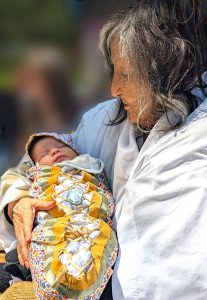
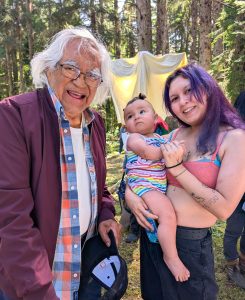
Photos by Zoe Blunt. Top to bottom: the Fool dance, the women’s dance, Ma’amtagila elder Tsasilqualus with baby Nih-ska, Pacheedaht elder Bill Jones with Lily and Jasmine.
Listen to the Ma’amtagila Declaration along with traditional songs, drumming, and speakers recorded at the Tree of Life gathering at Hiladi. www.watershedsentinel.ca/radio