In 2012, on a damp Sunday night, two rain-soaked women knocked on the door of a Pacheedaht man in Port Renfrew. They asked him to come see the Walbran. He was in his seventies, unwell, and by his own account a “last-class underdog.”
They carried him to the top of a pile of felled cedar giants, and a photographer took his picture while angry loggers glared with fists clenched. “And that was the start,” Bill recalls. “They had their ‘injun.'”
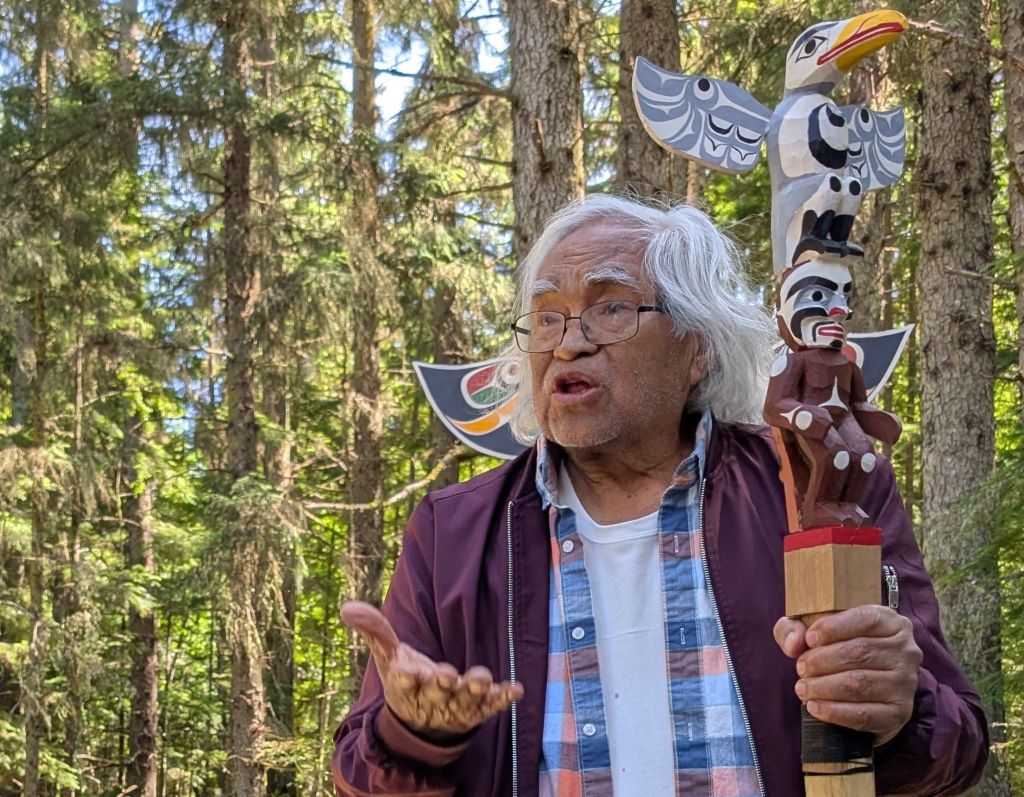
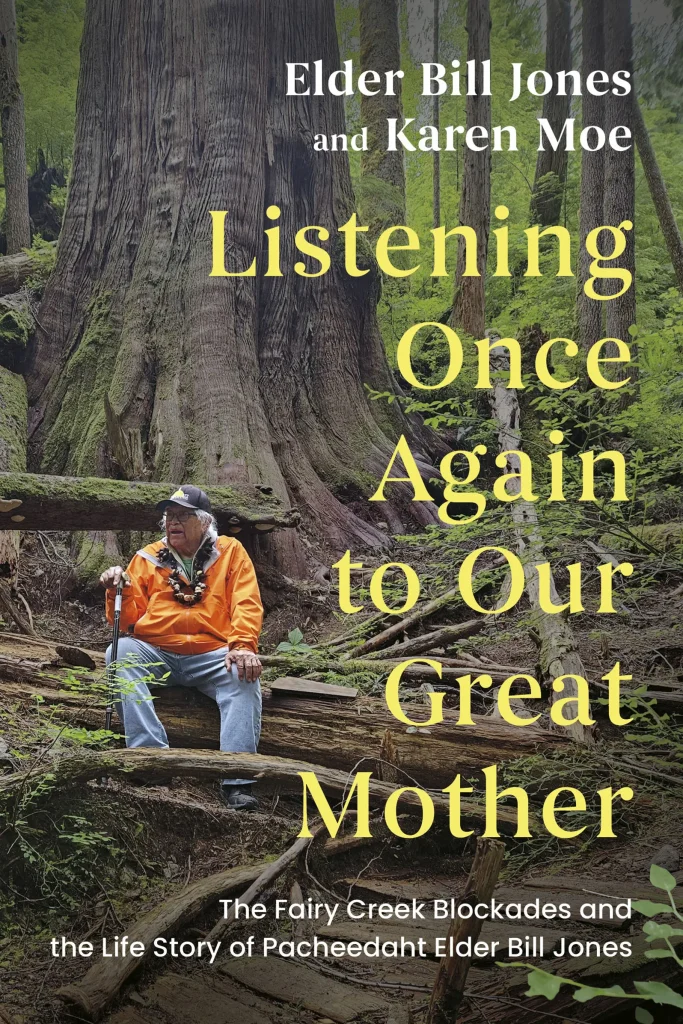
Elder Bill Jones’s story, told with writer Karen Moe over 161 recorded conversations, isn’t what you might expect from a protest book. In Listening Once Again to Our Great Mother, available now at Dundurn Press, he goes back to his grandfather Charlie, who began telling him the stories of their ancestors when he was fourteen and home from the Port Alberni Indian Residential School.
 Logging and killing
The book follows Bill into the woods as a sixteen-year-old logger in 1956, and into decades of alcoholism and collusion. When Bill was working as a logger, Grandpa Charlie told him, “Don’t cut down any of those trees.” Bill heard his grandfather’s word but didn’t understand until sixty years later: “It wasn’t until I was at Fairy Creek from 2020 to 2021 that I finally listened to my grandfather.”
What stands out about this book, is that it refuses to separate the destruction of the forest from the destruction of a people. Elder Bill Jones argues that everything is connected. Three chapters – “Denied,” “Deprived,” and “Depraved” – present residential schools, the Indian Act, the reserve system, and the logging industry as parts of one machine. They are all gears in a vast system of wreckage.
In the Preface, Bill says Indigenous people were desensitized and that there was no other work: “We were coerced into killing our Great Mother.” And Bill was no exception.
Demented and depraved
Anger is a driving force in this book, as Bill says from the first chapter. He writes that hearing of an old-growth tree coming down feels like murder, “a murder on par with a murder of a human being.” He then cites Andrea Dworkin and Chimamanda Ngozi Adichie on the power of anger to bring about change, and adds that he lives “through the motivational force of anger.” It’s an unusual thing to find in an Elder’s memoir, and it gives the book its power. In a world where coolness and indifference are the norm, this emotion is an extremely refreshing change.
“We were coerced into killing our Great Mother.”
But it isn’t a comfortable read. The chapter “Demented” is raw about addiction and sexual violence on the reservation, and Bill is scathing about band councils that, he says, serve government and industry without consulting all their members, especially Elders. Some readers will bristle at his sweeping judgments of reservation life. Good – the book doesn’t need to tidy that tension away.
Still, the book’s resounding emotion is not despair. It’s what Bill calls re-indigenization: the recovery of a bond with the living world that he insists every human being carries, whatever their ancestry. The Preface recalls Bill telling a crowd of roughly two hundred forest defenders, most of whom are settlers, “You were all Indigenous once.” When mainstream media asked why so few Indigenous people were on the front lines, his answer was: “They’re on the reservation watching TV.” He knew, because at one time, that was him.
The blockades
The book takes its time getting to the blockades, and that’s a strength. Chapter 8 recounts how, after that night in 2012, Bill spent six to eight years drifting up to the Walbran, often alone. He joined the Friends of the Carmanah Walbran, who had fought for the valley since 1991. Erika Heyrman, one of the group’s founders, remembers building trails and boardwalks and a lookout at Emerald Pool, partly so Bill could reach the cedars there despite his failing health. When Bill first started going, there were about half a dozen campsites. Today there are over a hundred.
Those years were when it started to sink in. Bill describes sitting with about a dozen people in old growth for two and a half hours, and realizing that his soul had known the quiet of the forest all along: “My soul knew it, but my conscience didn’t know it.” That’s the book’s title in action. The forest isn’t a warehouse, it’s a teacher, and we have been too dense to hear it calling out to us. Rainbow Eyes puts it plainly: “It is a spirit school.”
“To me, this is more important than life.”
A personal breakthrough came during a storm at River Camp in February 2021, when Bill felt the shell he’d lived inside break open. “It all shattered,” he says. “And I said: ‘I know what happened!'”
When the Fairy Creek blockades began in August 2020, Bill was already there in spirit – and soon, in person. Chapter 1 opens the book on August 14, 2021, when about 250 people gathered. By the end, 1,188 people were arrested at the blockades, surpassing Clayoquot Sound in the early 1990s as the largest act of civil disobedience in Canadian history.
Tactics and trauma
In Chapter 5, we learn that satellite mapper Joshua Wright tracked the logging from a distance in real time, allowing Forest Defenders to beat the trucks to the next cutblock and set up pop-up blockades. Builder Will O’Connell raised a sixteen-foot elk out of slash-pile wood across the road to Ridge Camp, and later a screech owl whose wings spanned the Gordon River Bridge. He explains his philosophy: “if you can make something beautiful it attracts people,” and it “makes your argument without having to make it.”
Defenders locked their arms inside “cookies,” huge slices of ancient stumps bored out for the purpose. They played hide-and-go-creek, scattering through the forest blowing whistles until the RCMP couldn’t find them, and the trees stayed standing. It sounds like a joke until you remember it worked.
Chapter 8 refuses to look away from the grim side, describing tree-sitter Panda’s extraction by RCMP climbers dangling from a helicopter, as he perched near the top of an ancient tree that thinned to about eight inches across. Asked to come down, he answered, “To me, this is more important than life.” The book also describes threats of tear gas and rubber bullets used as intimidation, and the authors’ argument that the RCMP’s response team put corporate interests ahead of the safety of the public.
Trauma and transformation came out of the very same summer.
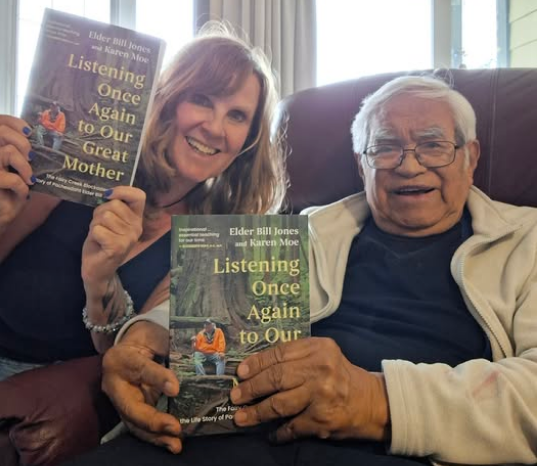
Karen Moe and Bill Jones
Deferrals and destruction
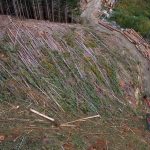
The Province’s famous 2021 old-growth deferrals covered only the Fairy Creek watershed itself, 1,184 hectares of the 1,950 that make up the Fairy Creek Rainforest. It left out the high-productivity old growth surrounding it, which is why the blockades didn’t back down. The authors also point out something rarely made public: 60 percent of the watershed was already protected as marbled murrelet habitat since 2005. By their math, the blockaders won roughly 474 hectares of new, temporary protection. Meanwhile, they report, 204 hectares of old growth were logged during the blockades.
An endnote cites a report finding that 45,700 hectares of old growth were logged across BC in 2021, the very year the government was announcing its deferrals. The authors call the result a “token temporary deferral” that eased public pressure, but did not end the cutting.
The rest of the ledger is even worse, as the Introduction and Conclusion detail:
● Edinburgh Mountain is being clearcut by Teal-Jones, as the authors were writing in January 2026.
● Sassin fell after the cameras left and the public relaxed. It was one of the forests cut “when no one was looking.”
● The Upper Walbran was never deferred at all. Cedars the authors estimate at 800 to 1,000 years old are coming down there, and the protection camp was disbanded in February 2026.
The book’s notes point to a March 2026 report of a leaked letter from a panel of experts warning the premier that rare old trees are being cut on land that was promised for protection. The Introduction reveals that scientists identified 319 species in the Fairy Creek watershed, sixteen of them vulnerable. The survey was carried out in only twenty hours, with police restricting access. Imagine what a proper inventory would turn up.
The verdict and the fallout
In the Conclusion, Bill offers his verdict on the government’s approach. Deferrals are “a marginally good thing,” but more a political strategy to keep logging old growth: “It’s smoke and mirrors.” The government diverts attention, while industry, which he calls its “bosses,” keeps cutting. He describes the NDP government backing industry while claiming to save old growth, and he says the scraps of old trees left at the edges are mostly useful for boosting the profit from second growth. In Chapter 8’s closing pages, he recounts a scene from Salmon Camp in 2021, when he told the RCMP commander that he had invited then-Premier John Horgan and the elected chief of his own band council to join the sacred circle, and that both declined. He then invited the officers to join. They also refused:
In an era when governments say the word “reconciliation” every week, this is hard to square.
“Our place is here.” Bill smiled and turned to the crowd: “My friends and I have flown the coop!”
The jobs argument gets a short, sharp answer in the same scene. Elder Mike Arnouse tells the gathering that if it’s jobs the government wants, it can create plenty: “Clean up the water. Clean up the air.” The crowd laughed, but he had a point..
Nothing about the loss of ancient forests is inevitable. The Introduction and Chapter 8 recall how Carmanah became a park in 1990 and Clayoquot was protected in 2000, and both happened because ordinary people refused to go home. The authors want the province and the Pacheedaht Band Council to agree to protect Fairy Creek and the Central Walbran in perpetuity this time, and they say so plainly.
In an era when politicians say the word “reconciliation” every week, this outcome is hard to square.
Grandma Losah, quoted in the Conclusion, says the hardest moment at Fairy Creek was watching people leave with sadness in their eyes, thinking it was over. “But it’s not the end, the fight continues.” She notes that the fight for the Walbran has now lasted thirty years. And the people who stood in the road are still paying.
The Conclusion details how Indigenous land guardian Rainbow Eyes received a sentence roughly three times longer than any other blockader, for acts many say are no different. “I was targeted,” she says.
Bill argues that the Crown will let Indigenous people protest only as long as they stay in the bounds the Crown has drawn: “Indians can yell at the Crown as long as they sing the Crown’s tune.”
Teal-Jones is attempting to sue fifteen people, Bill included, over an alleged $40 million in lost revenue. The company was granted creditor protection in 2024, a shield the defendants will never be offered. In an era when politicians say the word “reconciliation” every week, this outcome is hard to square.
The book isn’t flawless. The shifts between Bill’s oral storytelling and Moe’s more polemical prose can be jarring, and a few chapters could have been tighter. (Minus one point for pacing.) Some of Bill’s harshest judgments are debatable, and the book would have benefited from more room for the people he criticizes to answer.
But what it gets right matters far more. Elizabeth May calls it “the essential teaching for our time,” and Suzanne Simard says it belongs in every Canadian school. They’re right. Old growth isn’t a resource. A cedar that took a thousand years to grow can’t be replaced by a plantation, and no amount of “sustainable management” changes the math.
Bill spent much of his life cutting down what he’d been taught to protect. In his message to young people at the end, he tells them, “I’m not the thinker in your life.”
“You kids are my hope.”
Emily Milne is an aspiring educator who grew up on Vancouver Island. In her spare time, she enjoys reading, hiking, and exploring British Columbia’s nature.