As wildfires raged this summer, I turned to the documentary film BC Is Burning hoping to find ways to protect British Columbia’s wilderness from being destroyed. What I found instead was pro-logging propaganda that tries to fool the public into thinking forestry is the saviour that will keep us from burning.
The film’s creator, Murray Wilson, is an industry man through and through. From logger to tree-planting camp supervisor, he’s done every forestry job under the sun. He’s joined by many “experts” of the field, nearly all of whom have spent their careers prescribing more logging, not conservation or protection of natural landscapes. Wilson and his gang of industry people have every incentive to paint the forest industry as the good guys looking out for the public by claiming logging is the solution.
Wilson’s plan for wildfire mitigation is simple: active forest management – or plainly put, logging. By the film’s final act, the possible plan of action morphs into something more accurately resembling industry lobbying: “We need to go back and treat the wildfire situation like the mountain pine beetle infestation … and increase our harvest levels to address the fire risk.”
The film’s underlying claim, that industrial logging makes forests more resilient, fails at every conceivable level.
It should surprise no one that a film created by a lifelong industry man would land on “log more” as its solution, but something far more alarming came out of this documentary. Forty BC MLAs – including Minister of Forests Ravi Parmar, Speaker of the House and Burnaby-New Westminster MLA Raj Chouhan, and the MLAs for Cariboo-Chilcotin, Kamloops-North Thompson, Vernon-Lumby, and Kootenay-Monashee – were tagged on social media or personally shared accounts of attending screenings of BC Is Burning. In their respective photos, they are all grinning ear-to-ear after watching the film. It appears as if Wilson’s “log more” propaganda is landing well with all political blocs in BC.
Blaming environmental protections
Stripped to the bone, BC Is Burning makes three points. It begins by claiming that today’s “mega-fires” are caused by insect outbreaks and years of fire suppression, then moves on to its main mark: environmental protections. Wilson whines that “constrained harvesting around communities,” (which includes visual quality objectives, wildlife habitat rules, and old-growth management areas) is the true reason why wildfires are growing more devastating. He claims that because logging is limited in these protected areas, the forests are dense, and therefore there is more fuel for the fires.
This is misleading because most wildfires happen in managed forests, not protected areas. Nevertheless, the film goes on to frame prescribed burns, “regeneration harvesting,” and thinning as the fix for fires, going so far as to contend that the sale of the wood removed in the process is not a business perk, but a public service.
Logging releases carbon
Finally, the film turns to carbon. The speakers argue that a young monoculture stand functions as a “permanent carbon sink” if managed properly. However, this is inaccurate. Carbon sinks work by storing carbon in living biomass and soil as long as the forest is left undisturbed. A stand that is logged within a few decades is not a “permanent” sink, because logging releases stored carbon back into the atmosphere the moment the trees are cut, milled, and often burned as slash.
But not everything in the film is false. It’s true that fuel accumulates. Indigenous-led prescribed burning is an under-used tool. The brief mention of traditional ecological knowledge is the only credible part of the film. (One point for you, Wilson.)
But the underlying claim of BC Is Burning is that industrial logging makes forests more resilient, and this claim fails at every conceivable level.
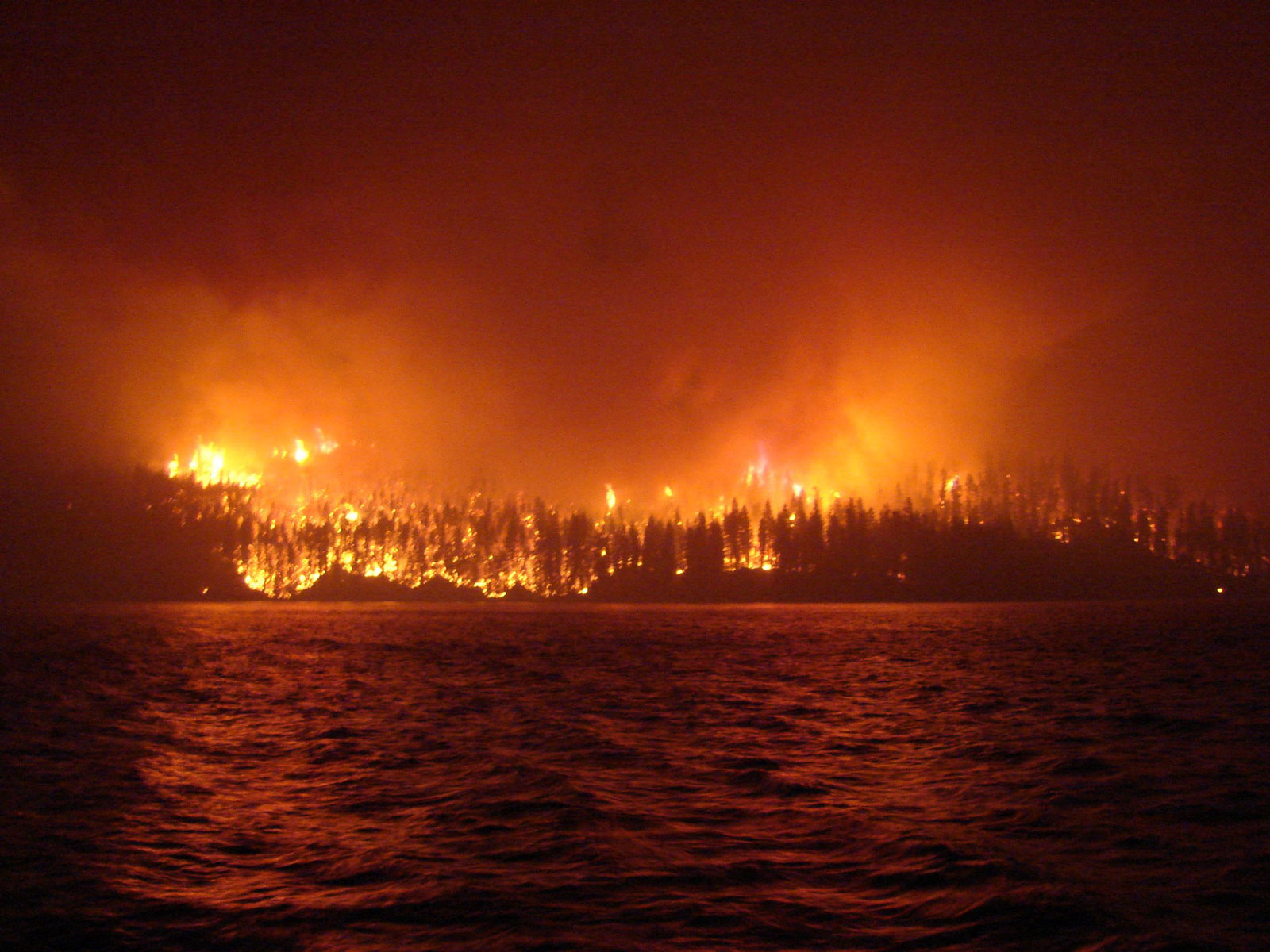
Shawn Cahill | Wikimedia Commons
The inconvenient truth
In August 2025, in the forests south of Port Alberni on Vancouver Island, a spark ignited the largest wildfire on the Island since 1967. BC Wildfire Service described the fire’s behaviour as “explosive,” and officials pointed fingers to wind and heat as the culprits. But a formal Notice of Complaint filed with the BC Forest Practices Board by researcher David Broadland and the Evergreen Alliance notes that the actual conditions the night of August 11 contradict this narrative.
The same complaint addresses the history of the burned forest. Satellite imagery shows roughly 68% of the forest in the fire’s wake had been logged and replanted by Mosaic Forest Management. BC Wildfire’s video footage of the fire shows widespread dead dry debris in the cutblocks, with fire crews working through slash-covered clearcuts.
The images taken after the fire reveal something completely different than what the forest industry tells the public. The planted trees burned to the ground, whereas the older, mature forest that Mosaic hadn’t logged remained standing.
The complaint references the Canadian Forest Fire Behaviour Prediction System to bolster its claim. According to the fire weather recorded that night, predicted fire spread through logging slash was around nine times faster than through the mature coastal forest, and its spread through young conifer plantations was more than four times faster than mature stands.
Low-canopy, young plantations let sunlight reach the forest floors, which dries out brush and creates the ladder-fuel conditions that BC is Burning warns about. The difference is that the film claims these conditions occur in mature forests. Mount Underwood demonstrates that young plantations and logging are the culprits.
Boreal research
This is the truth that the forest industry doesn’t want the public to know. Mount Underwood isn’t just a one-off – a 2025 study out of Quebec’s boreal forest proves it’s part of a pattern. Researchers analyzed 35 years of forest survey, harvest, and wildfire data across more than half a million forest plots, controlling statistically for site conditions. Their findings, published in a peer-reviewed forest ecology journal, form a powerful scientific rebuttal to the forestry’s industry’s “log it before it burns” theory.
The study showed that logging and wildfire target completely different kinds of forest. When loggers harvest, they search for the most profitable timber – the dense, old-growth stands. Wildfire tends to do the opposite. Researchers found that as forests get older, denser, and taller, the risk of wildfires decreases, whereas low-canopy, young stands are where fire concentrates the most.
This is consistent with the Mount Underwood fire. Open canopies dry out faster and keep flammable branches low to the ground, while mature forests hold moisture closer to the forest floor. The study also claims that because the industry logs the most fire-resistant forests and leaves the fire-prone matchsticks standing, our current method of forest management is applying a “double penalty” – meaning they shrink old-growth habitats while making our forests more flammable.
Make that a triple
That double penalty doesn’t stop at fire risk: it reaches into carbon too. This finding directly contradicts the carbon argument in BC Is Burning’s latter half. Mature, dense forests are not simply more fire-resistant; they also hold the most carbon because they have been left standing the longest.
Claiming that logging the forest preserves the carbon is false. Primary forests store carbon for centuries, accumulating far more per hectare than any replanted stand could reach within a human lifetime. Replacing them with young trees locks the landscape into a continuous cycle where the forest is cut long before it matches what was lost.
The film’s own contributors admit trees “can die from being burned, from pests, from storms, from harvesting” and release stored carbon regardless of which of those causes ends them. A young replanted stand is not a carbon sink “forever” like the film claims – it’s a matchstick waiting to be lit because the mature trees protecting it have already been hauled away.
Mature, dense forests are not simply more fire-resistant; they also hold the most carbon.
With sawmills closing, harvest volumes decreasing, and logging companies facing regulatory scrutiny for the fuel condition they leave behind, it is easy to see that this film is not based on neutral wildfire science. It relies on scare tactics and bunk science to persuade the viewer that it’s good to log more, faster, and without restrictions.
An industry that’s losing mills and logging volume has an incentive to reframe wildfire risk as a reason to expand logging, not restrict it – which makes a film funded by that same industry a poor messenger for real wildfire science.
The Forest Minister’s apparent endorsement of BC Is Burning should shock the public. When government officials openly support this narrative, it stops being a documentary and becomes government policy filtered through a camera lens.
Communities don’t need forestry propaganda; they need facts. And the facts, from Mount Underwood to Quebec’s boreal forest, demonstrate the opposite of everything this film says. Old growth doesn’t burn like this. Plantations do. The ancient forests were never the problem – they’re the only thing standing between us and more wildfires like Mount Underwood.
If MLAs smiling for a photo op is what passes for wildfire policy in this province, then the mismanagement isn’t in the forests. It’s in the legislature.
Emily Milne is an aspiring educator who grew up on Vancouver Island. In her spare time, she enjoys reading, hiking, and exploring British Columbia’s nature.
See also Watershed Sentinel, the Forest Crisis issue, April/May 2026.