 by Maggie Paquet
All living things produce waste products. That includes us, of course. How we handle this waste can have significant impacts on our shared environments, whether on land, in the sea (and rivers and lakes), or even in the air. Mostly how we handle it involves using water.
Water is one of the most precious— and abused—resources on the planet. Protecting and conserving water resources is an issue of great public concern. Previously, WS featured composting toilets as one of the tools for conserving water. Let’s face it, in our society, flushing and forgetting is one of the most rampant abuses of water we do. In this issue, we’re focusing on wastewater treatment systems.
Wastewater comes in two varieties: black water, or sewage containing fecal matter (flushing the toilet), and grey water, or water from bathing, laundry, dishwashing, and the like. In most of our cities, the two streams run through the same pipes to municipal wastewater treatment systems. All too often, they then flow into the nearest water body, whether lake, river, or the ocean. They call it waste because that’s precisely what it is: a waste of water. Cliff Turner, an Environmental Health Officer living on Gabriola Island, believes all water use in the province should be metered. That way, he says, communities, municipalities, and industries can be made responsible for leakage and other wasteful practices and maybe get motivated enough to use water resources more sustainably.
Much of the world can’t afford the “luxury” of wasting water. One of the sessions at the 3rd World Water Forum held in Japan last March focused on re-using treated domestic wastewater. In many parts of the world, recycled water is the only water source for local agriculture. By implementing safe technologies to enable re-using water, communities can achieve health and economic benefits otherwise unavailable. In the spirit of thinking globally and acting locally, we need to recognize water re-use as an important resource for meeting a variety of demands, including agricultural and non-potable uses, such as pollution abatement and public health protection, and as a means of energy conservation.
A wide range of technologies are currently under development, including constructed wetlands, aquatic greenhouses, and various types of bio-reactors and membranes. Unfortunately, and in spite of some recent improvements, there is still insufficient regulatory and policy support to encourage effective new technologies that are affordable and practicable for individuals and small communities. Not that there’s anything inherently wrong with the conventional septic system. Properly installed and maintained, it works. But where there’s a high density of septic systems, where people don’t maintain them properly (more common than you’d believe), where the soil and other physical conditions aren’t optimal, and where the amount of land needed for constructing a proper septic field isn’t available, we need to have safe alternatives that can meet regulatory approval.
John Rowse, Project Manager Health Planning, BC Ministry of Health, says the ministry’s primary concerns are for public health and safety. “Wastewater treatment systems have to be flexible enough to handle anomalies (problems). And people have to be committed to maintaining whatever systems they use. Septic systems are like a car; if you ignore or abuse them, they’ll fail. Government is revising the legislation (Sewage Disposal Regulation under the Health Act) because we have more options than we used to have and we’re recognizing the improvements in technologies and materials available. The new legislation is expected sometime in late 2003. The major changes will be around permits. The draft regulation is expected to replace the permitting process with a registration process. The proponent will register their system with the Health Authority and then install it. The current inspection process will not take place, but Health officers will have the power to audit or inspect the system at any time.”
TYPES OF WASTEWATER TREATMENT SYSTEMS
(For contact info for companies listed below, please see References and Resources section at end of article.)
ECO-TEK Wastewater Treatments Inc., Solar Aquatics Systems (Langley, BC) Eco-Tek designs, builds, and operates “enhanced ecosystems to reclaim and re-use the resources in wastewater to protect and regenerate human and natural communities with clean water, nutrients, energy, and biodiversity.” The company, based in the Fraser Valley, uses Solar AquaticsTM technology to treat wastewater using solar energy, water, and plants that mimic the natural purifying processes of streams and wetlands. These are combined with features of conventional technologies in a controlled environment, typically a greenhouse. The system produces clean water, recycles nutrients, recovers heat energy, and helps promote biodiversity. This technology is resilient to toxic loadings and can be constructed for small or large applications simply by adding more modules. ECO-TEK provides design, engineering, project management, training, and operations for Solar AquaticsTM facilities. Currently, they’re involved with an EcoVillage project near Yarrow in the Fraser Valley, building a solar aquatics system.
Hydroxyl Systems Inc. (Sidney, BC) Hydroxyl builds modular package wastewater treatment systems for a variety of applications, including marine. The systems generally incorporate multiple processes, including biological, advanced oxidation, solids separation, and can optionally include filtration or membrane separation. An example of their use is on the Bowen Queen, operated by BC Ferries. The vessel was retrofitted with Hydroxyl’s enclosed wastewater treatment system, which uses ozone rather than chlorine to disinfect the effluent. The Hydroxyl process uses two non-biological treatment processes and the resulting effluent is clear, odourless, and low in pollution (BOD and TSS). The entire process chain is enclosed in stainless steel tanks and residual solids are pumped out semi-annually as part of routine maintenance. The system provides environmental, economic, and social benefits in that no chlorine is used, there are lower maintenance costs than with conventional systems, and the crew of the ferry works in a safer environment. Hydroxyl also serves other treatment needs, from treating industrial landfill leachate at Crofton Pulp Mill to the septic system of a shopping centre south of Duncan.
Zenon Environmental Inc. (Oakville, ON) Zenon provides a membrane-based water treatment process that involves treating water by drawing it through membrane fibres in an “outside-in” flow path under a slight vacuum. The membrane fibres are installed directly in the tank of wastewater to be filtered and replace both the clarifier and the granular media filters of conventional drinking water or wastewater treatment systems. Zenon’s system uses a range of membranes that have been approved by the National Sanitation Foundation. The outside surface of the fibre is a highly water-permeable polymeric membrane that removes biological contaminants, particulates, and colloidal species from water, including: turbidity, bacteria, cysts and oocysts, iron and manganese. The membranes can be used in both water treatment and wastewater treatment applications. The basic process can be combined with enhanced coagulation (organics and arsenic removal), chemical oxidation (iron and manganese removal), and activated carbon (for taste and odour removal) to achieve particular effluent requirements. Zenon also provides reverse osmosis pre-treatment and tertiary treatment processes, can supply membrane bioreactor systems that combine filtration with a conventional activated sludge process to treat a variety of municipal, industrial, shipboard, or private development wastewaters.
Here are a few places in BC where some non-conventional wastewater treatments are in place:
Hornby Island
In 1994, concerns about groundwater and consequently well-water quality from faulty, failing or non-existent septic systems prompted Hornby Island residents to press for a change. The result was an experimental system that may also be useful in other locations with the right conditions. The project is a constructed wetland—a 12-by-6 metre rubber sheet lined structure that’s filled with gravel and covered with plants—installed at the Tribune Bay Outdoor Education Centre. It cost about $12,000 to set up, including a septic tank, pump, liner, gravel, plants, labour, and excavation of a 500-foot trench. The wetland services a 4-person residence. Wastewater (both black and grey water) goes subsurface from the septic tank and is pumped up to the wetland, where aquatic plants and microbes aid in decomposition. Under the government’s Innovative Technology Program, results were monitored for two years. Early tests showed reduced faecal coliforms and Biological Oxygen Demand (BOD), although there was a brief time when groundwater intrusion into the pump chamber temporarilylowered the effectiveness of the system. A period of antibiotic use by one of the residents also correlated with a period of higher than usual BOD levels. It is speculated that there was a connection between the two events, but this cannot be confirmed. Ed Hoeppner, of the community-based Greenhouse Organic Sewage Treatment Society (GHOSTS), which manages this project, says that the Health ministry is satisfied with the results and has given approval for three more constructed wetland pilot projects for BC, providing they can fine-tune the design in order to address the higher than expected BOD levels. Currently, GHOSTS is researching and testing a planter bed design for the treatment of greywater. The next stage for GHOSTS is to develop broader research capacity for environmentally sustainable wastewater treatment.
Errington, Vancouver Island
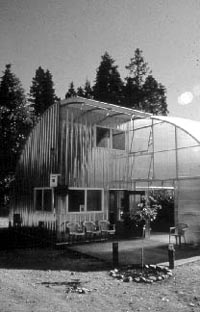
Steve Chomolok operates an Eco-Tek/Solar Aquatics system at a trailer park in Errington. The system services 52 mobile homes. Steve considers this a successful application of environmentally friendly wastewater treatment technology. The system has been installed for six years and processes between 45,000 and 60,000 litres per day. It functions well under provincial permit levels for BOD and TSS, and treats to secondary treatment standards. The system requires minimal energy to operate, a bit more in winter because some heat is required for the system to function. About an hour a day is needed for maintenance, consisting of maintaining filters, checking pumps, and monitoring inflow, outflow, temperature, etc. With proper training, it’s a fairly simple process. The system employs both aerobic and anaerobic processes and requires only very occasional removal of sludge. Barring problems such as floods, Steve believes it is an efficient and easy system to operate, and is much more resilient than a septic system. He has increased the use of native marsh plants, harvesting them just above root level to keep them working. His goal is to achieve Class 1 water quality for irrigation use. Steve says an important consideration for installing this type of system is the amount of land you have available. This one is housed in a 30-by-60 foot agricultural-style greenhouse, with a double envelope. It’s been relatively trouble-free and the owners are pleased with its performance.
Other Systems Some of the ways (not legally sanctioned) rural people deal with grey water include:
• Filter greywater to remove bits of food and grease (recommend an oil drum filled with sand, gravel, and sawdust on top). Of course, you must keep the water as free from chemicals as possible.
• Dilute greywater by 50 percent with water to speed decomposition and protect plants. Living plants are the best things for neutralizing greywater, but do not use this water directly on food plants; it should only be used for orchards or ornamentals.
• As much as possible, keep grey water underground or in pipes. If it’s not used to water plants, an outflow hole (filled with sand, covered with wood chips) can be built on a well-drained area away from streams and neighbours. One possible system for plant watering would be a pit lined with plastic and filled with dirt, then plant trees and flowers in the pit.
For more information, see, “Greywater Use in the Landscape,” Robert Kourik Edible Productions, Box 1841, Santa Rosa, CA 95402; and “Oasis Grey Water Information,” Oasis Biocompatible Products, 1020 Veronica Springs Rd, Santa Barbara, CA 93105-4532.
Feature sponsored by Friends of Cortes Island Water Stewardship project
The Johkasou system has been developed in Japan to treat domestic wastewater—both black- and greywater—in areas where there is no municipal sewage system. Johkasous are a form of bioreactor that separates suspended solids from wastewater through sedimentation, purifies pollutants through biological processes (aerobic and anaerobic), stores separated sludge, and disinfects treated wastewater with chlorine. There are more than 1 million Johkasous serving over 10 million people, and more than 200,000 are installed every year. There are so many of these systems, large and small, that the Japanese government has laws regarding their manufacture, installation, maintenance, training, and inspection. As long as the Johkasou system operates properly, the amount of separated and stored sludge will gradually increase, and the amount of chlorine needed will decrease. Unless it is properly managed, the accumulated sludge will exceed the system’s storage capacity, resulting in sludge flowing out with the effluent and high use of chlorine. To prevent such problems and under the Johkasou Law, the system must be maintained and desludged correctly, and pass an annual inspection. The Johkasou system has the following advantages: a) high treatment performance with low construction cost; b) a short time period for installation of a small-scale Johkasou; c) less topographic influence; and d) easy re-use of sludge. The key points of Japan’s Johkasou/on-site wastewater treatment experience can be summarized as follows: i) sustained efforts of research and development; ii) education and training system for technical workers; iii) establishment of legal system for construction, operation, maintenance, and inspection; and iv) policy initiatives to promote Johkasou systems.
References and Resources
Hydroxyl Systems Inc., 9800 McDonald Park Road (Brody Guy); Sidney, BC V8L 5W5; Ph: 250-655-3348; Fax: 250-655-3349; email: hydroxyl@hydroxyl.com, web: www.hydroxyl.com
ECO-TEK Wastewater Treatments Inc.; 20543 96th Avenue, Suite #10; Langley, BC V1M 3W3; Ph: 604-728-9599; Fax: 604-882-9331; email: ecotek@windsong.bc.ca; web: www.ecotek.ca
Zenon Environmental Inc., 3239 Dundas St. West, Oakville, ON L6M 4B2; Ph: 905- 465-3030; Fax: 905-465-3050; web: www.zenonenv.com
BC Sewage Disposal Regulation (Health Act): www.qp.gov.bc.ca/statreg/reg/H/ Health/411_85.htm#1
Ministry of Health guidelines: www.crd.bc.ca/nsaanich/soilrpt/volume1/part3.htm
BC Water and Waste Association, Suite 221, 8678 Greenall Avenue, Burnaby, BC V5J 3M4; Ph: 604-433-4389; Fax: 604-433-9859; email: dhaylock@bcwwa.org; web: http: //www.bcwwa.org/
John Rowse, Ministry of Health Planning; Ph: 250- 952-1501; Fax: 250- 952-1713
Bear River in Nova Scotia (interesting site): http://collections.ic.gc.ca/western/ bearriver.html
An ecological wastewater recycling system in North Carolina: http:// www.waterrecycling.com
Constructed Wetlands Information from the US EPA: http://www.epa.gov/owm/ mtb/decent/ and http://www.epa.gov/owow/wetlands/watersheds/cwetlands.html
Center for Ecological Pollution Prevention [See previous issue of WS]: http: //www.cepp.cc/products.html
Washington Sea Grant Program, Office of Marine Environmental and Resource Programs; 3716 Brooklyn Ave NE, Seattle, WA 98105-6716; Ph. 206-543-6600, Fax. 206-685-0380; email: seagrant@u.washington.edu web: www.wsg.washington.edu/about/ about.html
Adam Joseph Lewis Center, Oberlin College in Ohio (Environmental Studies Dept) has a Living Machine wastewater treatment facility; web: www.oberlin.edu/envs/ajlc/ Systems/Water/Tour/TourHome.htm
National Small Flows ClearingHouse (National Environmental Services Center), “Helping America’s Small Communities Meet Their Wastewater Needs”; web: http: //www.nesc.wvu.edu/nsfc/
***
[From WS September/October 2003]