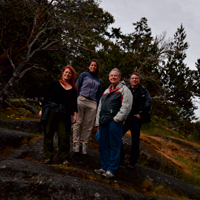
 Interviews with Environmental Elders and Senior Leaders in British Columbia
by Maggie Paquet
The Watershed Sentinel, in partnership with the BC Environmental Network, has embarked on a New Horizons project called “Voices for Change.” The project highlights the valuable contributions to environmental education and/or activism by people in BC who are considered to be elders and “senior leaders.”
Our working definition of an elder includes: a member of a family or group who is respected, and who has influence and authority within the community; and my own notions of an elder: teacher; a person who has lived long enough on this good Earth to have garnered some wisdom and, in how they live their lives, shows us how we may live our own lives; a person who has accumulated knowledge and skills and wants to pass those along to successive generations; a person who inspires me.
We surveyed a large group and eventually selected 16 people from across the spectrum of environmental concerns – whether they are well-known or relatively unknown – who have had tremendous impact on the quality of environmental achievements in BC. This is a big movement and there are many people to choose from. It has not been easy to sort through the dozens of well-qualified candidates. We hope we’re presenting a good cross-section of elders to represent the issues and concerns of Watershed Sentinel readers.
Because stories are universal – crossing age, culture, and language barriers – they help people understand concepts, define our identity, connect us with each other, build and preserve community, and create emotional connections and shared purpose. I hope you are inspired by the stories of these elders (in alphabetical order): Ruby Dunstan, Rosemary Fox, Paul George, Guujaaw, Gordon Hartman, Vicky Husband, Margie Jamieson, Ed Mankelow, Wayne McCrory, Michael M’Gonigle, Alexandra Morton, May Murray, Calvin Sandborn, Olga Schwartzkopf, Katharine Steig, and Catherine Stewart.
This is the first of three articles in successive issues of the Sentinel to feature these British Columbians who have contributed so much to both the “environmental movement” and the wider public. I have interviewed 12 of the 16 selected elders. The remaining four will be interviewed early this year, subject to their availability.
This first article introduces some of the leaders through their responses to a few of the 13 questions asked (questions 1, 2, 7, and 9), which highlight their past and future concerns, along with lessons learned and advice for future generations.
What is/has been your major field(s) of interest/activity? What was the primary impetus/reason that got you involved in environmental work? Why? (Questions 1 & 2)
Of the 12 elders interviewed, just under half were motivated by changes in their neighbourhoods. The rest mentioned either regional concerns, such as the need for more parks and protected areas, destructive logging practices, and damming rivers; or global problems, such as loss of biodiversity, an unsustainable focus on “growth” for its own sake, over-consumption and over-population. Half expressed specific concern for old-growth forests; all said climate change is an over-riding concern. Other major concerns were about oceans, the need for better environmental laws, threats to health and drinking water through a variety of practices and pollution, loss of agricultural lands, depletion of fish (provincially and globally), and the lack of controls on pollution from mining and other industrial practices. The breadth of concerns is as diverse as the personalities and interests of the elders interviewed, and reflects the biological and social diversity of our province and the wider world.
In every case, some pivotal experience – either as a young person or in the early stages of a career – sparked the notion that, “I need to do something about this.” Each person interviewed had some kind of “Eureka! moment.” Many were inspired by childhood experiences, noticing early on that their world was undergoing changes that they felt were so destructive or “anti-life” that they knew they had to do something to stop it.
At least one elder was inspired by his teachers. Biologist Wayne McCrory was fortunate in having Bert Brink and Ian McTaggart-Cowan as professors at UBC back in the 1960s, before the word “environmentalist” existed. Wayne travelled through Latin America and the Galapagos Islands, where he saw how over-population, poverty, and the introduction of alien species destroyed ecosystems. And then he came home.
Another elder, Rosemary Fox, also had experience with effects on wildlife and ecosystems in other parts of the world – experience that she brought with her to BC. She was raised in the foothills of India’s Himalayas. Later, she learned that India’s tiger population was dangerously close to extinction due largely to overhunting. She became concerned about the overhunting of caribou in the Spatsizi Plateau and embarked on a campaign that eventually resulted in a judicial review of BC’s Wildlife Branch and its relationship with the guide-outfitting industry.
Yet another elder was a teacher himself. Paul George, armed with a teaching certificate and degrees in zoology and sociology, took a group of students on a field trip to what was then called the Queen Charlotte Islands to study island evolution. “I was blown away by the beauty of the place, but also by the horrendous logging practices, especially on those steep slopes.”
As time went on, some expanded their focus into other issues or to geographically wider areas. Catherine Stewart had initially been a peace activist. Concerned about uranium mining, she “transitioned into concern about environmental threats, including fisheries, forests, aquaculture, and the ocean.”
Vicky Husband, who, as an artist born and raised on Vancouver Island and oriented “toward visuals,” started out concerned with major changes in West Coast landscapes due to extensive clearcut logging. When she saw how this was having an impact on all life, she “realized that protecting such areas as Long Beach, Meares Island, South Moresby/Gwaii Haanas, and the Khutzeymateen was the only option, and there was no time to lose.”
Olga Schwartzkopf also “transitioned” from concerns about water to toxins and health, and the right to participate in civil disobedience.
A few actually narrowed their geographical field of interest. Michael M’Gonigle began his work on the international scale, being concerned with whaling and getting Greenpeace into the International Whaling Commission in 1977. Later, he focused on BC issues, such as the Stein Wilderness and aboriginal rights. A law and economics professor at UVic, today, he is involved in agricultural land development issues near his home in Central Saanich. “My basic trajectory has gone from dealing with symptoms to trying to understand systems and root/driving causes, like capitalism, the State. I’ve gone from the international to the provincial to the local.”
Others stayed focused primarily on the issue that inspired them in the first place. Many of these occurred right in their home neighbourhoods. For over 20 years, Katharine Steig’s name has been practically synonymous with Friends of Cypress Provincial Park. Fighting off the development of a ski hill on Cypress Park’s Hollyburn Mountain, the only easily accessible mountain on Vancouver’s North Shore, and plans for a 27-hole golf course on municipal land below the park’s boundary in West Van – both of which have significant old-growth stands – has been her life’s work. When asked why, she replied: “These were places that I loved, that practically defined the environment of West Vancouver. I perceived these as major threats to my neighbourhood.”
Many moved through a spectrum of issues, but all have stayed involved because they feel the issues still need them.
What changes do you foresee, if any, in the role of environmental organizations in the future? (Question 7)
There were two major comments made by everyone who was interviewed: The first is that ENGOs need to learn to work together better in order to be more accountable, more strategic, and more effective. Ed Mankelow commented that groups may disagree on some things, but not on the issue. The second was well-articulated by Catherine Stewart, who said ENGOs must find more and better ways to motivate and engage the public, to show them they have the power to change things and that they need to start using that power.
Elders also commented on how today’s communications technology is a boon to getting out the message. Rosemary Fox said that groups must continue to adapt to changes in this technology, not only for outward communications, but for messaging within groups.
I tend to agree with Rosemary’s comment about ad hoc groups springing up as needed. When BC Hydro and Calpine of California wanted to put a gas-fired electricity generating plant in Alberni, an ad hoc group calling itself the Citizens’ Stewardship Coalition sprang up. Later, in response to the loss of forest jobs and the huge volumes of logs being trucked out for export, many of the same people re-grouped, calling themselves the Save Our Valley Alliance (SOVA). These days, many of them are reincarnated into two groups, one protecting water resources in the Valley, and another that is fighting the prospect of Port Alberni becoming a coal port for the Raven Coal Mine, proposed to be developed just uphill from what is probably BC’s richest shellfish industry at Fanny Bay, south of Courtenay.
Calvin Sandborn is the Legal Director of UVic’s Environmental Law Clinic. From his perspective, another important – and positive – change is in the increased number of public interest lawyers. Not only do they work with groups and communities, including First Nations, to help them stand up to corporations and governments, they are helping to “move the law forward” in getting better environmental laws and increasing the sensitivity of the courts to environmental concerns.
Wayne McCrory believes that grassroots groups will continue to be the backbone of the movement, people working within communities, often partnering with “ordinary citizens” and First Nations. The notion of volunteers vs paid staff can be a touchy one, and will be discussed in detail in the next instalment of this series, but both Rosemary Fox and Katharine Steig would agree with Wayne that there is no denying the effectiveness of local volunteers.
Many environmentalists have their roots in social justice issues. In fact, Gordon Hartman quoted from Hardin’s essay, “The Tragedy of the Commons”: “Conservation is social justice between generations.”
What lessons have you learned to share with the next generation? What advice would you give to the next generation of environmentalists? What advice would you give to all environmentalists? (Question 9)
This question generated a variety of stern responses. Chief among them were exhortations for environmentalists to get their facts straight, if they want to have credibility in their communities. Similar comments included: Be credible. Don’t overstate. Learn about your issue. Lifelong learning – self-learning – are important; teach others to value these. Work with others who know about your issue. Do your homework. Stay on track.
Added to these were comments about behaviour: Learn public speaking and communications skills. Build a good relationship with the press. Stay positive. Be reasonable. Make people feel good. Put your hand out. Be patient. Stand up for what you believe in. Be passionate about your issue. Be tolerant of others in the movement; lack of tolerance only benefits our opponents. We’re all in this together. Hang in there. Never give up. Keep hounding them. Spread the word. Be persistent. Avoid being abrasive or aggressive. And another gave sage advice I’m sure many of us can identify with: Don’t sacrifice your health.
Wayne McCrory said that everybody has to be an environmentalist. “We all have to think carefully of how to reduce our carbon footprint. Be centred in the issues. Be ethical, collaborative. Think strategically. Be open to helping and mentoring.”
For Gordon Hartman, the big lesson is about overpopulation and the buy-in to the “growth ethic and the socio-political paradigm of which it is part. As for specific issues, I think the tar sands are the biggest sore in the Canadian conscience.”
Paul George’s advice is to “Keep it new. Be creative. When the barge Nestucca ran aground on the west coast and we went to help with the cleanup, we put tarballs into small bottles and sent them off to all the MPs so they could have their very own stinky globs of pollution.” He added that “we need to get kids out from behind their electronic gadgets and games and get them more involved.” This was echoed by most of the other elders.
~
The Interview Questions
1. What is/has been your major field(s) of interest/activity?
2. What was the primary impetus/reason that got you involved in environmental work? Why?
3. Did it ever have an impact on your family or other relationships? In what way? How did you deal with that?
4. What has kept you involved in the environmental movement? What keeps you going when things look bleak?
5. Do you work with an environmental organization? If so, why? If not, why not?
6. What do you think are possible traps to effective activism, or known failing strategies?
7. What changes do you foresee, if any, in the role of environmental organizations in the future?
8. What do you think is the most urgent/important environmental issue today? For BCers? For Canadians?
9. What lessons have you learned to share with the next generation? What advice would you give to the next generation of environmentalists? What advice would you give to all environmentalists?
10. If you could design a strategy to engage people to live in harmony with our planet, what would it look like?
11. What are you doing these days?
12. If you had the proverbial three wishes, what would they be?
13. Have I left out anything you’d like to mention?
***
Author and editor Maggie Paquet was awarded the Martha Kostuch Lifetime Achievement Award from the Canadian Environmental Network (RCEN) in September 2010.