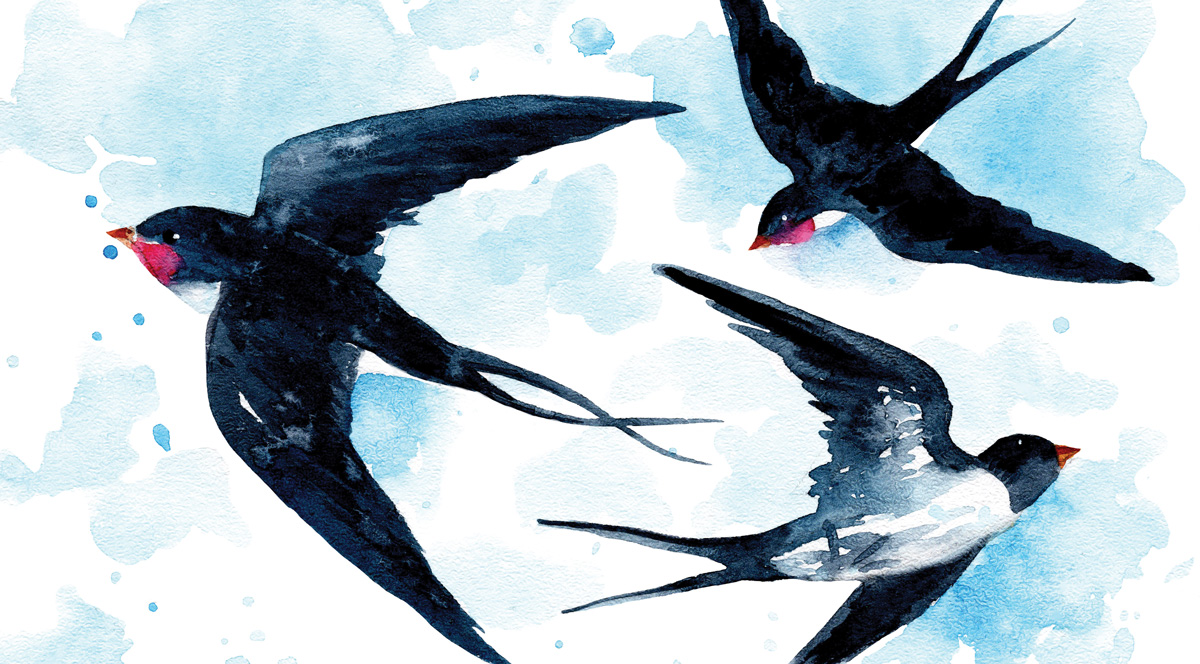
On a cool spring morning, as I walk hand in hand with my daughter, we look up, our attention drawn to the bright, quick chatter of the swallows overhead. They dart and swoop in the crisp air, catching insects on the wing and calling to one another as they stake claim to the skies.
Our walk to school is a ritual years in the making, but what we witness in the skies above is far older, older than our town, older than our species’ memory of this place. Yet there may come a day, perhaps soon, when the skies above fall silent, and we will have to find new signs to tell us that spring has come.
For as long as we’ve built homes, swallows have shared them with us. They nested beneath the eaves of Roman villas, in the beams of medieval barns, and in the roofs of the longhouses of the Snuneymuxw people whose unceded territory my daughter and I walk upon. Their return each spring has been celebrated in song and scripture, a promise of renewal as old as language itself. The ancient Greeks saw them as messengers from the gods, symbols of hope and rebirth. Sailors tattooed swallows on their chests before long voyages, believing that if they drowned, the birds would carry their souls home.
Their migratory paths align with human migrations that shaped this coast.
Even here on Vancouver Island, half a world away from those stories, the intimacy continues. The barns, culverts, and ferry terminals of British Columbia are stitched with the same mud-and straw nests that have cradled swallow chicks for centuries. We build and they follow, drawn not to us but to the shelter our industry provides. They thrive in our clearcut forests; in every human attempt to tame the wild, the swallow thrives. Until now, as our drive toward domestication and our talent for eradication puts the swallow itself under threat.
Long before ships and settlers arrived on Vancouver Island, the return of swallows was part of the story of this place. Their migratory paths align with human migrations that shaped this coast. Prior to colonization, the connections between people, the skies, and the waters were strengthened through observation and mimicry of the actions and cycles of the plants and animals. The local Snuneymuxw people would time their journeys with the return of salmon, the spawning of the herring, and the songs of the swallows in the air.
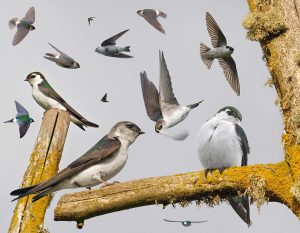
Swallows often built nests near human dwellings, fishing camps, and village sites. The argument could be made that these birds were not “wild” in the Western sense; they coexisted with people, seen as kin or messengers tied to the seasonal abundance of insects and salmon runs. The connection shifted through colonization, the swallows no longer regarded as kin by the Europeans who made up most settlers to this region.
The swallows became curiosities, not signs of nature but omens of agriculture, evidence that the seasons had shifted and it was time to plant, clear, chop, burn, and change. The swallows adapted quickly to colonial architecture, finding roosts in the barns, houses, and bridges that accompanied a settling world. As the land changed, so too did the swallows, nesting beneath our eaves and rafters and feeding on the insects stirred up by our disruption.
As the land changed, so too did the swallows
Swallows are insectivores, feeding almost entirely on flying insects like flies, beetles, wasps, bees, and ants – those small, persistent companions that hover between partner and pest in our cultivated world. But, as with most bird species, the modern landscape has not been kind to them. The clearcuts, monoculture farms, and nitrogen-rich sprays that fuel industrial agriculture also strip the air of the life they depend on.
Pesticides, particularly those once thought of as miracles of progress, have left long shadows. As recently as the 1970s, Dichlorodiphenyltrichloroethane – DDT – laced our fields and waterways. It was a chemical that not only caused cancer in humans but thinned the eggshells of raptors and songbirds, driving landmark species such as the bald eagle and peregrine falcon to the brink. By some estimates, swallow populations now sit at around two per cent of their historical numbers.
Though DDT was banned and swallow populations show signs of recovery, the question remains, recovery to what? Have we built healthier, more diverse ecosystems for them to return to, or have they simply adapted to a diminished and simplified world? Their success might not be a sign of restoration, but of resilience in a landscape increasingly flattened for our use and comfort.
As my daughter and I reach the school yard, the swallows trace their wild geometry overhead, stitching the air with arcs so rapid that our eyes struggle to follow. My daughter squeezes my hand as a pair loop above the roof, then lets go, running to join her friends. The morning fills with their laughter and the echoing cries of the birds above. I linger for a moment, watching the birds dip and dive through the bright air, and I think about this ritual, walking, releasing, watching, that mirrors their own. They leave and return, season after season, reminding us that home is not a fixed place, but a pattern, something that we make by coming back.
I know they might not always return in such numbers. The changes that we’ve set in motion, in climate, in landscape, in the very chemistry of the air, reach farther than their small wings can carry them.
Yet still, each spring, they appear, tracing the same invisible lines across a sky that has forgotten almost everything else. Perhaps that is the lesson they leave us: that persistence, even fragile and uncertain, can still be a kind of hope. A belief that things can return to what they once were, or failing that, that not all new things in our Anthropocene era are without beauty and grace. For now, their voices fill the morning, and as I turn home, I look up once more, listening, just to be sure.
Ben Wickham is a writer from Nanaimo, BC with a background in education and public service. His passions for writing and nature come from his father and mother respectively.