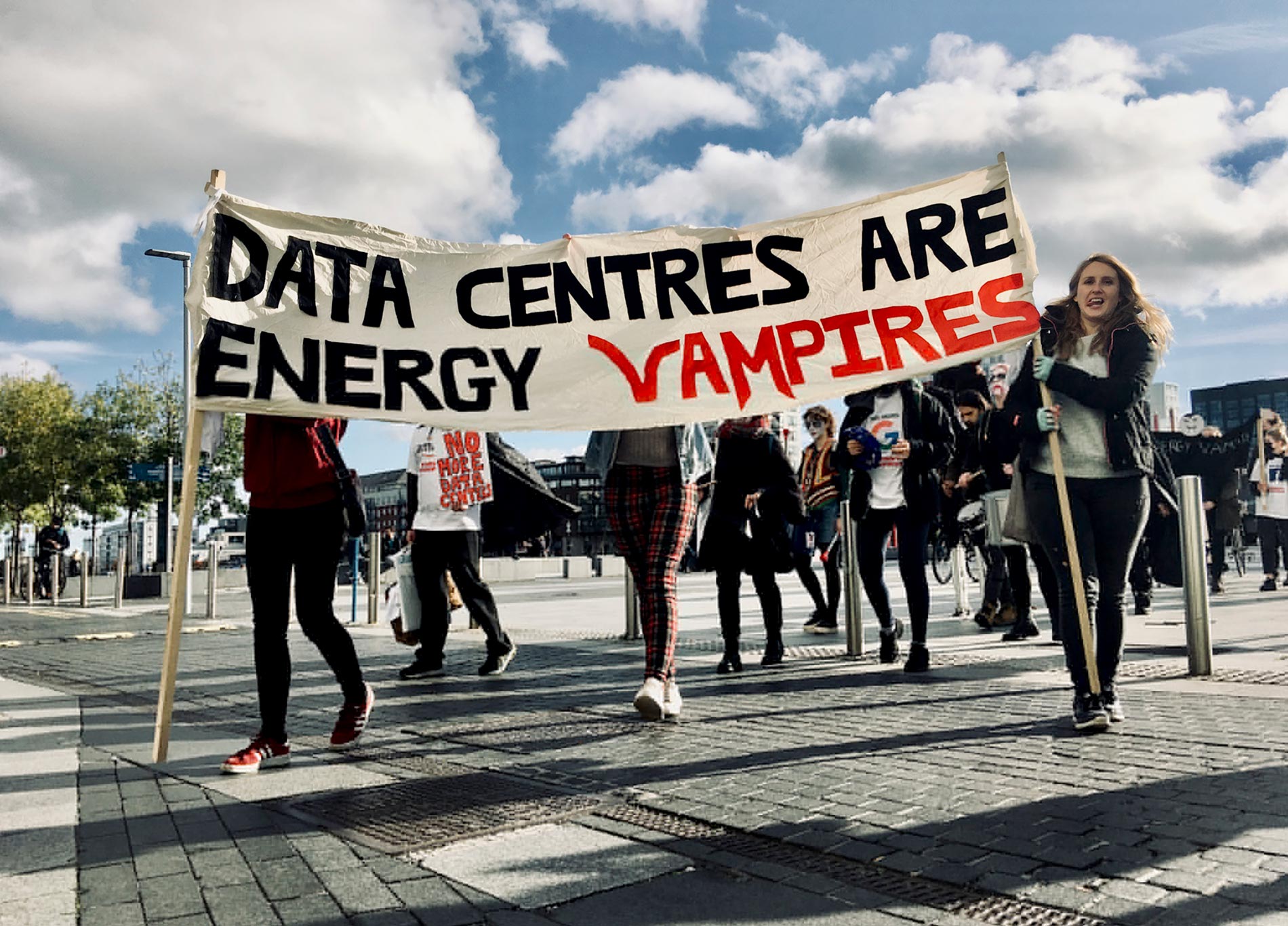
A dark spectre is looming over the heads of everyone who lives here. More than any other province, Alberta is about to be carved up by companies proposing to build more than 90 large-scale data centres that threaten to use up our water, send electricity prices through the roof, and take up huge amounts of land.
To many, AI at first seemed to be the greatest thing since sliced bread. Those who invested in such companies as NVIDIA, a leading manufacturer of computer chips that power AI systems, have cashed in on a scale rarely seen since the dot-com bubble and the housing market collapse. AI allows people to churn out computer-generated “creativity” that will literally produce any image it is asked to display. It also powers some innovative and useful technology like robot arms that can take garbage from among recyclables faster than any human.
Battle lines are being drawn. Places like Moose Jaw, Saskatchewan, Mississauga, Ontario, Rocky View County, Alberta, and Île-Des-Chênes, Manitoba, are pushing back, hoping the big tech companies will relent and locate their facilities elsewhere.
Five hyperscaler facilities are currently operating in Canada
Across Canada, from the Maritimes to Vancouver Island, there is heavy opposition to data centres, and according to polling information gathered by the Angus Reid Institute, 68% of Canadian respondents are against construction of data centres near their homes. Among the reasons for this is that the plants need to constantly use massive amounts of energy. AI servers need this power to cool their computer systems. Cooling also uses far too much water to be sustainable.
Small data centres, typically around five megawatts in capacity, have proliferated across the country. But the next generation of facilities, known as “hyperscalers,” are the powerful engines driving the AI boom, and they can demand 100 megawatts of power – enough to power 40,000 to 64,000 homes.
Five hyperscaler facilities are currently operating in Canada – two in BC and one each in New Brunswick, Ontario, and Quebec. Currently, 96 more hyperscalers are proposed or under construction. The power used by these facilities often comes from local power grids, but backups are also needed, and those can mean hundreds of smoky, incredibly loud diesel generators. Further, the centres need large amounts of cheap land, which is why they are looking to remote and previously unspoiled territory, according to Lyndsey Rolheiser, an assistant professor of economics at the Schulich School of Business, York University.
Residents and leaders of this successful grassroots campaign have set their sights on helping other nearby communities
Thanks to plenty of land and water and a compliant United Conservative Party, Alberta is where many big-tech companies are looking to build more data centres. Next on the list is Ontario, with 252 megawatts of facilities proposed or under construction.
According to City News Edmonton, Sturgeon County is the target for Meta Corp’s new $13.5 billion AI hyperscale data centre. The county has already seen investors ink a 250-megawatt deal to deliver electricity for the facility before breaking ground.
The proposed facility is sparking outrage from local citizens. The St. Albert Gazette reports that residents have been organizing public protests and rallies around the 21,000-person county, and they are also implementing transparency groups to directly question elected officials about energy grid impact and the lack of input from the public in greenlighting the proposal.
The community has also been reaching out to make alliances to fight the construction of the facility, most prominently with nearby Edmonton, population 1.2 million – all of whom have a stake in guarding against data centres: Because they use incredible amounts of electricity and water, they drive up the cost of utilities for everyone.
What if these massive centres get built and then become obsolete?
Monterey Park, California is a shining example of a community that effectively and legally blocked construction of a 50-megawatt AI data centre. According to The Guardian, the town was faced with the possibility of being swallowed up by a 250,000 square-foot data centre just metres away from homes and neighbourhood parks. Fearing relentless noise, mass consumption of water, and rising energy costs, residents rallied and forced a vote on the issue. Monterey Park thus became the first community in the US to block an AI company from building a local data centre.
The beauty of their accomplishment is that future governments can’t be enticed to reverse this decision without the proposal getting past a public vote on the matter. Many of the residents and leaders of this successful grassroots campaign have set their sights on helping other nearby communities to keep data centres out of their back yards.
We need to look at the long term. What if these massive centres get built and then become obsolete in a few short years? What if new technology replaces AI and we are left with hundreds or thousands of facilities that are not even good for recycled material? Remembering the early, bulky, expensive home computers that had the same processing power of a hamster on an exercise wheel: millions of tons of these computers were declared completely useless and thrown into garbage heaps the size of the Empire State Building.
At this point, you can’t even do a Google search without getting feedback from an AI bot. I sometimes find the information useful, but AI makes mistakes, sometimes a lot of them. In the end, without knowing it, all of us have been affected by AI, and this is just the start. With the expanding scope of the industry, we may find ourselves running out of land and water before we realize they are our most important priorities.
Leif Gregersen is an Edmonton-based writer, teacher, and public speaker who has written 12 books. https://edmontonwriter.wordpress.com.