
Through sound, we can see clearly the underwater environment of ‘Walas Max̱’inux̱ — the great orca. Our terrestrial eyes limit how we perceive our natural environment, but cetacean acoustics specialists Helena Symonds and Dr. Paul Spong have opened a portal that transcends this limitation.
Technology has become an extension of our senses. And for half a century, OrcaLab has been looking through this acoustic portal at the behavioral ecology, matriarchal social structures, and linguistic cultures of max̱’inux̱ in Kwakwaka’wakw territory.
OrcaLab is the research station for the Pacific Orca Society, located between Johnstone Strait and Queen Charlotte Sound in what can affectionately be known as “downtown Kwakwaka’wakw territory.” This is the core habitat of the Northern Resident population of the greatest marine predator and most widely-distributed marine mammal on earth. The famous rubbing beaches of Robson Bight Marine Sanctuary and Tsitika Provincial Park are OrcaLab’s front yard, one of the few locations where orcas have a brief moment of refuge from otherwise heavily-trafficked and commercially-impacted waterways.
In the beginning
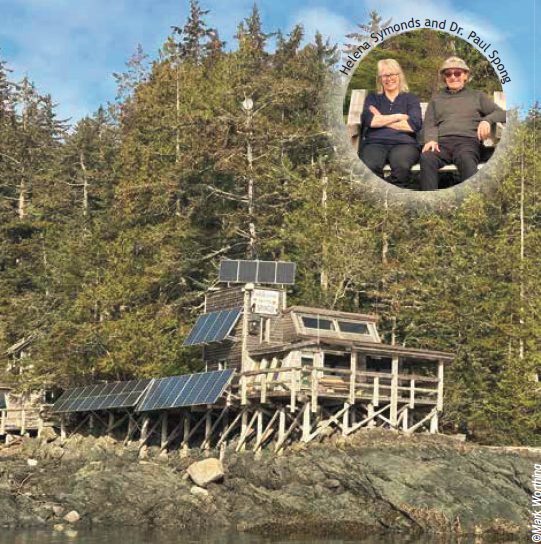
Dr. Paul Spong arrived on Hanson Island in 1970 after consulting with Kwakwaka’wakw fishermen and knowledge keepers who advised him on optimal areas with which he could develop a unique methodology of non-obtrusive, observation-based orca research. What started as a seasonal initiative grew into year-round monitoring and a precedent-setting framework for ethical research that centres animal welfare.
The famous rubbing beaches of Robson Bight Marine Sanctuary and Tsitika Provincial Park are OrcaLab’s front yard.
Helena Symonds joined Paul ten years later. Together, they built a family and ramped up the acoustics lab. Helena developed the assistant program which has brought hundreds of international volunteers to Yukusam (Hanson Island) from Japan, the United Kingdom, Argentina, France, and beyond. Helena and Paul have brought the everyday lives of orcas to light with a central do-no-harm ethic of increasing people’s access to nature and the incredible world of whales.
Forging new tools from old tech
Developing the research methodology itself was a beautifully innovative repurposing of salvaged equipment from the Second World War. Creative thinking from the anti-war movement spawned the first hydrophone that OrcaLab placed in the water at Parson Island in Blackfish Sound. It was made from salvaged sonobuoy equipment once used by the Navy to detect Japanese ships off the coast. The late Bill Ter Brugge, an ex-merchant sailor and then hospital engineer in Alert Bay, salvaged and recycled military transducers found in the old Coast Guard station and helped convert them from a military application to a mechanism that would enable greater insight and appreciation for our cetacean relatives. And this simple recalibration opened a gateway to the more-than-human world beneath the surface of the ocean.
The spirit of the sixties
The revolutionary spirit of ecology and social movements born in the 1960s carries on through Pacific Orca Society’s legacy. OrcaLab is a crucial ally to Indigenous resistance and resurgence efforts, as well as fighting destructive logging practices, defending cultural heritage sites, advocating for wild salmon, and pushing back against the pollution and disease spread by industrial fish farms. They joined the fight for an end to the inhumane practice of cetaceans in captivity, created conservation solutions for old growth and marine mammals, and campaigned to stop the destructive practice of commercial whaling globally.
There is an undeniable magic that the OrcaLab community has cultivated over the decades.
If you or your parents have ever signed a “Save the Whales” petition or supported a Greenpeace campaign, you should probably give Paul a hug (and maybe a donation to OrcaLab). Not only was he a founder of Greenpeace, he’s regarded as the one of the original thinkers and practitioners of the Save the Whales movement that led to a cascade of global socio-political and ecological impacts.
Closer to home, OrcaLab has helped launch the careers of many who came to Hanson Island to learn, and left to establish new, far-reaching campaigns and projects. Researchers around the world depend on the work of biologist and wild salmon advocate Alexandra Morton and the Salmon Coast Field Station. Others who cut their teeth at OrcaLab include the late conservation filmmaker Twyla Roscovich, the late anthropologist and culturally-modified tree expert David Garrick (Walrus), and Jared Towers, Cetacean Research Technician at DFO Canada and Executive Director at Bay Cetology. Another crucial offshoot is Cetacea Lab in Gitga’at territory near Hartley Bay, which is run by Janie Wray and Hermann Meuter.
A new generation of cetacean researchers, wilderness advocates, and marine mammal specialists is stepping up.
There is an undeniable magic that the OrcaLab community has cultivated over the decades, and it’s impossible to measure its local and global impact. But those of us who have benefited from the gifts of OrcaLab know that we will always pay homage to Paul, Helena, and the team whose shoulders we all stand on.
Clogging the passage
Through the decades of their research, one thing has become abundantly clear: the Inside Passage of Vancouver Island is increasingly jammed with massive cruise ships, articulated tug barges transporting petrochemicals, fishing vessels, logging barges, sports fishing, whale watching, and tour boats. The majority of the time researchers cannot listen to whales and dolphins without a deafening level of boat noise. It’s not uncommon to have one large, slow ship audible within range for several hours at time. And it’s rare to have no boat noise in the entire region for more than a few hours at a time.
Noise pollution is as great a threat to cetaceans as chemical pollutants and marine debris, but Transport Canada has done very little to mitigate the cumulative and acute impacts of this stress on the lifeways of cetaceans.
Passing the torch
Something special is happening at OrcaLab right now. The founders are passing the torch.
There have been many generations of researchers, advocates and community leaders who have graduated from OrcaLab’s nuanced schooling and the magic of Hanson Island. Now a new generation of cetacean researchers, wilderness advocates, and marine mammal specialists is stepping forward to carry on the tradition of non-obtrusive, do-no-harm research. They will steward half a century of data and investigate the teachings hidden in the dialects of orcas, the songs of humpbacks, and the electric chatter of Pacific white-sided dolphins.
Veteran volunteers like Momoko Kobayashi and Tomoko Mitsuya, plus researchers, coordinators and technicians like Suzie Hall, Megan Hocket-Bennet, Claire Guillaume, Jérémie Collado, and Quin McIntire are the pillars of these operations, bringing the incredible lives of orcas to people around the world.
With the next generation comes a new political climate, a new era of reconciliation and decolonization, and heavier industrial and commercial impacts on cetaceans. New tools like AI machine learning and other advancements in science open new possibilities for understanding non-human kin and animal communication.
Portals to the future
In the beginning, a small military transducer was the key that unlocked a portal to the sonic world of orcas. What portals might be opened with eDNA sampling methods, or artificial intelligence’s analysis of hidden algorithms in 50 years of acoustic data in the OrcaLab library? And what are the ethical implications with these new technologies? Does depending on AI for analysis cause more harm than good, considering the immense environmental impact of AI data centers and corporate consolidation of the tech industry’s love affair with the far-right and associated neofascist impacts on community?
What are the whales asking for? Have we been so focused on the means with which to communicate across species that we’ve missed the message altogether?
The Ma’amtagila are one of the tribes of the Kwakwaka’wakw peoples. They have an ancient treaty with the orca. Kwakwaka’wakw ancestral protocols resolved an ancient war where the max̱’inux̱ and people were in conflict. They managed to broker a peace accord during hostile times, and since that time orcas have not breached the terms of that agreement. Have we?
Perhaps the next 50 years of OrcaLab’s work will shine a light on how we can continue to seek peace with ‘Walas Max̱’inux̱ during uncertain times.
Mark Worthing is a settler of Scottish and English ancestry based on Vancouver island. He is a community organizer, researcher, and policy analyst working at the intersection of environmental activism, applied conservation biology, decolonization, and land-based methodologies.

