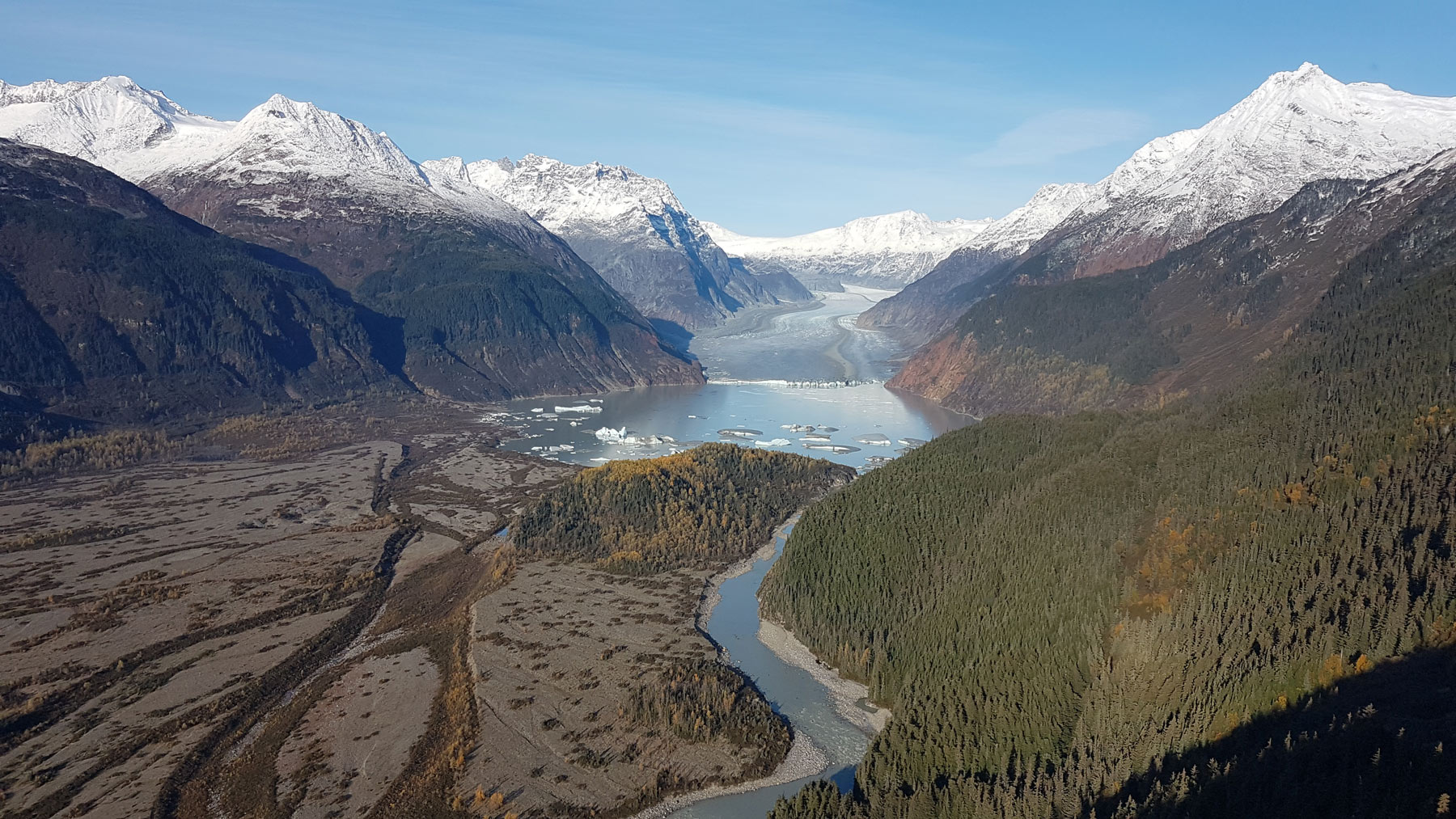
In Canada’s northwest, glaciers play a pivotal role in climate resilience and planning, and they are melting at historic rates.
In 2015, Garry Clarke (UBC) and colleagues projected that by 2100, the amount of glacier ice in BC will shrink by 70 to 80%. Deglaciation at that scale will transform the geology and hydrology of the province, causing the formation of new proglacial lakes, river “piracy” (course changes), outburst floods, and the release of new pathogens and pests. It’s expected that by the end of the century, Canada will have hundreds more post-glacial lakes held in place either by bedrock indentations, or landslides, or moraines (accumulated glacier debris that create berms).
Glacial retreat will also expose previously hidden geology ripe for mineral exploration and extraction. In the Golden Triangle, a highly mineralized, remote part of BC’s northwest, melt will expose some of the richest ore beds in the world. A map of registered mineral claims in the Iskut River watershed shows that almost half of the land base is covered by claims.
The landscape we see today will change dramatically over the coming century.
In May 2026, 70 Indigenous and non-Indigenous experts and leaders from northern BC, Yukon, and Alaska came together in Whitehorse for the Glacier Futures gathering. The intention of organizers was to build cross-boundary relationships and facilitate knowledge-sharing about the profound and rapid changes in glacier landscapes, and how they are shaping ecosystems, communities, and cultures downstream.
In western Canada, glaciers are replenished by snowfall that melts over the summer months. The balance between snowfall and melt determines whether a glacier is gaining mass or losing it. Provincial data shows snowpack was 34% below normal in BC in 2025, and the provincial snow survey stations interactive map shows just how quickly snowpack melted in the month of May. Log Cabin station, the northernmost station in BC, recorded a dramatic drop in snow depth, from 125cm to 90cm in a single week.
Researcher and spatial analyst Kara Pitman told participants at the gathering that more than half of the world’s glaciers will disappear by 2100 if warming is not limited to 1.5 degrees Celsius. “The landscape we see today will change dramatically over the coming century. Global acceleration of glacier mass loss reflects the global warming of the atmosphere,” she said.
Large-scale protections of watersheds and their glaciers are needed to “protect the health of emerging ecosystems so that they can support fish, wildlife, and water into the future,” says Jonathan Moore, professor of aquatic ecology and conservation at Simon Fraser University.
Recognized Indigenous Protected and Conserved Areas (IPCAs), such as Meares Island Tribal Park and the Meziadin IPCA on Gitanyow territory near Terrace, represent a Nation’s vision and plan for lands and waters in their traditional territory. They are defined by that Nation’s stewardship approach and reflect their unique governance and traditional laws.
However, the majority of recognized IPCAs address the current environment and don’t account for the changes that glacier melt will bring in coming decades.Ice recession impacts traditional hunting grounds, as tree lines creep upward and animals such as mountain goats lose habitat crucial to their survival. Flash flooding caused by outburst floods can cause sediment to impact salmon bearing rivers and creeks.
Programming at UBC’s Centre for Indigenous Land Stewardship, when applied to glacial melt, offers frameworks that can slow or buffer its impacts and expand how institutions and communities manage these new ecologies. But the Centre’s director, Garry Merkel, sees roadblocks ahead. “Until we change our pattern of what we’re doing as humans, it’s going to catch up to us somehow, and I think that’s a lot closer in the future than a lot of us think it is.” He doesn’t trust that government is up for the post-glacier challenge. “I have come to the conclusion that the Province is not capable of implementing large-scale strategic things like this. It just is too unstable.”
Moore also sees government reticence blocking the way. “The challenge is that current federal and provincial policies sometimes seem to be ignoring climate science and implicitly assume that the world isn’t changing.”
Merkel believes the Centre’s four-year program can slow climate impacts by teaching students how to work with Indigenous and non-Indigenous communities to create future economies built on a more ethical way of living. The program is about building land stewardship systems “grounded in [Indigenous] ethics and worldviews, and then translating belief systems into governance systems and structures based on looking after the land,” he says. Those systems “need to work with the rest of the world, and not just in isolation.” He believes they can lead by example, and that governments at the municipal level would benefit most.
In a 2023 systematic peer-reviewed study published in Science magazine, Moore, Pitman and co-authors affirmed positive correlations between Indigenous land stewardship and conservation outcomes. Globally, 60% of Indigenous lands are under threat by industrial development and climate change. A major source of that threat in BC is mining.
“First Nations and local communities are really leading the way in proactive stewardship approaches,” says Moore. “Their Land Use Plans often incorporate data from climate science and combine that with local knowledge values.” In the multiple communities he and Pitman work with, that data includes glacier monitoring and hydrology data.
Cooperation between researchers, traditional knowledge keepers, and Indigenous leaders may offer the best formula for addressing what will be one of the biggest environmental upheavals of our time.
Sidney Coles, PhD, PhD, is a journalist and human rights advocate living in Victoria on the traditional territory of the lək̓ʷəŋən people.