 Update # 33: July 15, 2011
At NHK this morning another article on the Decontamination system. These articles continue to confound. See the 2 SFK articles linked below for analysis.
TEPCO again stops key reactor cooling system
The operator of the Fukushima Daiichi nuclear power plant continues to struggle in its efforts to stably cool the facility's reactors. Workers have again halted a key wastewater system after discovering that it was operating below capacity.
Early Friday morning, Tokyo Electric Power Company stopped the system, which decontaminates and recycles radioactive wastewater. The system had just resumed operation on Thursday after a leak was repaired.
TEPCO says it found that even after the repair, the system was able to treat only 37 tons of contaminated water per hour, which is 20 percent below target [of 90%]…." Friday, July 15, 2011 12:51 +0900 (JST)
AT EX-SKF there are two detailed articles on the decontamination systems.
The first points out the dis-info in the above NHK article since the Areva system has been running at 70% efficiency since TEPCO started it up.
The second contains detailed information on the Toshiba SARRY (or SALLY) system being installed. Both very informative.
I've clipped the text below. But the second article has detailed diagrams of the Toshiba system if you are interested.
It also speculates that this system will completely replace the Areva-Kurion system, which is what I believe to be the case as well.
Contaminated Water Treatment System at Fukushima Is Stopped Again
"One post ago, I wrote "The on-again-off-again water treatment system is finally on again". Well that was premature. It's off again.
According to NHK Japanese (7/15/2011), after the contaminated water treatment system was restarted after 30 hours in the evening of July 14, TEPCO noticed that the system was operating at a much reduced rate (37 tonnes/hour) than the system was designed for (50 tonnes/hour). So the company stopped the system in the morning of July 15 and is investigating.
No information as to which part of the system is having a problem, Kurion or AREVA.
Well, either NHK or TEPCO is not telling the truth, because 37 tonnes per hour is 74% operating rate, and that has been about the rate of operation anyway for the system. So why would this alarm TEPCO?"
See the pictures and diagrams referred to at the link to this article:
Fukushima Water Treatment System: Toshiba's Long Tall "SARRY" to the Rescue!
"….SARRY stands for "Simplified Active Water Retrieve and Recovery System". Well, it doesn't quite stand for these words, but that's how Toshiba's been calling it.
It is already being installed at Fukushima I Nuke Plant, and is expected to come online sometime in early August. As it is planned right now, this Toshiba's system comes after Kurion and before AREVA….
Toshiba thinks SARRY can reduce the amount of radioactive materials in the water to one-millionth, and process 1,200 tonnes of water per day.
The water will first go through the resin filters that remove oil, then through the cylinders filled with zeolite and titamium silicate for cesium removal. The system will be surrounded by lead panels to reduce radiation. Compared to Kurion's system which basically uses the same principle, Toshiba's system uses less pumps and thus less chance of breakdowns, according to TEPCO/Toshiba.
The drawings are probably written in a language that TEPCO and workers understand without dictionary, and it is probably being installed by Toshiba and its affiliates who are building the system…."
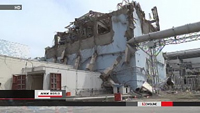 More on the nitrogen injection into MOX-fueled Unit 3 at NHK today. When they talk about a "gas" leaks, what they mean is the Nitrogen leaking, which would be radioactive once it was introduced into the RPV. Note the first article above mentions that there is no rise in radioactivity at the site. We will see. I'm not sure what they expected to happen when injecting gas into the severely damaged Unit 3 reactor. Remember that was the largest explosion and the pictures of Unit 3 show the devastation.
TEPCO checking for gas leak from No. 3 reactor
"The operator of the Fukushima Daiichi nuclear power plant is checking for gas leaks in the No. 3 reactor, into which nitrogen is being injected to prevent a hydrogen explosion.
Tokyo Electric Power Company has injected more than 200 cubic meters of nitrogen into the reactor's containment vessel since Thursday evening. But it says the interior air pressure has increased very little…." Friday, July 15, 2011 20:14 +0900 (JST)
CONTAMINATION
This article reveals that only beef within the artificially drawn 20/30 km evacuation circles was being tested. This despite the fact the government has been aware for months of equal or greater contamination in areas outside the evacuation circles. So sad.
All Fukushima cattle may face radiation checks
"Japanese health minister Ritsuo Hosokawa has said he is considering a plan to expand radiation tests on cattle to include animals raised outside the evacuation zones in Fukushima Prefecture…."
Friday, July 15, 2011 14:15 +0900 (JST)
A Bloomberg article was published yesterday on Japanese beef contamination.
It does not include the new information regarding the Asakawa farm which had sold another 42 head of cattle. This would amount to triple the tons of radioactive contaminated beef discussed in the article. My question: Has any of it been exported? The article contains details on the amount of beef exported last year from Japan.
Beef Contaminated by Radiation Intensifies Food-Safety Concerns in Japan
See EnergyNews for the plague of problems at USA Nuke plants now including plants in 4 states – New Mexico, Nebraska, New Jersey and Tennessee.
***
The Watershed Sentinel is proud to share Nelle Maxey's Fukushima Updates prepared for the BC environmental community.
Every day, Nelle pours over the media and other reports of the status of the reactors at Fukushima, comparing figures and trying to make sense out of the conflicting reports.