In December 2025, Domtar announced it would permanently close its pulp mill in Crofton, on Vancouver Island, ending nearly seven decades of operation and eliminating about 350 jobs.
The company’s stated reasons were blunt: weak global pulp pricing and a lack of access to affordable fibre in BC. The mill had already received provincial and federal support in recent years – including an $18.8 million funding package in 2023 to modernize its production – but those efforts were unable to sustain operations.
For North Cowichan, the closure isn’t an abstract “sector adjustment.” Domtar has been the municipality’s single largest taxpayer, contributing about $5 million a year in property taxes, that fund services whether a mill is operating or not. Beyond the payroll, the shutdown lands on the people who make a living around the mill: logging contractors, truckers and mechanics, tug and barge operators, chip suppliers, and the smaller businesses that live off the rhythm of coastal forestry.
Crofton is part of a broader pattern: shrinking harvest, mill closures, and a wood supply that no longer matches planning projections. The closure illustrates the downstream consequences of a deeper planning issue.
The over-reporting problem
BC’s forest economy is still governed by a number most residents never see: the Annual Allowable Cut, a government-set logging quota, determined region by region, that is meant to reflect what the land base can sustain.
In practice, the AAC is only as reliable as the modelling it’s based on. Timber supply reviews use the Vegetation Resource Inventory, growth-and-yield models, and future harvest projections to estimate how much merchantable timber exists and how quickly it will regenerate. If those inputs are inflated or overly optimistic, the resulting AAC is inflated as well.
A recent independent evaluation of the Mackenzie Timber Supply Area provides a striking example. The report found that wildfire impacts were underestimated in the base case used to determine the AAC. Since 2020, only 2,220 hectares of wildfire were predicted in the model, while more than 55,000 hectares actually burned, with an additional 92,000 hectares potentially rendered inaccessible. The authors state this modelling approach is not unique to Mackenzie and is “most likely being applied across the majority of the province’s regions.”
One indicator is the widening gap between projected supply and actual harvest. The Province’s aggregate AAC remains in the neighbourhood of 75 million cubic metres, yet the actual harvest has dropped to less than half that amount.
Falldown isn’t accidental, it’s embedded in timber supply projections.
Provincial forest revenues have followed the same trajectory. Revenue fell from $1.885 billion in 2021/22 to $690 million in 2022/23 – a drop of 63% in a single fiscal year, reflecting both price shifts and declining harvest volumes.
The modelling assumptions, particularly around growth, disturbance, and accessibility, appear increasingly misaligned with ecological reality.
When harvest exceeds growth
In forestry, “falldown” describes what happens when harvest levels exceed the forest’s long-term growth capacity. Marchak, in Falldown: Forest Policy in BC, defined it as the difference between the current rate of cutting and the lower long-term harvesting level that must eventually prevail once mature timber is depleted.
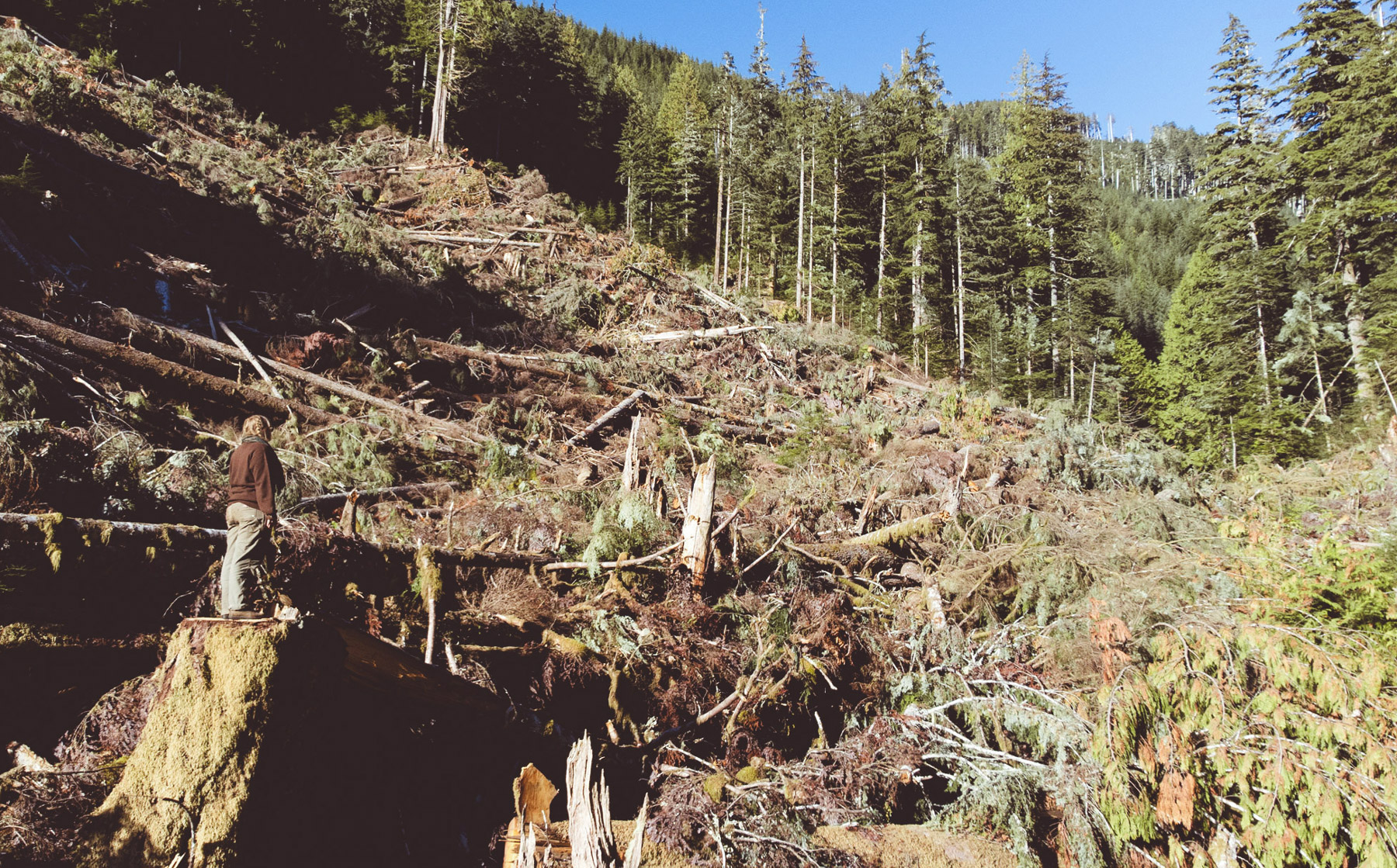
Photo by Hazel Volk
Falldown isn’t accidental, it’s embedded in timber supply projections. Base cases frequently show a period of relatively stable harvest – the plateau – followed by a step down when earlier cutting reduces the inventory of mature stands and younger forests are not yet capable of replacing them at equivalent volume or value. In other words: when more timber is cut in the short term than the forest can regenerate, future allowable cuts must drop.
Communities and companies plan around the plateau years: mills operate at capacity, contractors invest in equipment, and municipal budgets reflect expected tax revenues. That apparent stability can persist long enough to appear normal.
But when falldown hits, capacity is stranded. Mills close. Companies shift investment to jurisdictions with cheaper fibre and more predictable supply, including the southern US. Workers are laid off. Provincial stumpage (tax) revenue declines.
Forest policies frequently refer to “sustainability,” but the term is not defined
This is not a cyclical downturn tied to markets; it is a structural contraction following decades of policies that prioritized maintaining harvest flow within modelled limits. When those limits prove unrealistic, the adjustment is unavoidable, and the cost is borne by communities built around unsustainably high throughput.
Economic signals the system ignored
Since 2000, more than 100 mills have closed in BC, and approximately 60,000 forestry jobs have been lost. Forestry now accounts for less than two per cent of total provincial employment – a sharp departure from its historic role as a dominant regional employer.
On parts of the coast, raw log exports continue, with millions of cubic metres shipped overseas rather than processed domestically. In the Interior, much of the remaining production is oriented toward commodity-grade dimension lumber – a lower-margin, volume-dependent product sensitive to global pricing cycles.
Programs intended to support value-added manufacturing remain small relative to total harvest. BC Timber Sales allocates 0.7 to 1.1 million cubic metres annually to smaller manufacturers – about three per cent of the provincial cut.
The mismatch is structural. The system remains organized for high-volume throughput, yet the fibre base has shifted. Log quality has declined in many regions. Haul distances have increased. Smaller mills are frequently outbid for supply. This reflects design inertia – a framework built for high-volume throughput operating in a landscape where ecological and economic conditions have changed.
Legislative rigidity
Over decades, BC’s many forestry reviews and technical panels have identified weaknesses in inventory accuracy, disturbance accounting, and climate-risk integration. Yet the core legislative structure remains unchanged.
The Forest Act continues to centre on volume allocation through the AAC. The Chief Forester must consider economic objectives alongside ecological and social factors. In practice, this means unrealistic harvest-flow projections are embedded in timber forecast models.
Forest policies frequently refer to “sustainability,” but the term is not defined through any measurable ecological thresholds tied to verified forest condition or watershed function. Timber Supply Reviews remain model-driven. When assumptions prove unrealistic, factors within the framework are adjusted, but the overall architecture that prioritizes projected harvest flow is left unchanged.
Restoration would be treated as a public function
As a result, decision-making remains oriented toward maintaining volume, even as ecosystems suffer. Government and industry conversation emphasizes market diversification or export strategies, rather than reassessing whether projected volumes align with ecological reality.
The structural alternative
The New Forest Act (NFA) proposes a different starting point: redesigning governance rather than trying to adjust harvest targets within the existing structure.
The proposal is organized around three priorities:
• Ecological integrity
• Community-based decision-making
• Stable community economies
At its centre is a spatial planning model known as Protect–Restore–Harvest (PRH). Under PRH:
• Primary forests would be designated for protection, not logging.
• Degraded landscapes would be prioritized for restoration, including road decommissioning, hydrological repair, and long-term stand recovery.
• Harvest would be limited to previously logged or roaded areas and calibrated to verified ecological growth rates rather than maximum projected yield.
The economic framing is deliberate. Harvest levels would align with verified forest condition. Incentives would shift from maximizing cubic metres logged to maximizing value derived per cubic metre. Restoration would be treated as a public function, not a byproduct of extraction.
Primary forests would be designated for protection, not logging.
The proposal also recognizes forests as critical public infrastructure – systems that regulate water, store carbon, stabilize soils, and protect communities from flood and wildfire risk. In that framing, forest governance becomes comparable to watershed infrastructure management: the objective is long-term function, not short-term throughput.
The proposal reflects the view that stability depends not on sustaining historic harvest volumes but on recalibrating governance to ecological and economic limits. The New Forest Act Roadshow will present this framework in June to communities across the province as a structured alternative to reactive contraction.
Design vs collapse
The Crofton closure will be recorded in financial statements as a response to market conditions and fibre constraints. Those factors are real. Commodity prices fluctuate. Trade disputes and input costs escalate. But when closures recur across regions and decades – when harvest declines, revenues contract, and capacity is withdrawn – the pattern demands a broader explanation.
At that point, it becomes a question of system design. A framework built around projected abundance now operates in a landscape defined by disturbance, reduced productivity, and limited fibre access. Falldown is not an anomaly; it is the structural outcome of earlier assumptions meeting present conditions.
The choice facing BC is whether to redesign forestry law around ecological limits and long-term stability or to continue managing contraction reactively and ineffectively as falldown accelerates.
Forestry in BC is not failing because markets changed. It is collapsing because the assumptions embedded in its governing framework no longer match ecological and economic reality.
Jennifer Houghton is campaign director for the New Forest Act project at the Boundary Forest Watershed Stewardship Society.