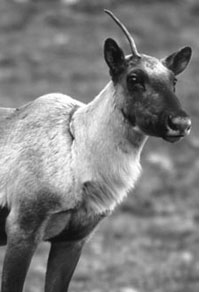
 The third largest logger of mountain caribou habitat is the BC government.
by Candace Batyki
By the time you read this the BC government will have released its new spotted owl recovery plan. If the rumours hold true, the plan will likely protect a few of the nesting sites that owls have used in recent years, and open most of the rest of their old-growth forest habitat up for logging, even nest sites used as recently as 2004. The public will be mollified with a captive breeding program, and treated to photos (and web-cam feeds?) of baby owls. But owl experts agree: without protecting habitat, there is no point in raising baby owls, since they will be released to an inhospitable landscape, with few survival skills.
The largest logger of spotted owl habitat? The BC government’s own Timber Sales program.
No, the spotted owl will not be our Olympic mascot. Indeed, there may not be any owls left in the wild by 2010 (there are only 24 now, an 84% decline over the last decade). The Olympic honour falls to the Kermode or “spirit” bear, a much safer bet for the government since after years of foot-dragging they have finally legislated protections for spirit bear habitat in the Great Bear Rainforest. One imagines many of BC’s other species at risk patting their spirit bear friend on the back in congratulation, while secretly wondering, “What’s wrong with me?”
Species Protection on 1% of BC Land
BC’s species deserve better. We live in by far the most species-rich province in Canada, with 5,250 species of plants, 1,138 species of vertebrates1, 60,000 invertebrates and 10,000 fungi.2 We also have the highest number of species at risk: 1,357 species are considered red-listed (endangered/threatened) or blue-listed (special concern) by BC’s Conservation Data Centre. Of the vertebrates 222 — more than 6% — are red or blue-listed.3 But BC has no stand-alone endangered species legislation, and the federal Species at Risk Act (SARA) is a gutless wonder that relies heavily on voluntary measures, and only protects terrestrial species on federal land: 1% of BC.
SARA also applies to migratory birds and to aquatic species. But the pending decision on whether or not to legally list the lower Fraser River population of white sturgeon as endangered shows another fatal flaw in SARA: scientists agree that the species is endangered, but the federal cabinet can still trump their recommendations using socio-economic arguments. In this case, the feds may well act to protect a $6.4 million guided sturgeon fishery, as well as gravel mining operations that could be curtailed if the sturgeon population is legally listed as endangered, rather than the sturgeon itself.
A glimmer of hope exists in SARA’s “safety net provision.” It states that the federal government may (but is not required to) act “where the Minister is of the opinion that the laws of the province do not effectively protect the species or the residences of its individuals.” In February 2004 four conservation organizations, represented by Sierra Legal Defence Fund, petitioned then-minister David Anderson to invoke the safety net. The petition cited the sharp decline in spotted owl numbers and the BC government’s failure to act.
Anderson responded that he would consider making the emergency order if “the collaborative approach does not soon result in the Province taking actions to protect the Northern Spotted Owl.” The 2004 federal election came and went, Anderson was out, and the new minister, Stephane Dion, did nothing either. On December 6, 2005 the organizations launched a landmark federal court case to compel the federal government to invoke the emergency provision. Lawyer Devon Page stated, “This is the first test of Canada’s Species at Risk Act.…If the spotted owl situation is not an emergency, then nothing is.”
There Oughta Be a Law
With SARA proving toothless, conservation groups in BC began calling for a provincial endangered species act in the run-up to the spring 2005 provincial election. The political response? The Green Party and the NDP both pledged to enact such a law should they take power. The Liberals claimed to have already done it. And they said it again in their 2006 Strategic Plan.
Don’t believe it. The legislation they are referring to is Bill 51, a set of weak amendments to the BC Wildlife Act designed to bring the province into minimal compliance with SARA. The amendments give the province the ability to, for example, designate critical habitat for species at risk. But there is nothing in Bill 51 that says they must, or defines critical habitat beyond the cripplingly restrictive notion of “residence.” The definition of “residence” is hotly debated by scientists, activists and bureaucrats, but thus far appears woefully inadequate to protect wandering species like wolverine or mountain caribou.4
It must be noted that not only do we not have a law to protect species, we actually have laws that prevent us from protecting species. The Forest and Range Practices Regulation restricts the government’s ability to protect wildlife (and most other non-timber values) by requiring that any actions taken not “unduly reduce the supply of timber from British Columbia’s forests.” The BC Forest Practices Board has done an excellent job over the last few years of pointing out such regulatory barriers to species protection. For example they have called for a review of the policy that says actions to protect species, such as the creation of wildlife habitat areas, can’t impact timber supply by more than 1%.
Looking Busy:
Species at Risk Coordination Office
In September 2004 the province announced it had appointed BC’s first-ever Species-At-Risk Coordinator, who would be tasked with accelerating recovery planning for mountain caribou, spotted owl, and marbled murrelet. In June 2005 the lone Coordinator became a full-fledged Species-At-Risk Coordination Office (SARCO), located in the new Ministry of Agriculture and Lands, under the also-new Integrated Land Management Bureau. The spotted owl recovery plan will be SARCO’s first test. Mountain caribou are next.
Like the spotted owl and the marbled murrelet, mountain caribou rely on old-growth forests for survival: they need shelter from predators, thick forest canopy to intercept snow and keep shrubs available in early winter, and slow-growing tree lichens, their late-winter food source. This reliance on old-growth forests puts the mountain caribou, like the spotted owl, squarely in competition with the timber industry. And the mountain caribou’s preference for sub- alpine terrain puts the animals in increasing confl ict with folks who like to snowmobile and heli-ski in those same places. Mountain caribou numbers are down by one-third since 1997. But protecting their habitat means putting land off-limits to the timber and recreation industries.
The third-largest logger of mountain caribou habitat is the BC government’s Timber Sales program. SARCO’s mountain caribou recovery plan is due this fall. Will it be any better than the spotted owl recovery plan? In the absence of a law that compels the protection of critical habitat, only sustained public pressure has a hope of making it so.
It’s not just about these two species. Hundreds of other species, including humans, also depend on these ecosys- tems. A study published in March in the journal Biodiversity reports that a quarter of the old-growth dependent wildlife species that share the same habitat of northern spotted owls are also at risk. Spotted owls and mountain caribou are the canaries in the ecosystem coalmine. It is the ecosystems themselves that are unraveling.
What prevents British Columbians, some of the most prosperous people in the world, from sharing our magnifi – cent forests with wild creatures, in the face of staggering evidence that our refusal to do so puts these species at serious risk of extinction? Why do we refuse to voluntarily limit our activities, to take responsibility for our actions? Are we okay with leaving our kids and grandkids a land- scape denuded, barren of the wild things that so enrich our lives?
Canadians care. British Columbians care. Poll after poll tells us so. The most recent, conducted by McAllister Opinion Research and publicly released in March, confirms that more than eight in ten Canadians believe “the govern- ment should enact stricter laws and regulations to support a more sustainable economy that protects and manages the country’s resources for future generations.” In BC a spring 2005 poll found that 84% of respondents supported creation of a “single, effective endangered species law for BC.”
People know that we are not separate from the other species, that we all rely on healthy ecosystems to sustain us. We know that our economic future, and all our industries – including logging, recreation and tourism – depend on a healthy, vibrant web of life. We know that healthy forests provide more than timber: clean water and air, berries, mush- rooms, fi sh and game, physical and spiritual health, mystery, awe and wonder.
We also know, deep in our hearts, that there is a moral imperative here. As the situation grows more urgent, voices from the faith and religious communities are increasingly speaking out. In the US the National Council of Churches is active in fi ghting congressional attacks on the US Endangered Species Act. Another coalition, The Noah Alliance, describes itself as “a new collaboration of Jew- ish, Evangelical, Protestant, and other religious commu- nity organizations, and individual people of faith, that are concerned about the protection of endangered species and biological diversity.” Buddhists, pagans and many others are also taking action to defend the web of life. Surely the notion that all life is sacred transcends any particular faith.
We need to get smart. If we’re thoughtful, if we take our children to spend time in nature, if we take seriously our responsibility as stewards of biodiversity, if we act decisively, we can maintain our quality of life and keep all the other species around too. But we don’t have much time. We need one strong, clear law to protect BC’s fl ora and fauna.
We are so fortunate. Let us act wisely, that we may pass on all that we have been given.
***
Footnotes
1 The vertebrates include fish, birds, amphibians, reptiles, marine and land mammals – anything with a spine
2 Species Ranking in BC, MSRM 2002
3 116 red, 106 blue
4 For a full discussion of the weaknesses of Bill 51, seehttp://www.environmentalleadership.org/safeguardingbcwildlife/
Caribou photos by Patrice Halley: www.patricehalley.com
Resources and links
Conservation Projects
Mountain Caribou Project (international coalition) — http://www.mountaincaribou.org
Species at Risk Working Group (provincial coalition – includes chart showing the elements of a strong endangered species law, and why Bill 51 doesn’t cut it) — http://www.environmentalleadership.org/safeguardingbcwildlife/
Reports
Logging to Extinction: Last Stand of the Spotted Owl — http://www.wildernesscommittee.org/campaigns/species/forest/spotted_owl/reports
Media release on federal court case, and link to report In Defence of Canada’s Spotted Owl (contains an excellent overview of the legal and regulatory systems for species at risk, and their weaknesses) — http://www.sierralegal.org/m_archive/pr05_12_06.html
Key reports on mountain caribou, including Staring at Extinction: Mountain Caribou in British Columbia (Mountain Caribou Project) and BC’s Mountain Caribou: Last Chance for Conservation? (Forest Practices Board) — http://www.mountaincaribou.org/links.html
BC Government Websites
Conservation Data Centre (provides information on species and ecosystems at risk) — http://www.env.gov.bc.ca/cdc/
Ministry of Environment page on Species and Ecosystems at Risk — http://www.env.gov.bc.ca/wld/serisk.htm
Species at Risk Coordination Office of the Integrated Land Management Bureau, Minister of Agriculture and Lands (responsible for provincial coordination of species at risk issues) — http://ilmbwww.gov.bc.ca./ilmb/sarco/sarco.html
Forest Practices Board (very good special reports on mountain caribou, marbled murrelet, and biodiversity protection under current management regimes) — http://www.bcfpb.ca/reports-publications/reports/list?field_publication_date_value%5Bvalue%5D%5Byear%5D=&field_report_type_tid_selective=64&field_natural_resource_region_tid_selective=All&field_forest_district_tid_selective=All&field_keywords_tid_selective=All
Federal Government Websites
Species at Risk Act Public Registry (gateway to information and documents relating to the Species at Risk Act (SARA); including documents open for public comment) — http://www.sararegistry.gc.ca/default_e.cfm
Federal Nature and Wildlife portal page — http://www.ec.gc.ca/wild_e.html
