Farmers are no strangers to hard work and challenges. Despite years of experience, pages of planning spreadsheets, and the ability to pivot when markets change, one poorly-timed rain shower, an unexpected frost, or the appearance of a new pest or disease can wipe out all contingency plans.
Farming requires a village of support to succeed and for millennia, farmers have worked together to keep costs down and share resources and risk.
Within the last 40 years, we have seen the breakdown of mutual aid and cooperation in the agriculture sector. Barn-raisings, borrowing equipment, and shared grazing used to be common practices within rural communities. Farmers are constantly being told that they need to be a “master of all trades” – not just in production, but in marketing, personnel, and business administration. Not surprisingly, the rates of depression and suicide among farmers are rising. The drive to be independent, to be less reliant on others, and to “make it on one’s own” may have diminished the demand for cooperation, but not the need.
Market collaboration
Thankfully, there are still some institutions that are built on farmer cooperation and collaboration. Farmers markets are probably the most visible, and they are more popular than ever, especially now with the US-Canada tariff war. Canadians who want to purchase local products know that they don’t have to spend hours searching the fine print when they shop at a farmers market. Markets require farmers to fund, manage, and operate collectively, participating in annual meetings and volunteering for non-profit boards of directors.
Even older than farmers markets in Canada are Farmers Institutes, which were incorporated into an Act in British Columbia in the 1930s. These Institutes enable farmers to work together to purchase equipment and inputs, raise funds for the community, and lobby government on issues related to rural life. Institutes are meant to have a direct connection with the Minister of Agriculture and the current Minister does take them quite seriously.
The drive to be independent, to be less reliant on others, and to “make it on one’s own” may have diminished the demand for cooperation, but not the need.
Although not a formal group, North Vancouver Island hazelnut farmers have been meeting regularly for the last four years to exchange information on the production of hazelnuts. While hazelnut farming is not new to Vancouver Island, a wave of new farmers entered the sector a few years ago when the Ministry of Agriculture provided incentives to plant blight-resistant hazelnut trees.
The trees are now reaching maturity, but farmers are noting that there is a lack of processing infrastructure on Vancouver Island. Unlike their counterparts on the Lower Mainland, Island hazelnut farmers can’t easily ship their product to be dried and cracked. Instead, they are experimenting with small-scale equipment to try and process on the Island. While not a formal co-op, the group is looking to collectively purchase equipment from Europe that would fit the needs of small-scale growers.
Sharing land
Shared land is another resource that has become easier to access, thanks in large part to a BC-based organization, the Young Agrarians. Farmers who have excess land that they can no longer farm are matched with new farmers who are looking to enter into or expand production. YA has a plethora of information on its website but probably the biggest asset is its team of Land Matchers, many regionally-based, who work one-on-one with land owners and new farmers to create lease agreements that work for both parties.
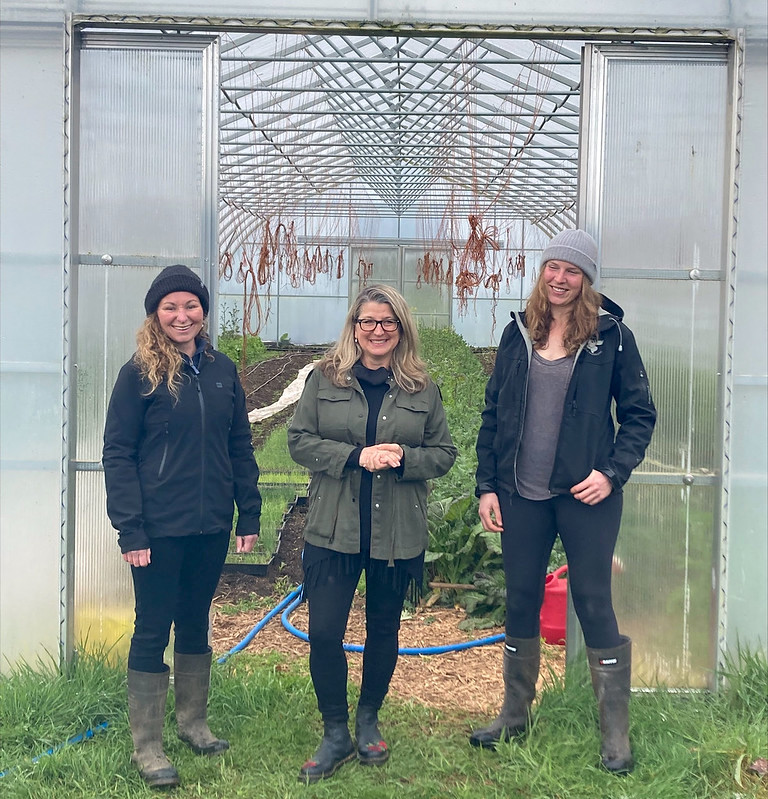
The BC Land Matching Program (BCLMP) delivered by Young Agrarians has achieved more than 200 matches, bringing farmers and landholders together to strengthen the province’s food supply. | Photo CC BY-NC-ND 2.0 via the Province of BC’s Flickr
At a recent screening of the film Sea to Land, hosted by the World Community Education Society in Courtenay, farmers were asked to discuss ways they were collaborating with each other in the region. Cohen Brown, representing local hazelnut growers, talked about the recent discussions about sharing equipment. However, he emphasized how important it was for growers to get together to discuss production techniques, as very little data exists on the north end of the Island on hazelnut production.
Jill Lambert from Shorewolf Farm described how she established relationships with local chefs and restaurateurs and encourages farms to list their products by providing a more fulsome fresh sheet. “Restaurants love to hear about farmers working together, and it simplifies the ordering process when they just have to order through one email,” she says. Farmers drop off their produce at Jill’s cold storage, and she delivers to restaurants for a small fee.
Once the produce is harvested, the co-op pays for wash stations, cold storage space, bags, twist ties, cartons, and delivery and market fees.
Collective marketing is also the reason that a group of farmers came together to form Comox Valley Organics Co-operative. Based at Amara Farm, north of Courtenay BC, the Co-op enables organic farms to sell at the farmers market and to restaurants through a single entity. Farmers are responsible for crop planning, production, and harvest. Once the produce is harvested, the co-op pays for wash stations, cold storage space, bags, twist ties, cartons, and delivery and market fees. The co-op charges a 20% fee to cover these costs, and any funds that remain at the end of the year are then reimbursed to growers.
While the co-op is a much more involved model, it does provide access to critical infrastructure that farmers, especially new ones, often struggle to pay for. In many ways, the co-op is a business incubator. It has grown from its initial four member farms to a total of six today. While each farm is its own unique business, allowing some independence, the co-op model enables product aggregation and access to markets that the small farms wouldn’t be able to achieve on their own. The best of both worlds.
Arzeena Hamir is a food security activist and farmer. She and her husband run Amara Farm, a certified-organic vegetable and fruit farm in the Comox Valley.