 A personal account of the celebration that marks the success of Haida elders 25 years ago, when they gathered at Athlii Gwaii to put a stop to the logging of their land.
by Eduardo Sousa
In November 2010, I had the good fortune and privilege to be on Haida Gwaii to celebrate with the Haida and non-Haida alike a seminal moment in the history ofthose beautiful islands, their people, and indeed British Columbia. The celebrations marked how, twenty-five years ago, Haida elders and youth stood together at Athlii Gwaii (Lyell Island in South Moresby) to say, No! – there will be no more logging of our land beyond this point.
First Nations blockades arguably began in the 1970s as a means to protest and raise awareness of their inalienable rights and title over their unceded traditional territories. At the 1984 Ahousaht and Tla-o-qui-aht blockades at Meares Island in Clayoquot Sound, and the 1985 Haida blockade at Athlii Gwaii, such protests over industrial logging began to increase in scope and scale, and take on international significance. Indeed, each succeeding blockade drew a line in the sand that inspired others to do likewise to assert rights and title to their lands.
For the Haida, the issues at stake were not just environmental, but went to the core of what it meant to be a people who have inhabited the same lands over millennia. This was about regaining control over managing the bounty of land and sea, of beginning a process to re-establish a functioning, sustainable local economy that was originally shattered through a century of colonial control.
As a result of the stands taken, first at Meares and then Athlii Gwaii, momentum built over the following decade, leading to the huge-scale anti-logging campaigns of the 1990s. For Greenpeace, in addition to the important social justice dimensions of the blockade at Athlii Gwaii, we are grateful to the Haida because that line in the sand led not only to our involvement in Clayoquot Sound and the Great Bear Rainforest, but also inspired the development of our international forests campaign work.
And so I went to Skidegate to celebrate the 25th anniversary of Athlii Gwaii, to not only say haaw’a to the Haida on behalf of my organization, but also to honour what they did on a personal level.
Gwaii Haanas
It seemed highly significant to me that the celebrations would begin on Friday November 12th at the Haida Heritage Centre at Kaay Llnagaay, near Skidegate. The Centre shares facilities with the offices of the Gwaii Haanas National Park Reserve, which was born out of the protests at Athlii Gwaii. The park is based on a co-management model, where both Haida and non-Haida are equally responsible for its governance and management. As well as stories told about Athlii Gwaii, the creation of the Heritage Centre and Gwaii Haanas, there was a photographic installation profiling elders and youth – some of whom are today’s leaders in the community. Also featured that evening was the newest chapter in the story of Gwaii Haanas – the recent creation of a marine conservation area around the entire park reserve, essentially tying together land and sea, providing protection, as they noted, from “mountain top to sea floor.”
Dancing, Drums, Masks, Speeches, Food
The core of the actual celebrations took place at the community centre in Skidegate all day Saturday November 13th. Though the whole thing was to kick off at 1 p.m., by 10:30 a.m. there was already a large number of young people and elders waiting to get in, in anticipation of the day’s events – the dancing, the drums, the masks, the speeches, and the food. Being new to the community, I felt somewhat out of place at first, but that soon changed as I was warmly welcomed into the hall and ended up helping pour refreshments, and later ladled seafood chowder out of huge soup pots.
By the time the festivities began with the singing of the Haida anthem, there must have been at least 1000 people in the community hall. Interestingly, only very recently has that song become the Haida anthem, for it was originally called the “Coming into the House Paddle Song,” which became known as the “Lyell Island [Athlii Gwaii] Song” in honour of the blockade that people were here to celebrate. It was with great joy that people across generations came to remember that important moment in time, to honour and say haaw’a to all those who put themselves on the line, as well as to all those who supported the cause of Haida rights and title over their traditional territory.
As much as I would love to recount all the extraordinary speeches made by all the speakers – the memories, the homages, the stories – I can only give a few accounts here that, hopefully, convey the meaning of Athlii Gwaii and of the day itself.
To begin with, in a creative and original recounting of what happened at Athlii Gwaii, a group of youth stepped out on the celebration floor, representing in dress and signs, all the various parts of the conflict – the Haida on the front lines, the loggers, the RCMP, and others.
After the young people’s historical re-actment in song and dance, former President of the Council of the Haida Nation, Miles Richardson, spoke, continuing the importance of creating a historical context for this special gathering. He noted that there was already a twelve-year history of land use negotiations between the Haida and the federal government prior to 1985, which had gone nowhere. With the threat of industrial logging on the few remaining intact areas, the Haida drew the line at Athlii Gwaii. The conflict brought together the two Haida villages of Skidegate and Masset in a commitment to protect the land and surrounding waters. But Richardson also made the point that, as much as he loves “celebrating the past, what turns [me] on is the future.” This was a sentiment shared by most of the speakers – that the meaning of Athlii Gwaii lay not in the past – though it was important to honour that and the sacrifice of many – but in marking out the future for the Haida in terms of governance and control over their resources.
Diane Brown gave a moving, personal account of life on the line during the blockade – from agonizingly watching elders being arrested and taken to jail in Queen Charlotte Village by helicopter, to her own arrest as one of the 72 arrestees, and subsequent conviction. The impact of Athlii Gwaii on her life was clear in her voice. She also noted it took many people beyond the 72 arrestees “who pulled it off.”
Indeed, there were many, many people from away who supported what the Haida were doing, and all that support also contributed to the meaning and success of Athlii Gwaii. What happened at Athlii Gwaii “gave hope to all of [us] and to the rest of the world…that human beings can take care of a small piece of the earth for the children.”
One speech that stood out for me was that given by Chief Allan Wilson. Twenty-five years ago, Chief Wilson was one of the arresting RCMP officers at the blockades and had the “heart-wrenching” task of arresting elders, including his aunt. He noted that though it wasn’t far to walk, arresting and walking his aunt off the site, “was the longest walk in my life; my legs felt 300-400 pounds.” Though he was doing his job, he believed deep inside in what his fellow Haida were doing. Also deeply moving was the forgiveness of the elders he arrested, that they understood, and were “proud of [him] doing [his] job.” This story really moved me, not only by the tenderness with which it was told by a former police officer, but also because of my own experience as a political activist for many years. Having faced the heavy-handedness of police at protests, Chief Wilson’s story illustrated for me that, behind the sunglasses, shields, and batons are human beings with their own feelings, some likely with mixed feelings, over what they have been tasked to do.
I was rather stunned and pleased to hear a senior Parks Canada official acknowledge that what Haida youth and elders did twenty five years ago was important, sending a powerful message that the land and sea are connected, that the people who have been living on the land for millennia have to be listened to in terms of how to steward the land and water. A BC ministry official also spoke about the impact Athlii Gwaii had on provincial negotiations and policies towards aboriginal reconciliation. The co-management model that emerged out of the creation of Gwaii Haanas and the lessons learned provided momentum behind the province’s creation of conservancies, protected areas, ecosystem-based management, and First Nations-owned and operated forest tenures. Another legacy, as noted by the Chair of Gwaii Trust, Peter Lantin, was the creation of Gwaii Trust Society with $38 million to fund environmentally sustainable social-economic development projects.
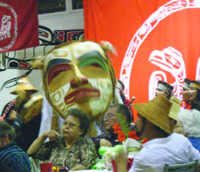
Although I have been writing here about the words and the stories, there were many dances and songs as part of the celebration. The beautiful masks and costumes worn spoke to the power and beauty of a culture long-rooted in the land and water. Young and old danced, both professionally and as part of communal-community dances. Dancers came from Massett and Skidegate, and also from Prince Rupert and Vancouver. The deep beating of the drums kept us all deeply connected to the moment.
A Legacy of Working Together
Towards the end of a terrific day of stories, songs, dances, and feasting, the current President of the Council of the Haida Nation, Guujaaw, said that what was imperative at Athlii Gwaii and its legacy was the working together of both Haida and non-Haida. Land and culture are intrinsically linked, their protection was and is the imperative, and everything just follows from that. The fight continues, though, for rights and title with an impending Supreme Court decision. He called for continued vigilance with the new ecological threat of proposed oil tanker traffic going through Haida waters – tankers chomping at the bit to pick up Tar Sands oil by way of the proposed Enbridge pipeline to Kitimat. Guujaaw, in noting the success of Athlii Gwaii, pointed to the strength of the Haida as deriving from their ancestors – that their power continues through the present and into the future. In the end, he exhorted ever so eloquently that the fight the Haida and all non-Haida alike have now is no longer just for their island home but for the future of the planet.
The evening’s cultural activities wound up with powerful dances recounting Haida past history. Thus we had the story-dance of Icewoman, who led the Haida to Puget Sound when the last ice age arrived. The masks for these dances were created by renowned carvers Reg Davidson, Guujaaw, and Jim Hart. They were literally larger than life with a power exuding from them that gave me the sense of the power of the trees from which they emerged into life as masks through their carvers.
The evening wrapped up with the naming of every person, all 72, who stood on the line and was arrested. A number of those honoured have now moved on, but those still alive were in the community hall and so walked onto the main floor to receive their gift – an honourary blanket with the crest of the Haida nation. After a communal dance that bound them together, much as their desire to save the trees and their land did those 25 years ago, those who were named were joined by the rest of us in a special song. Like the way the day began, a song, this special song composed by well-known Haida artist Robert Davidson for all clans, brought the nine hours of feasting and celebrating to a formal close.
As a Personal Post-script:
I mentioned there was also a personal reason for coming to this event. Over the course of most of my life living in southern Ontario, I have been an activist for both social and environmental justice issues, whether standing in Toronto in solidarity with the Mohawk people during their standoff at Oka, or being a friend of Lubicon Cree when they were fighting for their land rights, or undertaking solidarity actions in the 1990s around Clayoquot Sound, or advocating for a free Tibet. I have worked for both environmental and social justice organizations for a number of years. I don’t see a distinction between environmental and social justice issues.
So with this backdrop for context, I was deeply honoured and grateful for the opportunity to go to Haida Gwaii and say thanks, not just on behalf of my organization, but also in a very personal way to all those who sacrificed of themselves to defend their land. At Athlii Gwaii in 1985, people didn’t know if they would be arrested, and if they were arrested, for how long and what kind of treatment they would receive in jail. The fact that people stood on the line regardless of what lay ahead of them was deeply moving and inspiring to me. I could only hope to have the same courage and conviction in my elder years when I reach them, should I be called to defend the land and water and in respect of the ancestors who have gone before.
I say again, Haaw’a.
***
Eduardo Sousa is a Senior Forest Campaigner with Greenpeace. He can be reached at esousa@greenpeace.org