The Pembina Institute’s June 2026 report The LNG Gamble: Separating Hype From Evidence paints a gloomy picture of uncertain markets for LNG, especially Canada’s expensive gas. It should be required reading for Prime Minister Mark Carney and BC Premier David Eby.
Demand uncertainty
The American war on Iran has created a situation of high prices, but if the Strait of Hormuz re-opens, and Qatar’s vast and readily accessible reserves come back online after Iranian bombing, that price bonanza will only last two or three years (The New Arab, June 24, 2026).
Projections of future LNG demand vary according to their assumptions about future prices compared to other options. The Pembina report discusses factors that suggest demand for Canadian LNG may weaken in the future. For example, it goes through each accessible Asian market one by one. In almost every case, countries are increasingly turning to solar, wind, battery storage and, in some cases like Japan and China, nuclear.
The report notes: “LNG projects typically require five years to construct and several decades of operation to recover investment costs. If global gas demand follows lower-demand pathways, Canadian projects built today could face declining demand, underutilization, or increased competition in global markets.”
While the demand for natural gas for data centres looms large in small towns, the International Energy Agency projects the global total will be relatively small, and about half the energy required will be supplied by renewables, according to its 2025 report Energy Supply for AI.
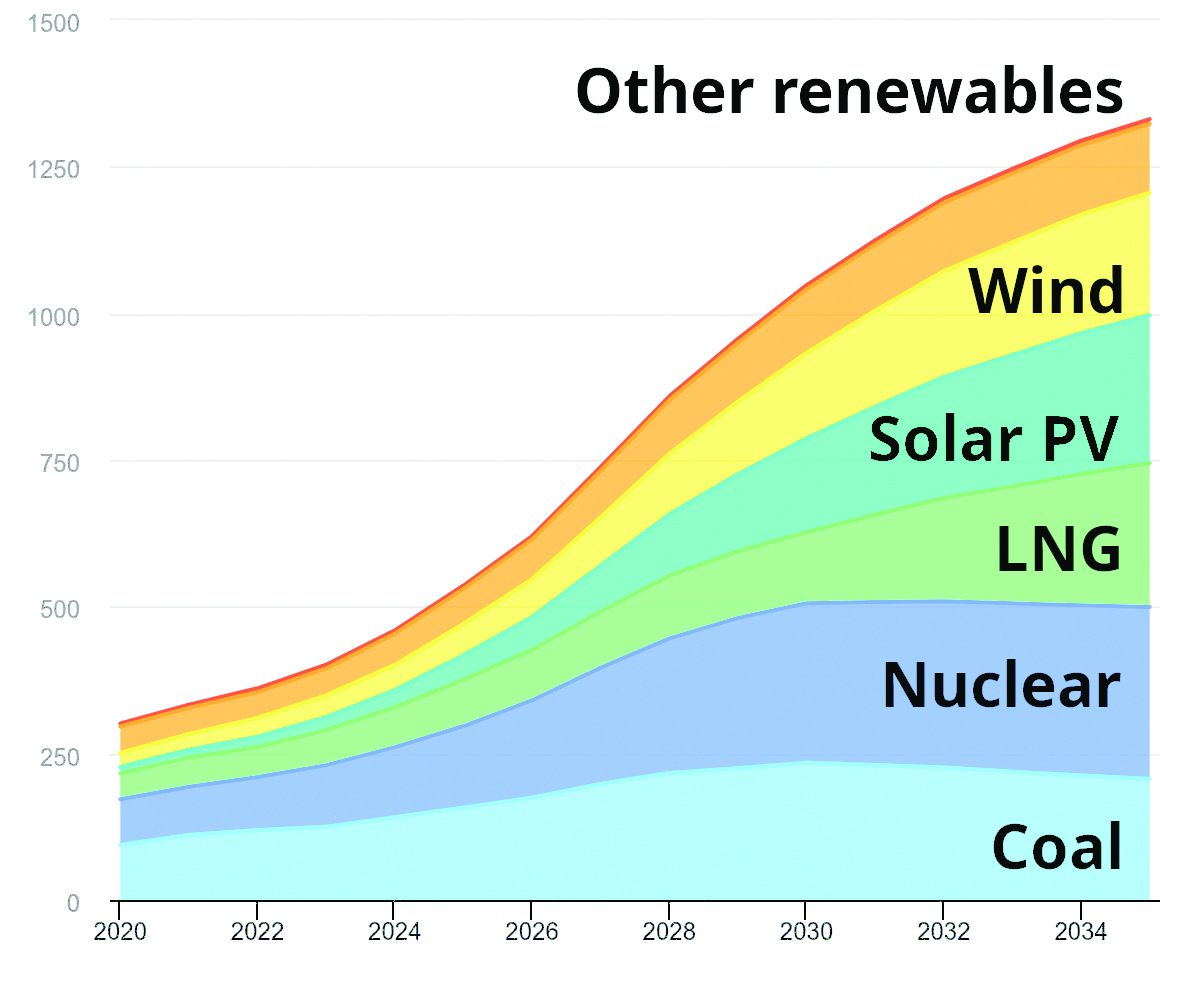
Global electricity sources for data centres
2020-2035 (Source: IEA)
High costs and urgent warnings
Canadian liquefaction costs, passed on to buyers, run about double the global average; 40% above new US facilities. Meanwhile, competition is coming on fast with new plants in Qatar, the US, and Africa, and a global glut forecast by 2030.
The biggest weakness for Canadian industry competitiveness in a surplus market is cost. New infrastructure, long pipelines, and high labour costs reduce profitability, especially given low prices and low demand. GHG emissions and pollution are also potentially significant financial risks.
But US LNG facilities clustered along already-built Gulf Coast infrastructure and pipelines may remain financially viable if prices drop. Meanwhile Qatar, with its large reservoir, existing infrastructure, and skilled labour, can deliver gas at even lower prices.
The study recommends that governments should not subsidize, finance, or enter into risk-sharing agreements with LNG projects. That includes offering preferential electricity rates and tax expenditures, because all these interventions shift commercial risk to taxpayers and increase the likelihood that public funds will be exposed to stranded-asset outcomes. Pembina advises governments to require LNG projects to proceed only on fully commercial terms. If private capital won’t absorb the risks associated with long-lived LNG infrastructure in a volatile, competitive, global market, governments should not do so on its behalf.
The BC government initially painted a pretty profit picture for its proposed new LNG facilities. However, in August it admitted to $1.5 billion in accounting errors which falsely inflated expected gas royalties. The error, unmasked by Treaty 8 First Nations and other economists, apparently failed to deduct overhead from the company profits on which royalties are based. Disputes continue over the exact nature and amount of the error, according to reports in Business in Vancouver.