There is nothing quite like a story told around a campfire. Growing up on the prairies, the tales shared around a dancing flame ranged from fictional legends to lifting a truck transmission without a hoist in -30ºC weather. Before humans chipped stone into tools, the campfire clan was our first institution.
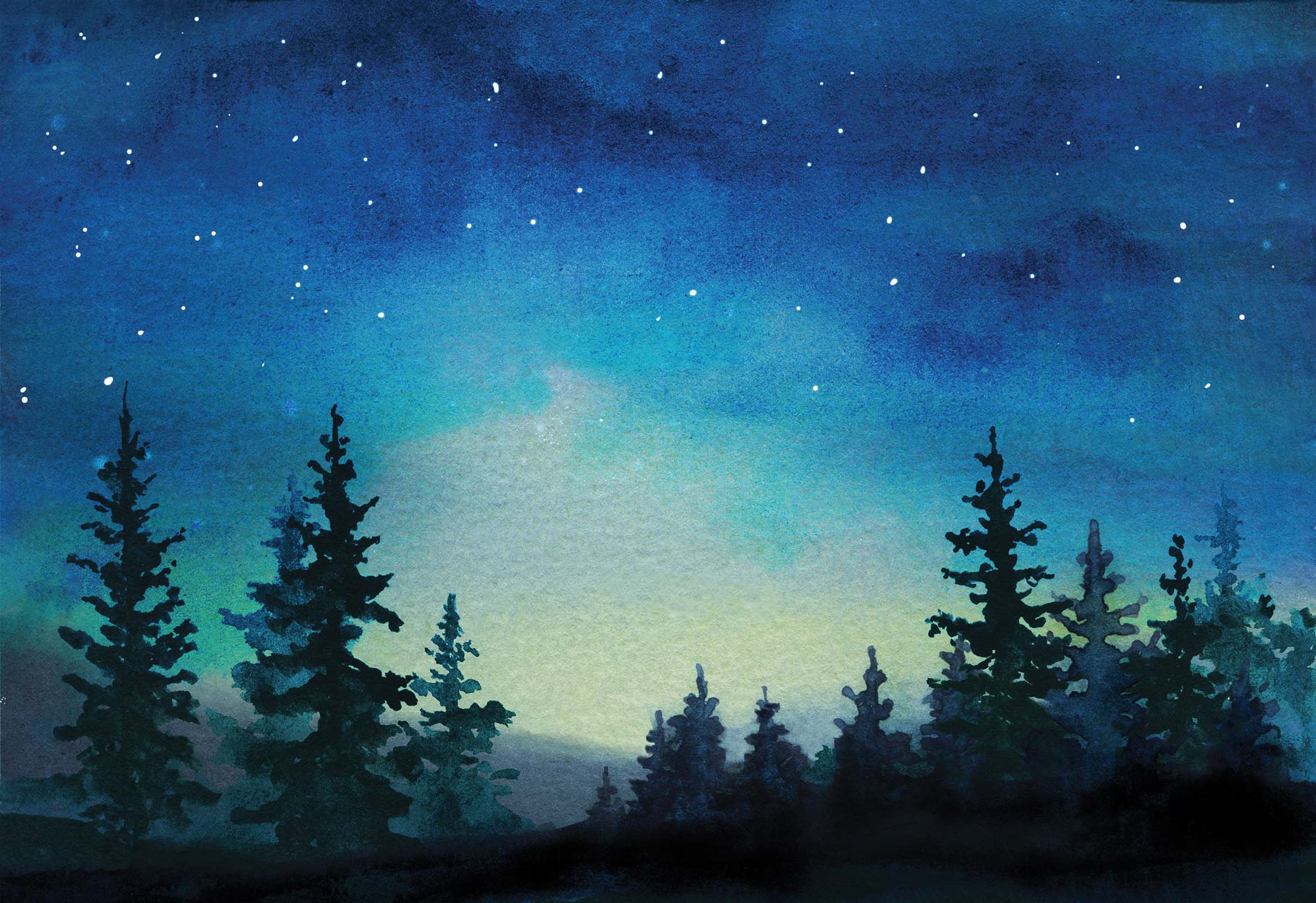
As the sun set and stars emerged in the darkening twilight, the night sky served as humanity’s storyboard. Early civilizations mapped their truths, cycles, and sacred mythologies onto the celestial canvas.
That shared canvas, however, is vanishing. Over the last two centuries, we have bathed the planet in a relentless artificial glow. We’ve traded the collective wonder of the campfire clan for the isolated glow of individual digital screens, walled off inside concrete, steel, and artificial light.
When environmental advocates talk about light pollution, the conversation focuses on ecological disruption: disoriented sea turtles, birds colliding with illuminated towers, disrupted bat feeding cycles, collapsing insect populations. But building broad, lasting support for light pollution abatement means expanding the narrative. Saving the night sky isn’t just about saving turtles or bugs; it is an act of human self preservation. Reclaiming our connection to the cosmos restores a missing piece of human health and identity.
Events serve as powerful engines for outreach to both the public and industry leaders. Back in April 2009, during the International Astronomical Union’s yearly “100 Hours of Astronomy” celebrating Galileo’s legacy, I hosted a major event in Strathcona County, Alberta, that drew 800 attendees and an energy company sponsor. By pairing telescopes with local artisans live-painting the night sky, we proved that industry collaboration and public celebration can walk hand in hand.
Over the years, a multi-sensory approach became the core of my outreach philosophy. At Manning Park in BC, we brought dark skies to life through immersive outdoor activities, with something for everyone – from midnight paddle boarding under the Milky Way, to twilight yoga, to hearing different cultures’ stories while discovering their constellations.
Saving the night sky isn’t just about saving turtles or bugs; it is an act of human self-preservation.
Once emotional and collaborative connection takes root, light pollution abatement look less like a restrictive sacrifice and more look like intelligent design for the common good. Dark Sky advocacy groups are forming in communities around the globe, including on Gabriola Island, where they are working to get dark sky principles adopted into the new Official Community Plan in 2027.
The principles of dark sky preservation apply whether in a prairie municipality, an industrial corridor, or a coastal island community. In rural and island settings, light pollution creeps in through unshielded residential floodlights, unmanaged commercial glare near local businesses, and bright, unshielded security lighting at ferry terminals and marine hubs.
Smart lighting design makes commercial, industrial, and transportation sites safer. Blasting a work yard, ferry terminal, or roadway with intense, unshielded light does not improve visibility; it causes “disability glare” as blinding light constricts the human pupil and creates pitch-black shadows adjacent to the light fixture, where hazards can lurk unseen. Proper abatement eliminates glare, ensuring that workers, drivers, and visitors can see clearly without being light-blinded.
When I led the application to establish Bon Accord, Alberta, as Canada’s first International Dark Sky Community through DarkSky International, our goal wasn’t to turn off the lights but to master them. The regional utility company stepped up as an annual sponsor of our Equinox celebrations and a direct partner in municipal infrastructure. Together, we executed a full lighting retrofit across the town by upgrading park and street fixtures to warm, fully shielded, full-cutoff halogen lamps to comply with our Light-Efficient Community Bylaw.
To track our impact empirically, we took baseline readings using Sky Quality Meters before and after the municipal retrofits. The data offered immediate proof: a measurable, significant reduction in skyglow over the town and a drastic drop in light trespass. We demonstrated that a municipality near a major urban hub could safeguard its night skies while launching practical, safe lighting standards.
Effective lighting policies rely on three straightforward engineering principles:
- Shielding and direction: Utilizing full cut-off fixtures (FCO) that direct 100% of emitted light downward onto target surfaces, eliminating upward light scatter (skyglow) and horizontal glare.
- Colour temperature controls: Restricting outdoor lighting to a colour temperature that minimizes short-wavelength blue light, which blinds the eye at night and disrupts circadian rhythms in humans and other animal species.
- Adaptive controls and curfews: Implementing automated timers, motion sensors, and dimmers so that lighting scales down during overnight hours.
By retrofitting fixtures, managing commercial glare, and establishing sensible light-efficiency codes, communities and industrial partners cut energy waste, reduce costs, and eliminate dangerous glare for night workers and drivers.
The campfire clan of our ancestors gathered under a dark canopy of stars that stirred human curiosity, birthed our earliest philosophies, and bonded communities together.
We do not need to choose between safety, productivity, and the ancient magic of the night sky. Through thoughtful governance, precise fixture design, corporate cooperation, and creative community outreach, we can easily have all three.
The campfire clan of our ancestors gathered under a dark canopy of stars that stirred human curiosity, birthed our earliest philosophies, and bonded communities together. By treating darkness as a precious natural resource, we restore that ancestral canvas for future generations. Reclaiming the dark sky is far more than an environmental chore; it is a return to what makes us human.
Patrick Earl has spent his career in municipal economic development in BC and Alberta, driven by a lifelong passion for night-sky preservation. He is the founder of Novaburn.
