This summer, the BC government announced it is “exploring” a “working forest” solution for the logging industry. But forest advocates question whether it will address the roots of the forest crisis.
The Eby government’s “modern forest management vision” outlines a three-zone model that designates areas for industry, “multiple-use,” and conservation. Forest Minister Ravi Parmar said this would improve “predictability” for forest companies, workers, communities, and First Nations by reducing “unnecessary red tape” and building a “competitive and value-added” forest sector.
This vision comes two months after the New Forest Act tour presented its own conservation-based forest solution (Watershed Sentinel, April-May 2026). The zones resemble the NFA framing, but the goals of the working forest differ sharply. The NFA aims to safeguard intact forests and watersheds for drinking water, fish, wildlife, protection from drought, floods, and fire, and economic diversity.
In contrast, Parmar’s statement focuses on intensive region-wide resource management to attain a harvest level of 45 million cubic metres of forest, or about one million truckloads every year.
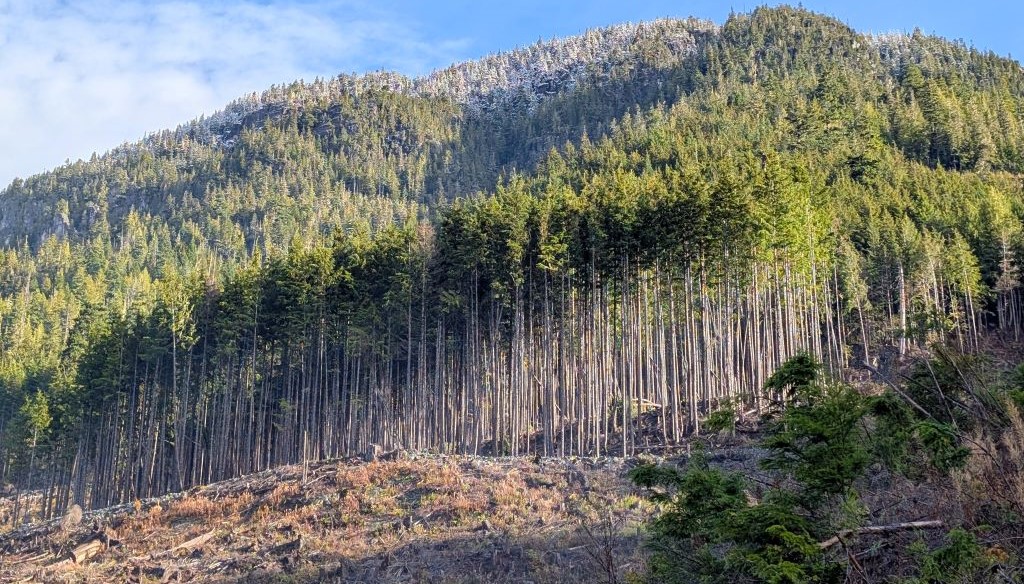
In response to the August 2026 announcement, Aurora Teijera of Sierra Club BC said the working forest model is tied to an “unrealistic timber target.” She warned that it “could give industry a free pass to clearcut old growth to the brink” and “reduce habitats to fragments that are too small, too isolated, or too degraded to support biodiversity.”
Previous provincial promises did not slow the flood of mill closures, job losses, and unsustainable old-growth logging. The Ministry of Forests may have to acknowledge certain inescapable truths, such as the lack of harvestable trees and the global economics of pulp.
The Ministry of Forests may have to acknowledge certain inescapable truths, such as the lack of harvestable trees.
“Falldown” is the term for cutting forests faster than they can grow back. The forest sector has seen this shortfall widening for decades, and now it may be coming to a head. As former BC MLA Mike Morris told Dan Miller on The Clearcut podcast this summer, forest resources were “squandered.”
And as we learned in January, so is public money. Some forest-products companies appear to stay afloat only because of multi-million dollar government handouts, even as they lay off workers by the hundreds. For example, Greenpeace reported this year that the federal and provincial governments gave Domtar, one of the world’s largest forest products companies, $200 million in public funds from 2020 to 2024.
Meanwhile, in the last five years, Domtar and its parent company Paper Excellence have closed five mills, most recently the Howe Sound Pulp Mill and the Crofton Mill. The industry giant cited “lack of access to affordable [fibre]” and the “shrinking supply” of available wood in its announcements. As a global conglomerate, it carries on buying, selling, and reorganizing its companies from country to country like a grand game of chess.
It’s no coincidence that Domtar and the Paper Excellence Group share an owner with another forest-products empire: Asia Pulp & Paper, which went through Indonesia’s largest bankruptcy when it defaulted on $14 billion in loans from state-owned banks in 2001.
These powerful multinationals are playing the same game. Take public money, liquidate forests, plead poverty and shut down operations with a few weeks notice. Without decisive action to protect and restore the land, the Province’s jobs-and-conservation plan is little more than a dog-and-pony show.