Indigenous people on BC’s Pacific Coast say a North Coast pipeline and oil tanker route would put their economy and way of life at risk, and they will never allow it.
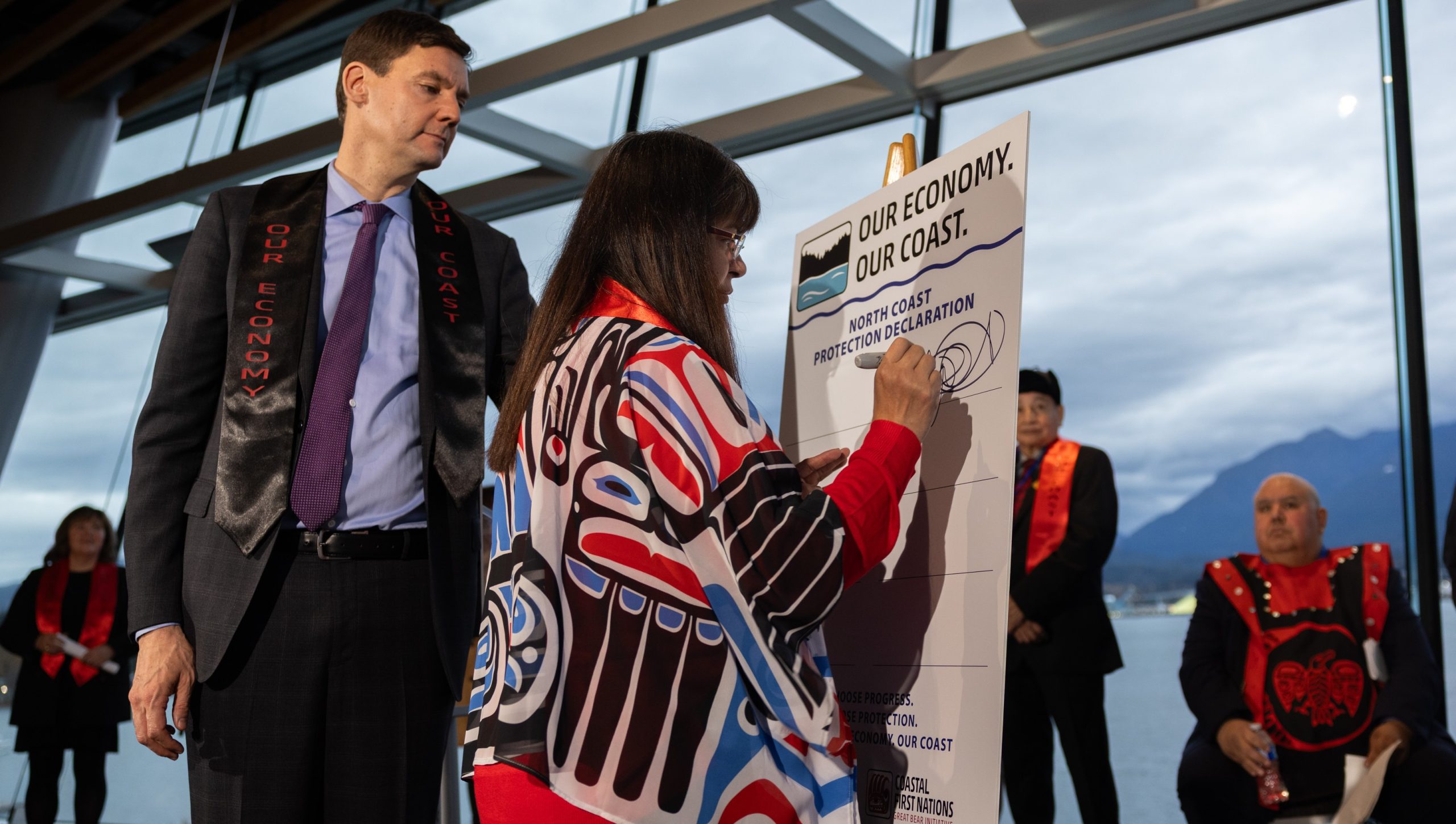
In a public statement, Marilyn Slett, President of the Coastal First Nations-Great Bear Initiative and elected Chief of the Heiltsuk Nation, declared that an agreement between Ottawa and Alberta “does nothing to increase the chances of a pipeline and oil tankers route to the North Coast ever becoming a reality.”
Prime Minister Mark Carney and Alberta Premier Danielle Smith signed a Memorandum of Understanding in May after months of discussion. Central to the MOU is a federal commitment to facilitate building a new pipeline from the Alberta tar sands to the Pacific coast for shipment to offshore markets.
Slett stated, “We have heard directly from the Prime Minister and the Minister of Energy and Natural Resources, Tim Hodgson, that no project, and no route, will proceed without the support of affected First Nations and the province in which it is proposed.”
The MOU asserts the parties’ goal for Indigenous co-ownership of a future pipeline. But CFN rejects the idea outright. “No offer of equity or ownership will change our position,” Slett clarified. “Governments and would-be proponents should be aware of our absolute determination to protect our economy and our coast, which contributes more than $3 billion annually to our region and employs 30% of the workforce.”
Coastal First Nations launched in 2000 with the Declaration of the First Nations of the Pacific Coast, which includes the Council of the Haida Nation, Old Massett Village Council, Skidegate Band Council, Gitga’at Nation, Gitxaała Nation, Heiltsuk Nation, Kitasoo Xai’xais Nation, Metlakatla Nation, and Nuxalk Nation.
CFN works to protect the cultural and natural resources of its member Nations, promoting economic self-sufficiency and sustainable development throughout the North and Central Coast and Haida Gwaii.
“No offer of equity or ownership will change our position.”
As legally recognized rights and title holders, Coastal First Nations and the Lax Kw’alaams Band, along with the Province of BC, are calling on Ottawa to uphold the North Coast Oil Tanker Moratorium Act in its entirety, with no exceptions, Slett said in her statement.
Last year, member Nations pledged to use every legal tool in the box to keep oil tankers and the risk of a catastrophic oil spill out of BC’s northern coastal waters.
“We have made repeated calls to the federal government to uphold Bill C-48, the Oil Tanker Moratorium Act, as it is foundational to the successful conservation economy we have built on the North Coast,” reads a CFN statement from December 2025. “Coastal First Nations, along with the province of BC, have made it clear through our joint declaration that the tanker ban is not up for negotiation, and no MOU will change that.”
“Throughout this process we have been met with a wall of silence from the federal government,” the statement noted. “Such conduct is not honourable and is fundamentally at odds with Canada’s constitutional, legislative, and international obligations to coastal First Nations.”
“Our Nations understand the economic challenges Canada is facing,” the statement reads. “This is why we much prefer to work with the federal government on truly nation-building, forward-looking projects and initiatives that are built in partnership with Indigenous peoples. We should be working together to protect our environment, diversify our economy, and create jobs that support our communities, instead of squandering everyone’s time on politically-motivated MOU’s that are only dividing our country further.”
Read more: www.coastalfirstnations.ca