Old-growth forests in British Columbia hold a prized position in our collective imagination. Our relationships with these places define our regional identity.
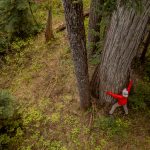
We often picture them as valleys of towering cedar and Douglas fir with sunshine filtering down through diverse canopies, and salal and huckleberry stretching up to the light. But old growth also includes high-elevation forests of slow-growing subalpine fir and mountain hemlock, rooted to the sides of cliffs, weathering avalanches and wind, and old northern stands of unassuming boreal white and black spruce that have supported lichen and caribou for centuries. In rainforests, old growth is defined as stands averaging 250 years or older. In drier forests, the threshold is 140 years. These are all complex, ancient ecosystems that do not regenerate on human timelines. But they are still being logged.
Ecosystem distinctions matter because industrial forestry has focused on high-productivity valley-bottom forests with the biggest trees, richest soils, highest biodiversity, and greatest carbon storage.
We’ve been here before
The conflict over old growth in BC is cyclical. In the 1990s, mass arrests took place in Clayoquot Sound. Thirty years later, blockades at Fairy Creek became the largest act of civil disobedience in Canadian history. And then last year, more blockades erupted in the Walbran Valley.
Without rapid action, the rarest and most productive old-growth ecosystems could be lost
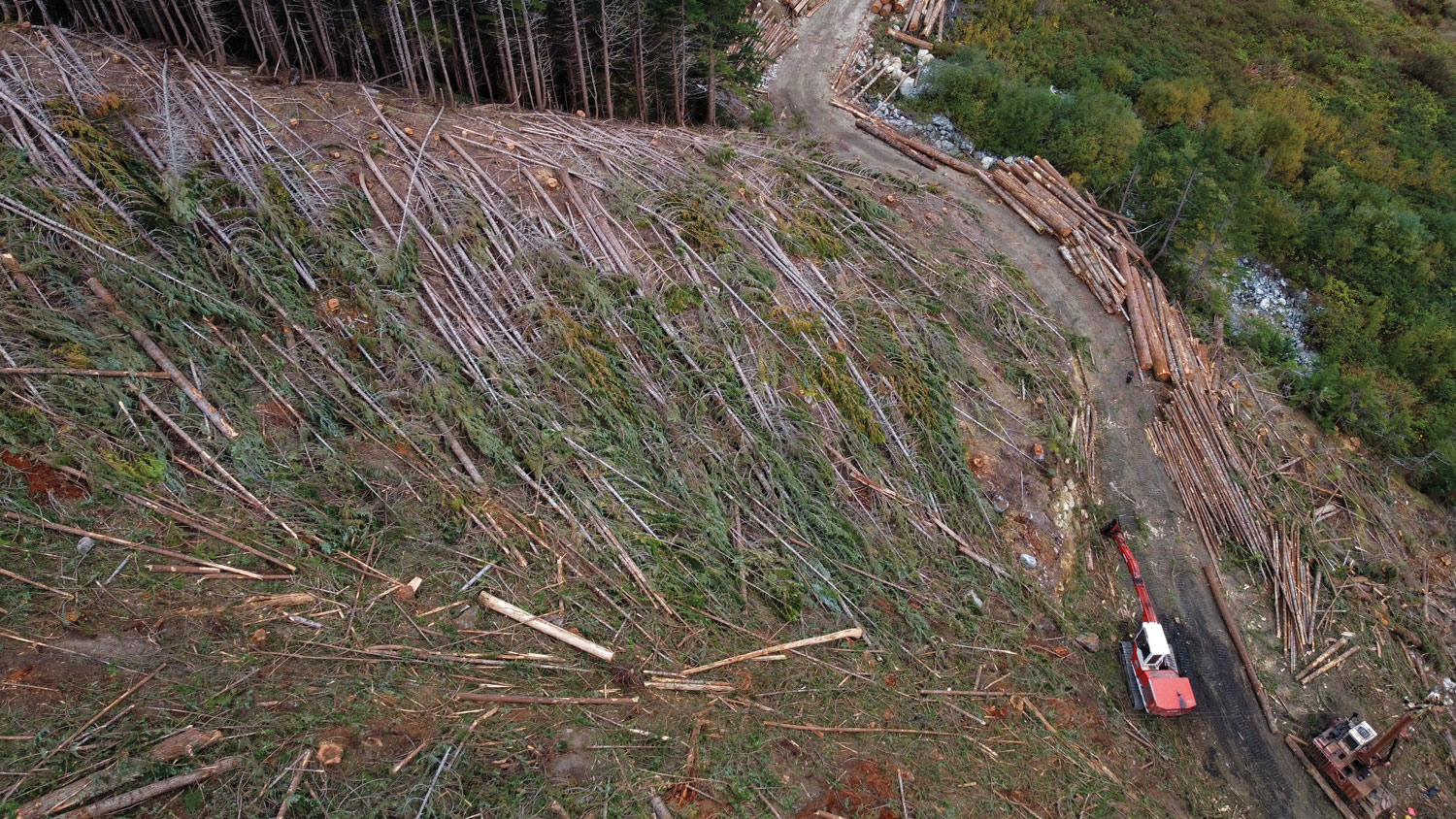
The message from government and industry is the same every time: forestry has changed, sustainability is improving, and lessons were learned. But on the ground, old-growth logging continues. There’s a name for this pattern: “talk and log.”
The Old Growth Strategic Review
In 2020, the province released the Old Growth Strategic Review, authored by two independent professional foresters. The report made 14 recommendations and called for a fundamental shift in forest management. The authors urged a move away from the timber-first model toward one that prioritizes ecosystem health and respects Indigenous rights and title.
Key elements of the OGSR included immediate deferrals of logging in the most at-risk old-growth ecosystems, transitioning to ecosystem-based management, shared decision-making with First Nations, transparent monitoring and public reporting, and economic transition programs for forestry workers and communities already destabilized by decades of overcutting.
The authors warned that without rapid action, the rarest and most productive old-growth ecosystems could be lost before new planning frameworks were in place. Publicly, the provincial government accepted all 14 recommendations. But none of them were fully implemented.
The following year, the Province convened the Old Growth Technical Advisory Panel (OG TAP), which mapped all remaining old-growth forests and determined the most at-risk areas.
In 2021, the Province announced temporary logging deferrals in selected areas, but many of the best valley-bottom forests – those most likely to be logged – were not included. Furthermore, in several cases, deferrals were later lifted or modified. The structural shifts envisioned by the OGSR, including legally-binding biodiversity thresholds, ecosystem-based management, and a clear end to logging endangered old growth, have not yet materialized at scale. The timber supply framework, cut-level determinations, and tenure system remain largely intact.
Process without protection
The Provincial Forest Advisory Council was convened in 2025 to provide independent advice on the future of forestry in BC. Its mandate included examining how to balance ecological sustainability, economic stability, and community well-being. The result was yet another iteration of the provincial talk-and-log cycle.
Deferrals were later lifted or modified
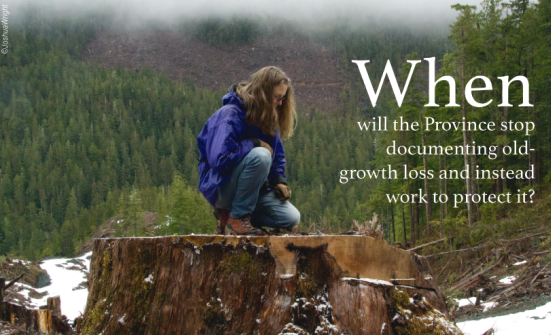
When the PFAC released its final report, it emphasized the need for economic diversity, collaborative land-use planning, and improved monitoring. But the report stopped short of recommending immediate protection for the most endangered old-growth ecosystems. It didn’t set firm conservation targets or timelines to end logging in high-risk forests, or call on industry to transition to sustainable models. Instead, the PFAC leaned toward more study and more dialogue; specifically, another review, nearly identical to the OG TAP. When will the Province stop documenting old-growth loss and instead work to protect it?
What’s left and what’s at risk
The rarest and most productive old-growth ecosystems, particularly valley-bottom coastal forests, represent a tiny fraction of the original landscape. They are also the most commercially valuable, the most accessible, and the most vulnerable in the absence of hard caps and legal safeguards.
Ancient forests are not renewable on human timelines.
Government reports emphasize that 80% of old-growth forest in BC is not currently at risk of logging. However, much of what remains is high-elevation, low-productivity (small, slow-growing) trees in remote areas, and/or is already within parks or protected areas. By contrast, the 20% still at risk for logging likely includes most of the high-productivity old growth – the tall, low-elevation trees that store the most carbon and support the greatest biodiversity.
A question of values
Ancient forests are not renewable on human timelines. A 500-year-old cedar cut today will not be replaced for centuries. The web of lichens, fungi, insects, soil microbes, and hydrological systems built over millennia cannot be replanted.
Through protests and demands for consultation, communities demonstrate that old growth matters. Scientists have documented the stakes for biodiversity and climate stability. The unresolved question is not whether change should happen; it’s whether BC will move from talk to action before the most valuable old-growth ecosystems are lost forever.
Tobyn Neame is the Forest Campaigner at the Wilderness Committee.