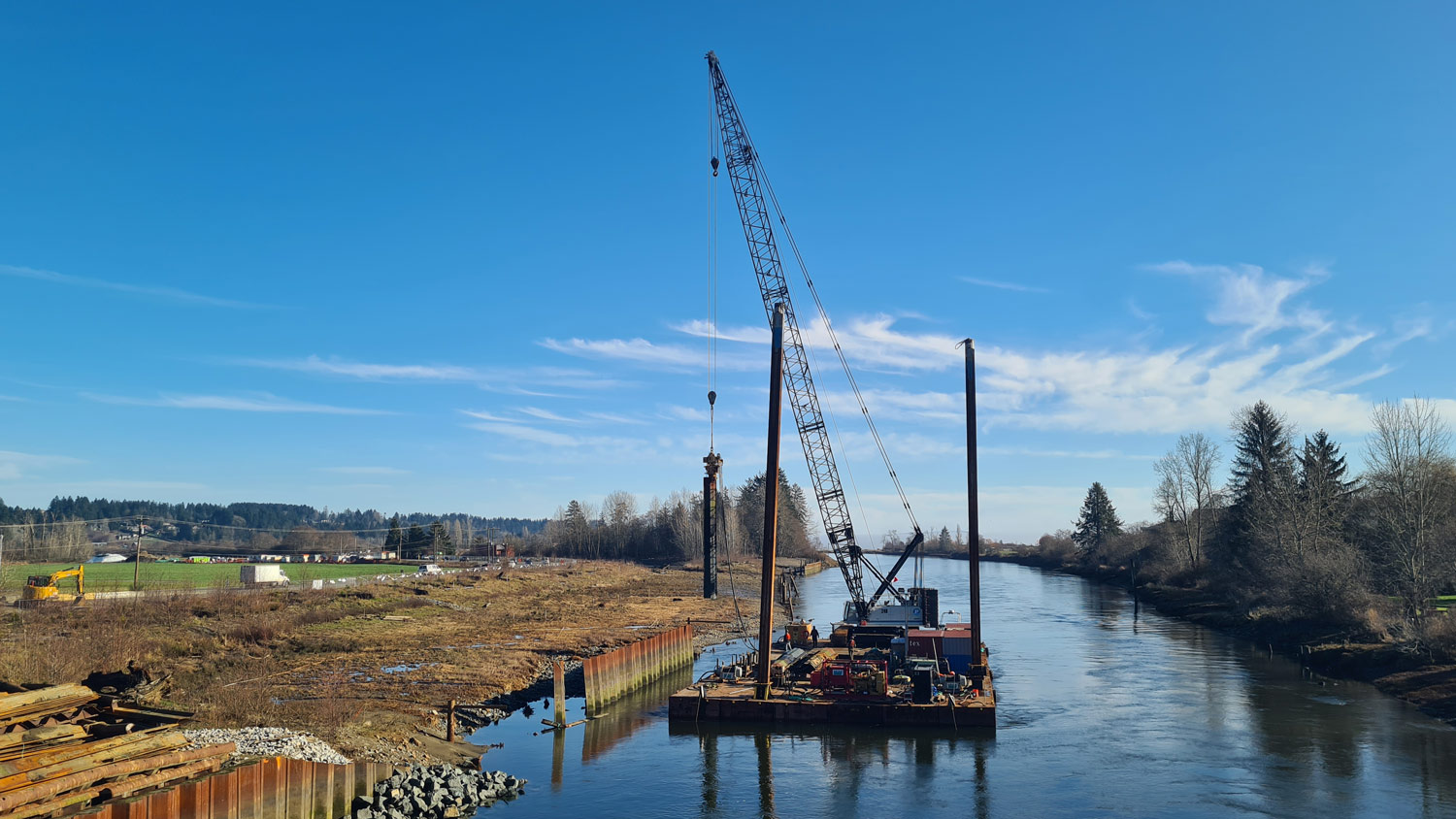
In winter 2025, a barge carrying a crane moved slowly into the Courtenay River estuary to remove the last remains of the old sawmill. For weeks, 20-metre-long rusty steel pilings were wrenched from the mud one by one, marking the end of a 400-metre retaining wall that had kept the land apart from the water for 70 years.
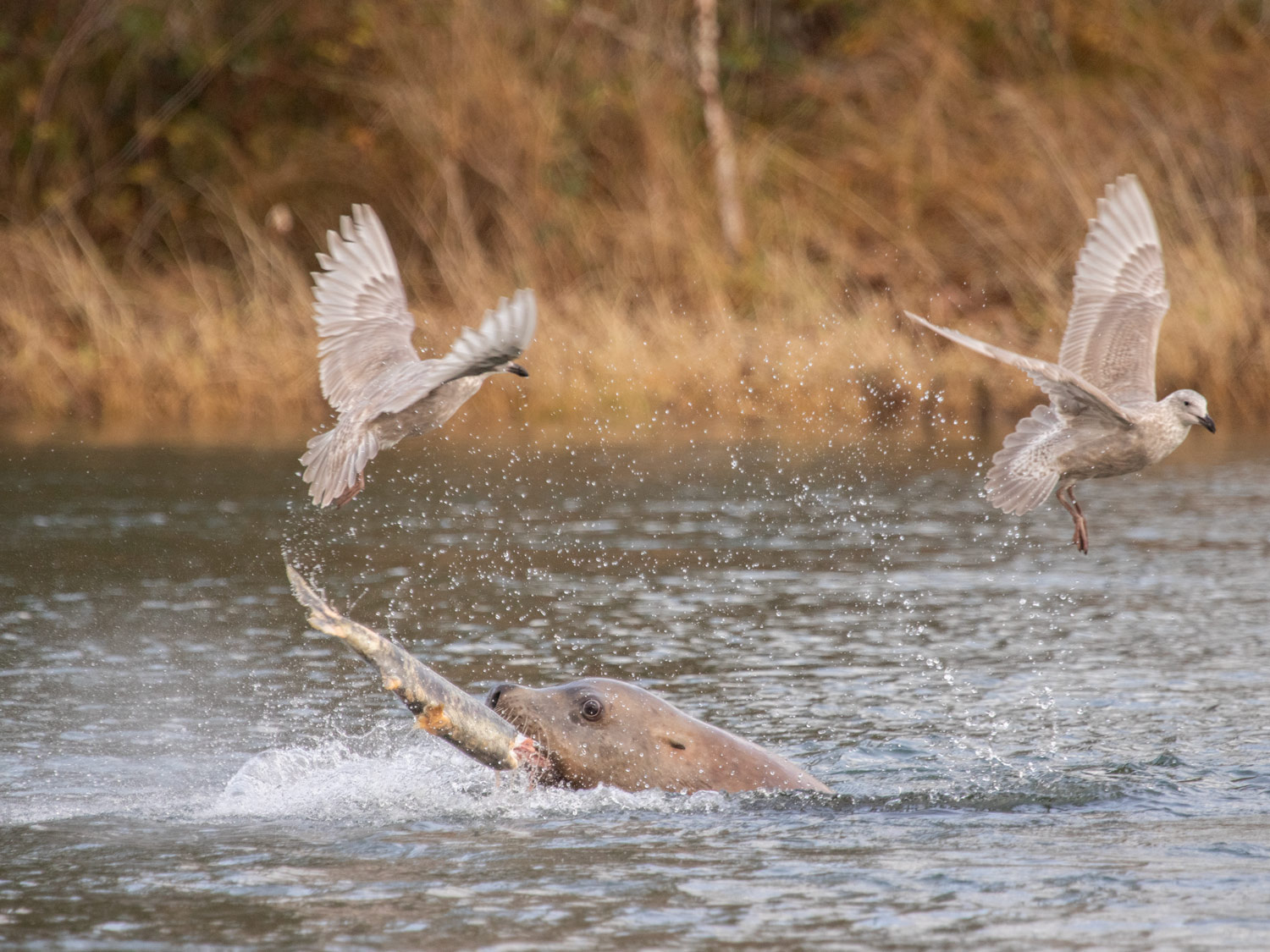
The barrier is emblematic of a common coastal engineering practice known as “hard armouring,” where rigid, permanent structures are built to protect shoreline properties and infrastructure from erosion, waves, and flooding. This corrugated metal “killing wall” – built to support a sawmill that operated from 1947 to 2006 – trapped juvenile salmon, leaving them exposed to hungry seals. The rush to make usable land destroyed many acres of prime habitat. Thousands of years of cultural-use history, including parts of an ancient wood stake fish trap fishery, were buried.
The restoration project started in fall 2017, when Project Watershed began fundraising and working with the K’ómoks First Nation and the City of Courtenay to purchase the old mill site from then-owner Interfor. K’ómoks First Nation named the site Kus-kus-sum, meaning “very slippery,” to honour a nearby village of that name that existed before colonization.
By March 2021, the site was secured and demolition and restoration work began. Since then, volunteers have spent thousands of hours in the mud, restoring salt marsh habitat for dozens of species of fish, birds, and plants. Salmon were already spotted spawning in the new lagoons while demolition was underway. Even in its degraded state, the estuary supports important populations of great blue herons, Canada geese, loons, sandpipers, bald eagles, and trumpeter swans.
It’s not just about removing the wall. It’s about restoring the relationship with the land, the river, and one another.
Beyond rehabilitation, the project highlighted how development leaves deep, long-lasting scars on the land when local ecosystems are treated as merely an obstacle to be tamed, controlled, and paved over. As communities learn firsthand the cost and labour involved in removing these scars, alternatives to hard armouring that leave natural habitats more intact begin to look attractive to municipal councils and planners.
For independent ecological advocate Vanessa Scott, Kus-kus-sum offers an opportunity to learn how to build with rather than against nature in future development projects. The problem, she suggests, lies in the colonial mindset that land exists primarily for human consumption.
Scott recognizes that in conversations with government officials, the natural world often has to be translated into economic terms to be taken seriously. As a volunteer with Project Watershed’s Fundraising Committee who worked on the original Kus-kus-sum communications strategy, she saw firsthand how “eco-asset language was a foundation for investment by governments and the public.” In short, when governments can formally recognize ecosystems on spreadsheets, much like roads and sewer pipes, they become more legally and financially committed to protecting them.
This framing “proves” ecosystems’ usefulness to humans: they provide flood protection, absorb climate impacts, and save public money by replacing man-made infrastructure. While this kind of cold accounting loses something essential – the land is no longer valued because it is alive, but because it serves our needs – it remains a necessary concession to our current social reality. For now, Scott sees such frameworks as a strategic bridge or common ground on which to meet, allowing the natural world to enter spaces where decisions are shaped by budgets, legal obligations, and risk assessments.
Coming back to right relationship
Structures like the killing wall serve as a stark metaphor for the ways humans have created an illusion of separation from the natural world through control, force, and domination.
With the wall now dismantled, the land and sea have come back into their original relationship. Are we also being asked to soften, reconnect, and reconcile with the natural world? In the bigger picture, including ecosystems in decision-making is not enough on its own if the deeper relationship remains unhealed. A real paradigm shift asks us to question outdated values that shape how we inhabit the Earth and belong to it.
Ultimately, this is what Kus-kus-sum teaches us. As Courtenay Mayor Bob Wells said at a milestone gathering in January, “It’s not just about removing the wall. It’s about restoring the relationship with the land, the river, and one another.” Returning the 8.3-acre site to Indigenous stewardship once restoration is finished reminds us that some relationships should never be broken.
The Kus-kus-sum site will be fully returned under legal ownership to the K’ómoks First Nation, while the rest of the estuary will see the Nation gain shared legal authority and a consent-based role in all major decisions, through a modern agreement with the Province designed to keep the estuary healthy and protected. Currently, the estuary is managed by a mix of stewardship community groups, Indigenous land guardians, and local government officials.
K’ómoks Chief Nicole Rempel, who sees caring for the area as an “inherent duty,” explained: “K’ómoks First Nation believes in partnerships, particularly with like-minded groups that share a similar vision.” Caitlin Pierzchalski, Project Watershed’s Executive Director, added that the project is succeeding only because of “widespread community support.”
In the end, we protect what we love. When people regain a sense of responsibility toward the land and a sense that they belong to it, life returns – not just in the places around us, but in how we understand our relationships to the human and more-than-human world. The collaboration between the Nation, volunteers, and local organizations at Kus-kus-sum shows that the community’s heart is already there.


