| Vol.11 Number 5 |
Devember 2001/January 2002
|
|
| Index & Home Page | ||
 |
||
|
|
||
Go to: Watershed Sentinel home page Go to: Reach For Unbleached! home page
| Vol.11 Number 5 |
Devember 2001/January 2002
|
|
| Index & Home Page | ||
|
|
||
|
|
||
Wait for this document to finish loading, before using the following links
Vol.11 Number 5 - Devember 2001/January 2002
Sustainability, says the Union of Concerned Scientists, means leaving something for our children: "The words a mouthful, but the concepts a no-brainer. Just like us, future generations will need food, water, energy, air and land, not to mention some wildness somewhere. This means we cant behave like guests at the mad hatters tea party, polishing off one plate and moving on to the next. " [No-brainer: in modern jargon, a concept that takes limited brain power to understand - ed.]
The problems are immense, from groundwater pollution to climate change, soil and habitat destruction, and the re-design problems are acute, but the scientists say there are ways to repair the earth. "For instance, switching from fossil fuels to renewable energy will slow climate change. Reserving antibiotics for therapeutic, rather than economic, uses will protect our storehouse of medicines. Sustainable methods of agriculture, like crop rotation, will help to keep the environment clean ... These solutions aren't sacrifices. They're what it takes to keep the planet going. We should take these steps, for the same reasons we preserve our health or maintain our homes. Anything less would be irresponsible, if not to ourselves, then to generations to come."
But what are the changes we need to make, and how? The change in how we live has to start where we live. Norberto Rodriguez dela Vega wrestles with the building blocks and methods of moving to sustainability through community planning, a process within the reach of all citizens.
 I Dream of Pueblo Verde, and a Road Map to Get There from Here
Three Third World Communities Lead the Way to Sustainability
Power, how we get and how we use it, is a major part of the sustainability puzzle, as the events of the last two months have proven once again, and Don Malcolm discusses in our editoriL, "Oil and War." There's a lot more to be said on that sad matter, but we move instead to Vancouver Islands search for energy, from green power such as wave generation, to coal bed methane drilling with its potential groundwater problems. The Georgia Strait Crossing natural gas pipeline takes another drubbing as Tom Hackney addresses BC's energy policy review. We provide a review of the impact of natural gas on marine life, and look at the potential of making electricity from manure. Talk about crisis and opportunity!
Quotes to Savour
Coal Bed Methane
New Power Emerges from the Waves
Life in the Sea Doesn't Like Gas
Biogas Opportunities
Learning from Plants
Extension on Sour Gas Pollution
Air Index is Off the Wall
Caving in on Zero Emissions
St. Lawrence Oil and Gas Moratorium
Energy Confusion in BC's New Era
Its probably hard to see a bright future right now, for the thousands of unemployed British Columbians this holiday season, from the public service to the forest industry. Once again its a dark time in forest communities, as mill after mill closes due to the softwood lumber dispute with the US over subsidies. But as the government follows the corporate chorus, chanting "It is not subsidized, It is Not Subsidized, It is NOT Subsidized, It is NOT....," forest analyst Ralph Keller clings to a clear vision of a solution to the mess in the woods: Reform the forest tenure and redistribute the timber in woodlots around forest communities, allowing a diverse, and resilient, economic base to flourish. Meanwhile, another longtime student of the industry explains where $2.5 billion in "stumpage" payments for the public forest was spent, and explodes the myth that "enhanced silviculture" actually works to grow better trees faster.
Yes, A Magic Bullet for Forest Woes
Central Coast Truce Disturbed by New Process
'Forest Renewal' BC Scrapped
Innovative Forestry Agreements, An Affront to Common Sense
Also Inside
Recycling: Include Milk!
Water Runs Through Friends of Cortes 2001 AGM
Better Left Said by The EcoCurmudgeon
Oil and War
The United States imports 700,000 barrels of oil each day from Iraq while at the same time enforcing a trade embargo on that country. Innocent children go to bed hungry because that oil rich country has been shut out of reciprocity in the market place, a leftover legacy from President George Bush's Gulf War a decade ago.
An editorial in the Seattle Post-Intelligencer, Nov.18, 2001, opens with: "There is a direct, inescapable connection between our war on terrorism and our nation's dependence on the internal combustion engine."
In both the US and Canada, our governments should have taken steps long ago to lessen our dependence on oil. Both have all but backed away from the Kyoto Protocol in spite of scientific evidence that we must reduce carbon fuel emissions in order to combat global warming.
Automobile manufacturers are allowed to build ridiculously overpowered vehicles with no regard to fuel consumption. Highway speed limits creep upward. Fuel-thirsty four wheel drive toys crowd our paved highways, their drivers drunk on imagined personal power. Solar and wind power development receives almost no financial support from governments while oil based energy is heavily subsidized.
The US and, by our close relationship, Canada, are playing political games in the middle east, propping up oppressive regimes, in order to protect North America's oil supply. We make enemies that way.
There are alternatives. There are hybrid engines that run on either electricity or fossil fuel. There is a hydrogen fuel cell engine already operational. Public transportation could be made more user friendly, more frequent. Free public transportation in cities would cost far less than what it now costs to build and maintain our ever expanding road system to accommodate more and more private cars.
It seems our market system does not plan ahead but rather survives by reacting to and capitalizing on emergencies, like a cougar finding an injured fawn.
Are we not now facing an emergency?
Our chickens have come home by Don Malcolm
With fire in their bellies to the towers of trade
Trading misery for misery
Who will claim the chickens
Whaletown, November 2001
"Seventy years is longer than the time between the Wright Brothers at Kitty Hawk and Neil Armstrong walking on the Moon. It is an inappropriate interval for cleaning up the discharge of raw sewage into coastal water." Excerpted from an e-mail by John Jordan, manager of environmental services for the Vancouver Port Authority, quoted in Vancouver Sun, October 26, 2001
"BC's forest industry, unfortunately, is about as diverse as a parking lot." by Cheri Burda, explaining that diversity is the key to survival, in nature and in the marketplace, Vancouver Sun, November 21, 2001
Yes, A Magic Bullet for Forest Woes
"Magic bullets," easy solutions to regional economic or social problems, are rare but Ralph Keller, long time student of logging practices and forest policy insists there is an effective way to turn the BC forest economy around, for good: Reform the Land Tenure.
BC's forest industry has been in steady decline for two decades, with the US/Canada Softwood Lumber "Disagreement" being the latest blow. The economies of many rural forest dependent communities were collapsing well before the expiration of the Softwood Lumber deal. Towns like Sayward, Tahsis, and Youbou, once thriving forest sector towns, may soon be little more than points on a map.
What's ironic is that these towns are located in the middle of productive forest farms and, worse, some had profitable sawmills shut down. In the last decade alone, more than 14 saw and pulp mills have been shut down, throwing thousands out of work and devastating BC's rural economy. While many corporations are down sizing milling infrastructure, raw log exports have increased. Ironically, BC's Annual Allowable Cut has, until the most recent imposition of US countervailing duties, remained relatively high.
There are many complex reasons for the decline of the forest industry in BC: Changing global markets, loss of high quality softwoods (Old Growth), and a noteworthy change in the corporate psyche to one of utter disregard for anything (or anybody) but maximizing profits.
At the heart of BC's difficulties is a government-sanctioned forest land tenure system. Nowhere in the developed world is so much of the forest land base controlled by so few. Furthermore, these forest lands are virtually all public. This concentrated corporate control of public land is without parallel anywhere. The American claim that our forest industry is not free market based is probably true. BC corporate tenure holders horde their timber quota, selling only uncommitted surpluses to small local mills.
Timber value can be difficult to determine because the vast majority of logs cut are used internally by corporations and seldom make it to the public auction block. Stumpage, paid to the government for cutting rights is often under valued. Some forestry officials claim the only way they are able to set stumpage rates is through the value of exported raw logs. In effect, we do not have free and open log markets in BC, which leaves the survival of local, untenured manufacturing facilities at the whim of the forestry giants.
The problem with BC forest economics may not be the result of free market conditions or capitalism, but the lack thereof. When we examine the successful forest economies of other countries, like Germany or Sweden, we see that control of the forest resource is highly decentralized and controlled by many small woodlots. In the European Union there are over 1 million licensed small woodlot operators who, independently or cooperatively, direct their timber to saw mills and other specialty manufactures at fair market values.
A major revitalization of our provincial forest economy could be accomplished by a simple stroke of a pen--reform forest land tenure. To a certain extent, the government has recognized the importance of small scale forestry by creating the BC Woodlot tenure. There are presently 800 family owned and operated woodlots throughout BC and they are, by all accounts, exemplary models of forest management.
These tenures, from 200-500 Hectares in size, are coveted by their owners and the pride of the BC Forest Service but represent only a tiny fraction of BC's managed forests. They are the antithesis of the Tree Farm Licence industrial model.
Woodlot owners nearly always live in the communities most affected by their operations and are accountable for their activities. They hire local loggers and contractors and logs are sold to local manufacturers at fair market value. According to the BC Woodlot Association, not only do woodlot owners employ locals, they hire 3 loggers per thousand cubic metres cut--this compared with the Tree Farm Licence Industrial model which provides only 2/3 of a job per thousand cubic metres cut. Woodlot operators also hire more outside help, like mechanics, foresters, and accountants, than do corporate Tree Farm Licence holders. How can this be? Simple economics. Big corporations put the value of a tree into expensive helicopters, office towers, high priced executives, and shareholders. The woodlot operator puts the tree's value into his home, his employees, his contractors, and his community.
And there are other significant attributes of woodlot tenure. They completely embrace free market principles by maximizing timber value. Woodlot style tenure offers the kind of transparency demanded by the US forest sector representatives in softwood lumber negotiations.
Furthermore, woodlot operators provide a steady supply of timber for the open market, a reliable wood supply which will, over time, encourage more value added industry to locate in smaller forest communities. This system is virtually identical to European economic forestry models in terms of employment rates in the woods, and in the mills.
Finally, increasing the availability of free market wood will encourage entrepreneurs to maximize local and export market potential, and efficient utilization of wood. Along with all this comes greater community stability, greater employment levels, and increased tax revenues for provincial coffers.
I have a dream of a sustainable and diverse economy for BC. Imagine taking a place like Sayward and dropping 300 woodlots around that town. Imagine 900 full time year round employed forest workers and add another 300 professionals, foresters, accountants, mechanics, and so on. Imagine forest product manufacturing facilities locating there because of the availability of reliable free market wood.
Imagine then an equally strong tourism sector in that town based on a beautiful and unmarred environment. Imagine its waters full of wild salmon and a healthy fishery. Imagine a thriving shellfish industry and seafood processing facilities.
Imagine a place so beautiful, so diverse, so economically and culturally vibrant that all kinds of professionals want to live there along with a retirement community. This could and would be a reality but for the corporate control of our forest lands.
Coal Bed Methane
New Gas Wells Promise Vancouver Island A Blast from the Past
by Delores Broten
Most of the coal mines on Vancouver Island closed long ago. A few working remnants of that robust past linger on, such as Quinsam Coal in Strathcona Park, but Vancouver Island's coal industry had said farewell to its glory days. Now the ghost of that dangerous and grimy past, when the Royal Navy fuelled up in Nanaimo, and Ginger Goodwin lost his life in a union organizing drive, is surfacing. The implications of coal bed methane gas extraction for an island just beginning a new life in the post-resource extraction era are startling.
Coal bed methane (CBM) is the natural gas trapped under pressure with water in seams of coal. It is currently supplying 8% of US gas requirements. It can be extracted and after collection from several sites to build volume, fed almost directly into natural gas pipelines. The production of many wells is required to develop an economical operation.
Unlike natural gas, CBM is generally "sweet gas" with little or no hydrogen sulphide, benzene or other impurities, except carbon dioxide and water. It burns cleaner than natural gas. This methane is the same clean-burning greenhouse gas that can be produced by "biodigesting" manure and organic wastes.
The US Geological Survey says the US holds about 100 trillion cubic feet (Tcf) of CBM economically recoverable with current technology, enough for 5 years' supply to the US.
The BC Ministry of Energy & Mines estimates that BC holds 90 to 250 trillion cubic feet of available coal bed methane. The ministry comments rosily that if only 20% is extractable, "the marketable volume of 18-50 Tcf is equivalent to 25 to 75 years of gas supply at current production rates."
In a similar vein, estimates for CBM in the coalfields of Vancouver Island are close to 1 Tcf, which, if 20% was extracted, would "be enough energy for every gas customer on Vancouver Island for about 25 years." Other areas of BC with high CBM potential are the Peace River, the Elk River area of the East Kootenays, Hat Creek and Telkwa.
In BC, the Crown owns the rights to oil and gas, including coal bed methane, even on private property, except in the areas of old land grants such as Vancouver Island and the Fraser Valley. In those areas, the companies must negotiate with private land owners for the drilling rights but the wells still require regulatory approval.
Three companies are reportedly lined up to cash in on the Island's ghost gas reserves. Priority Ventures, which has tested sites near Courtenay, says it has arranged gas rights for 7000 acres from the landowners, and has applications pending to the Oil and Gas Commission for production wells in the Dove Creek area, near Courtenay. The company claims to be projecting a half billion dollar a year industry, with hundreds of wells from Courtenay to Nanaimo, on the east side of Vancouver Island.
How will they do it?
To get the gas out, it is necessary to force open the fractures in the coal seam, by pumping down a nitrogen-based foam or sand, and then relieve the pressure by extracting water, so that the methane, mixed with water, flows up to the wellhead. The ministry comments that "effective de-watering may take anywhere from several months to several years," after which the methane flows out until the seam is exhausted and the wellhead is sealed with cement.
The amount of water varies according to the coal seam, but it is substantial. In Wyoming, the environmental council calculates that just 82 wells are dumping almost one and a half million gallons of water a day, enough to fill a football field ten feet deep in 57 hours. The implications for surface and groundwater are startling.
The Ministry notes that the water from CBM wells is usually of good quality but is "formation" water from a deeper depth than drinking water wells. The well shafts are sealed with cement around the pipe so that the deeper water does not get into groundwater, at this stage.
Disposal of water from CBM wells in the US has been by one of three methods:
In the Powder River Basin of Wyoming, or rather in the dislocated electrons of the Internet, two versions of CBM extraction impacts duel for credibility. The area is in the midst of a methane boom, with the number of CBM wells growing from 227 in 1997 to 2,469 as of March 2000. The Powder River Information Council, an industry association, claims that coalbed methane water is a "much-needed resource" in times of drought for local ranchers (www.cbmwyo.org) although the Council gives a nod to the problem of Sodium Adsorption Ratio, explaining that not all the CBM water is too high in Sodium Adsorption.
To say the Powder River Basin Resource Council, on the other hand, views the situation with alarm would be an understatement. Their website (www.powderriverbasin.org) says that, at the huge scale planned for their area (up to 120,000 wells producing 12 and a half million million cubic feet of methane - comparable to the projections for Vancouver Island), detrimental effects are evident:
"Water must be pumped from the targeted coal seam at rates up to 100 gallons a minute, for as long as the first two years of a well's operation. Discharge of this water is already causing extensive erosion and in some cases irreversible soil damage from high salt and sodium in the discharge water. Each coalbed methane well produces an average of 20 tons of salt per year."
With claims that wells have been contaminated or dried up and soils have been irreversibly damaged, the council has appealed and stopped discharges into the Powder River and Tongue River drainage, fighting for deep well injection as a disposal method.
On Vancouver Island, permits are required for the discharge of any industrial waste, including the water, for each well. However, the previous government changed the procedure so that these waste permits will be issued by the Oil and Gas Commission, which also licenses the wells, instead of the Ministry of Water, Land, and Air Protection. That ministry, with its environmental expertise, will do the technical studies on waste discharges, but the Oil and Gas Commission says suitable water disposal will be decided on a site by site basis. The permits will be appealable.
A note of caution was sounded in the late 90's from Las Animas County, Colorado, where 24 million gallons of water from over 100 wells is dumped on the land every month. Landowners don't own mineral rights, and must allow the wells, and they fear drinking water aquifer contamination. They sued under the US federal Clean Water Act and the state environment department suddenly discovered that the waste water is toxic to micro-organisms.
British Columbians will have no such recourse once the action starts. We had better get it right the first time. Watch the paper for those notices.
* Selected Sources
"Coal Bed Methane in British Columbia," BC Ministry of Energy and Mines, at http://www.gov.bc.ca/em/
"Coal-Bed Methane: Potential and Concerns," USGS Fact Sheet FS-123-00, October 2000
"Look Out Below," Westworld, November 1998
"Water co-produced with coalbed methane in the Powder River Basin, Wyoming: preliminary compositional data," USGS Open File, Report 00-372.
New Power Emerges from the Waves
by Guy Dauncey, author of "Stormy Weather: 101 Solutions to Global Climate Change"
Along with a couple of hundred people, I attended a packed presentation on wave energy organized by BC Hydro in Victoria at the end of October.
BC Hydro is committed to produce 20 megawatts (MW) of demonstration project green energy on Vancouver Island, including 4 MW of wave energy. The world's shorelines have twice as much energy potential as the world's energy demand, but wave and tidal energy are very new.
BC Hydro is looking at two sites on the Island, Ucluelet and Winter Harbour. They will shortlist one or more of the technologies, and then work with them to develop a local application. Hydro has selected 4 international companies as front runners. They've all got pictures on their websites, which are fun to explore.
Wavegen http://www.wavegen.co.uk
This Scottish company has constructed a 500 KW shoreline system called the "Limpet" on Islay, off Scotland's west coast. A Scottish utility is buying the energy for 9 cents US/kwh. The Limpet involves an inclined concrete tube with an opening below the water level. The waves cause the water in the tube to oscillate, which compresses and decompresses the air to drive a Wells turbine. Future designs may produce electricity for 4 to 7 cents/kwh.
Energetech http://www.energetech.com.au
An Australian company is developing a shore-attached parabolic wall, where an oscillating water column drives a turbine. Each unit could produce 1-2 MW, at a depth of 5-10 metres. 3 km of coastline could generate 100 MW, with 50 to 100 units.
Ocean Power Delivery Ltd http://www.oceanpd.com
This company is developing an offshore wave energy converter called Pelamis - a long, articulated, floating "snake" whose joints gather energy through the pressure in hydraulic jacks. They have a 1/7th scale model, with a full-scale model scheduled for next year. They have a contract to install a pair of 375 kw prototype devices off Islay, Scotland, early in 2002 and to generate over 2.5 million kwh of electricity per year, enough for 150-200 homes.
AquaEnergy Group Ltd http://aquaenergygroup.com
From Washington State, Aqua-Energy bases their design on a floating buoy, attached to a long underwater hose or pump. As waves move the buoy up and down, the pump produces pressurized sea water, which runs a turbine. Tested in Sweden; no applications yet.
The question period covered issues of floating logs, fouling, marine sediment drift, cost, utility policy, and critiques of BC Hydro's 500 MW gas commitment versus the 20 MW green commitment. The installed prototypes will produce energy for around 15 cents Canadian per kilowatt hour (versus 4 - 6 cents for gas and wind), but BC Hydro stood firm behind their commitment to develop a pilot project. The presenters said that the original entry price for wind, now in full-scale economical production, was 30 cents; they estimated that wave energy prices too will fall to 4 to 6 cents as the market develops.
|
Stormy Weather: "101 Solutions to Global Climate Change" http://www.earthfuture.com/stormyweather |
It makes sense to recycle milk containers like other bottles, cans, and juice boxes instead of paying to let them choke the landfills
by Ann Johnston
Who ever would have expected such a ground swell! In three months, BC's Southern Gulf Islands Recycling Coalition had submitted 19,270 signatures on its "Include Milk" petition to Joyce Murray, Minister of Water, Land and Air Protection. In June, the Coalition from Mayne, Pender, Galiano, Saturna and Saltspring Islands had decided once again to attempt to get containers for milk, and milk substitutes like soya and rice drinks, included under the Beverage Container Deposit Refund Regulation. Since the regulation came into force in October 1998, we recyclers have all been asked continually by our communities why milk was exempted. There was no acceptable explanation then, nor is there one today.
|
Background
In 1997, the British Columbia government announced the Beverage Container Stewardship Program Regulation, an expansion of the mandatory provincial beverage container deposit/refund program which had been established in 1970. The flagship programme included all ready-to-drink beverage containers except milk, milk substitutes and meal replacements. All designated containers were brought into the deposit system in the fall of 1998, except polycoat containers such as Tetrapac, (aseptic and gable-top), which were exempted until October 1, 1999.
The regulation had three outstanding features:
The Capital Regional District attributes much of the 37% reduction since 1996 in glass, food and beverage containers in their waste stream to the expanded deposit system.
Milk containers were exempted from the regulation by decision of Cabinet following pressure from the Dairy Council of BC.
Recovery Rates
In the past three years, the three responsible stewardship organizations have achieved recovery rates of:
75% - Encorp Pacific (All non-alcoholic beverages)
85% - Liquor Distribution Branch
95% - Brewers Distributors Ltd
The failure of Encorp to reach the 85% target, despite an active education campaign, is partially explained by the addition of tetrapaks and other new single serve containers to the system over the past couple of years. Also Encorp, an agency set up by the manufacturers to manage their deposit/refund and recycling responsibilities, has made it clear that it is not a 'true-believer' in this system.
Plastic Milk Jugs and Paper Milk Cartons
Even though there is no deposit to encourage their return, the 'recovery rate' for recycling of plastic milk jugs is about 60%. This relatively high rate (for plastics) has been achieved without help from the dairy industry. It was reached because recycling groups have voluntarily collected milk jugs because there is a BC plastics recycling plant that is both anxious to receive this feed stock and willing to pay for it. Merlin Plastics in Richmond is one of the foremost plastics recycling facilities in Canada.
Taxpayers pay the cost of landfilling the other 40% of this most expensive type of 'garbage.' In 1999, approximately 1,600 tonnes of milk jugs were landfilled, based on a June 2000 Report on Rigid Plastic Containers, prepared for a government-sponsored multi-stakeholder steering committee. Rigid plastic containers (like milk jugs) cost almost twice as much to landfill as the next most expensive material at sites where recyclable materials are banned, such as Hartland Landfill (Capitol Regional District) and Burns Bog Landfill (Greater Vancouver Regional District).
The recovery rate remains about 1% for polycoat/gabletop containers, the cream and milk boxes. Norampac paper mill in Burnaby (formerly GreenCoast) has been recently re-engineered to recycle this material, together with tetrapac-style containers. Tetrapacs which contain juice are covered by the deposit law; tetrapacs which hold milk substitutes are not. Tetrapac recycling is, contrary to our expectations, extremely successful, recovering about 90% of the material in the three layers.
Beverage Container Management Board and the Dairy Council
The Beverage Container Management Board was established in 1997 to advise the Minister on the Regulation and the Stewardship Plans submitted by the three beverage agencies. In 1999, it was reconstituted to monitor the programme. Over the past year, the Dairy Council of BC, which is not a member of the Board, has volunteered to report on its plans to increase the recovery of its containers.
In October, the Dairy Council began a year-long study in the communities of Abbotsford and Mission to find ways of most effectively recovering their used beverage containers through the existing municipal infrastructures, instead of by taking full responsibility as other producers have done. This 'multi-material' approach is intended to demonstrate that a 50-50 division of responsibility and cost between industry and municipalities is to the mutual benefit of both. It is no surprise that the co-sponsors of this 'study' are Corporations Supporting Recycling and Encorp Pacific.
Multi-Material Working Group (formerly ProBC)
This industry group appeared a year ago. Corporations Supporting Recycling is the principal organization promoting the Waste Diversion Organization Bill 90 currently being fought out in Ontario. This bill would make those manufacturers which use recyclable packaging responsible for no more than 50% of the cost of handling their waste, while those manufacturers that do not use recyclable materials would be rewarded by paying nothing! The Canadian Manufacturers and Exporters Association are strongly opposed to this perverse bill. Encorp is the administrative arm of the Multi-Material Working Group in BC.
Their objective is to reduce the cost to industry for managing its own waste to a maximum of 50%, with municipalities--ie, taxpayers--picking up the rest. They claim that 'consumers and taxpayers are one and the same,' an argument we absolutely reject. There is every reason to believe that we will hear more of them in the near future.
Full Extended Producer Responsibility
The principle which recyclers in British Columbia have advocated for many years is full product stewardship by manufacturers for the management of their 'waste' in an environmentally sound manner. It is the application of this Polluter Pays Principle that has made British Columbia the acknowledged leader in the stewardship field in North America.
The "Include Milk" Campaign
The campaign to 'Include Milk' is supported by the Bottle Depot Association, various non-profit recycling groups such as the Recycling Council of BC, and the Coast Waste Management Association. Vancouver's Society Promoting Environmental Conservation (SPEC) has endorsed our efforts.
The Union of BC Municipalities as well as several regional districts, support the campaign. The Capital Regional District, the Regional District of North Okanagan and the Central Coast Regional District cite:
It's time for Minister Murray to save money for taxpayers and save the environment - Include Milk!
* For further information, contact: Ann Johnston, Ph/fax: (250)539-2888, email: ajohnston@gulfislands.com
Ann Johnston is the Coordinator of the Southern Gulf Islands Recycling Coalition, a former member of the Interim Beverage Container Management Board, 1997-1998 and the BC Plastic Steering Committee, 1999-2000, and currently sits on the Beverage Container Management Board for the BC Environmental Network
|
In March 2000, Encorp, despite vigorous opposition from recyclers, introduced a 'recycling fee' which is passed on to consumers on top of the container deposit. The organization claimed that the unredeemed deposits (i.e. deposits paid by consumers but not reclaimed, which had been used to finance their system in previous years) and the market value of the recycled material were no longer sufficient to fund their system. It should be noted that this is not a tax but an industry levy. There was a general outcry because it was considered that any costs should be internalized by the manufacturers, with an increase in price of their product if this were deemed necessary. As a consequence and at the insistence of the Ministry of Environment, (Ron Driedger), Encorp, for the first time, made public its Annual Report. For the year 2000 it shows an excess revenue of over $5 million. Not bad for a not-for-profit organization! |
Life in the Sea Doesn't Like Gas
Impact of natural gas in the marine environment
by Dr. Irene Novaczek
from: "Environmental Impact of the Offshore Oil and Gas Industry,"
by Dr. Stanislav Patin, translated by Elena Cascio, PhD.
Publisher: December 1999. ISBN 0-9671836-0-X, 425 pgs.
See www.offshore-environment.com
During drilling and extraction of gas deposits from the sea floor, releases of gas into the marine environment are inevitable. Gas is dumped into the sea mixed in with produced water, may leak from pipelines, tankers and underwater storage tanks, or may be released during catastrophic well blowouts, explosions and smaller accidental spills. Spills and blowouts occur due to drilling equipment failure, corrosion of pipelines, human error, earthquakes, ice, storms, shipping accidents etc. Pipeline failures are most commonly due to material or welding defects, but pipelines may also be hit by anchors or trawls, or affected by earthquakes or ground erosion. The environmental consequences of releases of natural gas into the sea are especially severe when they happen near shore, in shallow waters or in areas with slow water circulation.
Among the most dangerous situations are gas tanker accidents, which may trigger explosions when rapidly evaporating gas at the sea surface stimulates formation of gas clouds, which then can combust and explode, destroying every living thing in areas of up to 400 square km.
Toxic to Fish and Shellfish
Many people think that natural gas would just bubble up to the surface and quickly evaporate off but in fact a significant portion dissolves in the water and is highly toxic to marine life. The gas can rapidly penetrate the bodies of fish, doing direct damage to gills, skin, chemoreceptors and eyes, and filling up the gas bladder, making the fish unable to control its buoyancy.
At concentrations of 0.02 - 0.05 mg/l, gas will be sensed by fish and they will move away. If however, fish are exposed to concentrations above 1 mg/l they become excited within seconds of contact, then disoriented and unable to flee. Within 15 - 20 minutes fish exposed to such concentrations show signs of acute poisoning, and they die within 1-2 days of exposure. Shellfish are also killed by exposure to gas. Zooplankton and phytoplankton can tolerate higher concentrations of gas than fish or shellfish can (i.e. they die at 2 - 5 mg/l).
Accidental gas releases on a migratory route of fish such as salmon, either in the sea or from a pipeline close to a river, can block a spawning migration. A localized release can thus have a regional impact.
In the Gulf of Mexico, high concentrations of methane were found around offshore drilling rigs during a 1975 study by Sackett and Brooks. In the North Sea and in California, bottom ecosystems are disturbed and their species compositions altered where there is gas seepage. Biomass of living things declines and shellfish disappear.
Some fish, such as flounders, are more sensitive to gas than other species. Juveniles are more sensitive than older fish. Fish also become more sensitive if repeatedly exposed to low concentrations of gas. Fish are more vulnerable when water temperatures are high or when oxygen concentrations are low (as in an eutrophic estuary in summer). Under conditions of cold temperature and high pressure, gas may react with water to form hydrates. These can be trapped and accumulate under ice in winter and be converted to methane as water temperature rises in spring, with serious environmental consequences. If the gas is "sour," or contains sulfides, it is much more highly toxic to marine life.
Air Pollution from Flaring
Flaring or burning off of natural gas at drilling sites causes air pollution. Pollutants are commonly removed from the air by precipitation and deposited in the sea around the well. Impacts of this pollution have not been well studied.
Rigs as Fish Aggregating Devices
Petroleum developers often point to the Gulf of Mexico and say that rigs there are good for the fishery because catch rates have gone up. Indeed, rigs placed on sandy bottom where there is no other shelter act like artificial reefs. They attract fish and it is easy for sport fishers to catch them. Analysis of the situation shows that although rigs do act like fish aggregating devices, there is no increase in the abundance of the stock, it merely gets redistributed and easier to catch with hook and line. In the North Sea, where fishes are bottom species, there has been a negative relationship between the number of oil and gas rigs and fish catches.
Biogas Opportunity
Polluting manure could be a source of electricity
The poultry and hog manure which is currently causing water pollution problems in the Fraser Valley would become a source of alternative energy, if BC Hydro or Canadian governments followed the lead of the US. In both Oregon and California, dairy farms are now encouraged to biodigest the manure and recover the methane gas, which would otherwise be released to the atmosphere. The methane is then burned in a six stroke engine similar to a car engine to generate energy, and fed into transformers. The electricity can be used for running the farm itself, or be fed into the grid. Ten cows can produce enough manure to power one Canadian or American home. As well as a small project near Salem, Portland General Electric is developing a large project in eastern Oregon which will collect manure from three dairies with a total of 20,000 cows. It is expected to generate enough power to supply nearly 2,500 homes.
Biodigesters have been used in India as part of rural development plans to produce cooking gas from farm and human waste for many years. Denmark began generating power from the anaerobic digestion of manure and agricultural waste nearly 20 years ago. Now the state of California is offering loans to dairy farms to put in the systems, loans which can be paid off in credits as the system generates power.
In the meantime, BC Hydro will partner with the Capital Regional District and BC Buildings Corporation to use methane gas from Victoria's Hartland landfill as an alternative electricity generating source. Currently the landfill gas is collected and "flared" to reduce greenhouse gas emissions.
* BC Hydro, California Diary Power Production Program, and the Oregonian, October 2001
Solar power could provide energy for more than 1 billion people, creating over 2 million jobs by 2020, and 26% of global energy needs by 2040, according to the European Photovoltaic Industry Association and Greenpeace in Berlin. The report Solar Generation shows that solar photovoltaics can make a major contribution to both a secure global electricity supply, and to prevention of dangerous climate change.
Greenpeace is calling on world governments to provide renewable energy to the world's poorest people in the next decade.
* Greenpeace, October 2001
After a multi-stakeholder consultation, the Alberta Government has extended the deadline for old sour gas plants to clean up to 2016. The aging plants were originally "grandfathered" to exceed hydrogen sulphide emission limits in 1988, because it was expected that they would shortly be retired. New technologies have managed to extend the working life of the plants, but strangely have been unable to clean up their emissions. The new exemptions do provide incentives for the plants to clean up earlier.
* Edmonton Journal, August 2001
Ever wondered how the air can be brown or blue with smog and yet the air monitors don't show very high numbers, and the air is rated as ok? In November, doctors and Toronto health officials told the Ontario government that its air quality index was clearly inadequate. The doctors found that 92% of people who died or were admitted to hospital with respiratory illnesses related to air quality did so while the air index said the quality was good. Ontario issued smog alert warnings for Toronto 30 days last summer. The doctors reason that the air is bad enough to cause harm for much of the rest of the year, especially due to fine particulate from automobiles and power plants, which is not appropriately measured.
* Globe & Mail, November 2001
After "negotiations" with the auto companies, New York, Massachusetts and Vermont will probably postpone any requirement for electric cars for another four years to 2007. This move would cut the market in half, with only California requiring the sale of such cars for 2% of the market by 2003.
* New York Times, November 2001
In a report on the Oceans Act tabled in November to the House of Commons, the federal fisheries committee urged the federal government to impose an oil and gas exploration moratorium in the southern Gulf of St. Lawrence off the west coast of Cape Breton. The committee expressed concerns about the effect of seismic testing on many species and the impact of long-term discharge of effluent from exploration.
* Halifax Chronicle Herald, November 2001
Energy Confusion in BC's New Era
An Update on the Georgia Strait Crossing and the Port Alberni Generation Project
by Tom Hackney
|
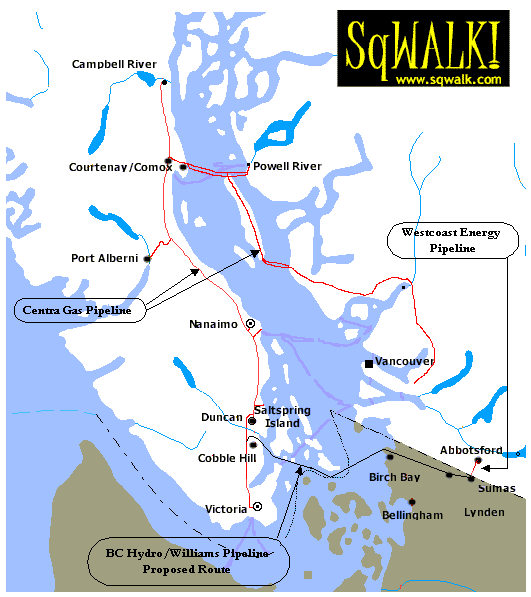
BC Hydro’s natural gas strategy The Georgia Strait Crossing (GSX) natural gas pipeline, is a proposed second pipeline to Vancouver Island. Hydro wants GSX because:
BC Hydro plans to meet this demand by burning natural gas. Hydro thinks locating power plants on Vancouver Island would avoid its having to renew the under-sea cables. In December 2000 Island Cogeneration Project (ICP) in Campbell River was completed, with a capacity of 240 megawatts (MW). In May 2001, Hydro applied to build Port Alberni Generation Project (PAGP), 265 MW, in partnership with Calpine Canada, a wholly owned subsidiary of US energy giant, Calpine. Hydro’s plans call for a 640 MW power plant to be put in operation for 2007. According to Hydro documents, this could be located in Duncan. |
|
Are these two visions compatible? As you might guess, the second vision comes from BC's new Liberal government. In August, they struck an Energy Policy Task Force. Its purpose is to create a provincial energy policy to "guide all participants in the energy sector to where we are going and how best to get there."
The terms of reference for the Task Force include phrases like, "British Columbia has the potential to take advantage of this increased [energy] demand, but only if we are structurally and competitively sound in a North American energy market that is increasingly interconnected." It also says, "... foster energy development ... consistent with exemplary environmental practices."
Given the Liberals' attitude toward free enterprise (read, corporatism), we can assume they will work eagerly toward the first goal. Given the real difficulties (experienced by societies all over the world) of protecting the environment, they will need lots of help to ensure the second goal will not become just a slogan.
Some of the biggest environmental impacts come from energy. Northern gas exploration brings wells, pipelines and roads that fragment ecosystems and devastate the traditional hunting territories of First Nations inhabitants. Coal bed methane extraction in the western US lowers an already over-subscribed water resource and brings mineral-contaminated water to the surface. Air pollution from vehicle traffic is having measurable impacts on our health and longevity. And recently, the over-arching problem of global warming and climate change, driven by CO2 released from fossil fuels, threatens the long-term stability of our planet's ecosystems-as well as the societies and economies that depend on them.
So what do the Liberals think about energy? During the election campaign, they promised to speed oil and gas development and to encourage independent power production. They also promised to return Hydro rate regulation to the BC Utilities Commission; not to sell off Hydro (though its subsidiaries might be sold); and to shut down Hydro's Burrard Thermal power plant (without saying how its power output would be made up).
Since the election, the government spoke in favour of lifting the moratorium on off-shore oil and gas development; prevented the municipality of Delta from regulating electricity "cogeneration" proposals associated with greenhouse operations; supported ordering Hydro to buy power from these cogeneration facilities; spoke in favour of "clean coal" and coal bed methane developments in BC; supported independent power production for domestic use and export through the Hydro grid (while again promising to retain Hydro).
Through their energy proxy, BC Hydro, the government has: back-tracked on shutting down Burrard Thermal (Hydro will "re-power" it with new gas turbines); supported more private gas generation projects; said Hydro needs to split its power generation from its transmission arm, to conform to emerging international (read US) "common carrier" standards; avoided discussion of Hydro's proposed Port Alberni Generation Project gas power plant and the GSX pipeline that would fuel it. (Though against this, Hydro's new CEO, Larry Bell, has said industry should cut energy waste, and he is considering $45 million of investments in energy efficiency in buildings to conserve energy. On the consumer protection side, Bell has spoken against deregulating consumer rates.)
These generally expansionist energy measures are supported by cuts in the government's ability to govern on environmental issues. The old Ministry of Environment, Lands and Parks has been cut in two. Sustainable Resource Development has been oriented toward easing commercial access to resources. The remainder is now the unpronounceable and joke-inspiring WLAP (Water, Land and Air Protection). It has no funding for its Climate Change Business Plan or for public outreach programmes on climate change.
The general direction is already clear: expansion, with a bias toward profit. It is less clear what substantial decisions have been left to the Task Force. Their schedule (less than six months from announcement to submission of the final report to the Minister of Energy and Mines) is so tight, that they could not realistically consider the relevant issues, let alone consult the public.
Once more, it falls to the public to advocate their own interests in goals like healthy air in our communities, clean water, a reduction of greenhouse gases to reduce climate change, and the long-term sustainability of our way of life. So get your two cents worth in. It's your province and your future!
Port Alberni Generation Project
While the government pushes expansionist energy policies, BC Hydro is trying to proceed with the next steps in its energy policy: Port Alberni Generation Project (PAGP), a 265 megawatt gas-fired power plant, and the Georgia Strait Crossing (GSX) gas pipeline that would fuel it.
In October, the Port Alberni town council withdrew the rezoning bylaw that would have allowed PAGP to be built on Tebo Avenue. This reflects strong expressions of public opposition, largely concerned with air pollution, since gas plants emit large amounts of toxic fine particulate matter, PM2.5, as well as other emissions. In May, five consecutive re-zoning hearings on the Tebo site were filled with speakers from the public, until council finally got the message and postponed the hearings. [See 2nd Tidal Wave Hits Port Alberni, Watershed Sentinel, August/November 2001]
Although BC Hydro has not formally withdrawn their application for PAGP, its public relations people now say it is looking for Vancouver Island sites outside the Alberni Valley. But other locations could also be opposed. Richard Hughes, Cowichan Valley Regional District director for Cobble Hill, was quoted in the Cowichan Valley Citizen saying, "Gas is really a negative thing for the Island economy. It brings price fluctuations, destabilization and the Americanization of our energy components."
To complicate things, the provincial assessment of PAGP has been upgraded to a "second stage" review, a first for gas power plants in BC. This is a significantly more rigorous level of review and reflects strong public input on the project, including data and analysis on air pollution and greenhouse gases. But this may be moot if the loss of the Tebo site kills the present application.
Public Input: 50% and Counting.
We can make a difference. In 1999, when GSX was proposed and Island Cogeneration Project was being completed, BC Hydro expected speedy approval and offered no measures to address greenhouse gas emissions. In 2000, extensive public input persuaded the federal government to order the more rigorous Panel Review assessment for GSX, rather than a Comprehensive Study. By 2001, Hydro was undertaking to "offset" half of the greenhouse gas emissions from ICP and PAGP. This is a significant concession to public concerns (though offsets remain highly questionable).
|
The National Energy Board-Canadian Environmental Assessment Agency Joint Review Panel
In November, the National Energy Board-Canadian Environmental Assessment Agency Joint Review Panel published the list of issues to be considered in the review of GSX-but it is still too vague. Will BC Hydro assess energy conservation as an alternative to gas power? Will the Panel look at greenhouse gas emissions from the end-use of GSX gas? If so, how? Will the Panel acknowledge the collective and global nature of controlling greenhouse gas emissions, or will they dismiss the BC power plants as "a drop in the bucket"? These questions have remained unanswered since the start of the National Energy Board process in 2000. A new development: the Panel requires Hydro to demonstrate its long-term gas supply and a long-term market. This raises the question, if the PAGP application is no longer valid, how will BC Hydro be able to justify GSX? |
Do We Really Need Gas Power?
Or "What Happened to Power Smart?"
1994 - The BC Hydro-sponsored Electricity Conservation Potential Review estimates BC could cut demand by 13,800 GWh/year, using marketable energy conservation measures. This is about twenty percent of BC's total electricity demand.
1995 - Hydro's Integrated Electricity Plan says BC could cut about 7,000 GWh/year through conservation.
1990s - Power Smart actually cuts demand by about 2,400 GWh/year.
2000 - Hydro's Integrated Electricity Plan has no specific plans for energy reductions through conservation. Hydro's Electric Load Forecast assumes there will be no net increase in conservation by residential customers.
Nov. 2001 - Hydro revives the Power Smart campaign with advertising, Internet evaluation tools, and power smart discount coupons for light bulbs, conserver shower heads and appliances, mailed out with consumer bills. It's still not clear how much electricity demand will be reduced by this.
|
I Dream of Pueblo Verde
And a road map to get there from here
by Norberto Rodriguez dela Vega
If you are thinking a year ahead, sow seed.
If you are thinking ten years ahead, plant a tree.
If you are thinking one hundred years ahead, educate the people.
by Kuan Tzu, Chinese Poet, c. 500 BC
In these sombre days of the Autumn of 2001, at the beginning of what some people like to call the First World War of the 21st Century, it is very difficult to think about a sustainable future. For many people in the world, there is no future at all.
I wonder if we should change priorities in the sustainability discussion, putting as priority one "sustainable peace." It seems that it is in our genes to conquer, and if victory requires the destruction of Nature, the annihilation of cultures, of other species, so be it. It is just part of the game.
I wonder if we will ever evolve from this terrible shameful condition of being the conqueror and ruler, to something better. I even wonder if we have the capability for this evolution. I wonder if we can even envision World Peace I, instead of World War III.
We need to transform ourselves. We need to metamorphose into some-thing else. We need to envision a new way of living, learn how to create a better life, not just a wealthier one.
We are not only in war amongst ourselves, but against nature. We are facing an overwhelming set of problems, from massive degradation of natural resources to overpopulation, starvation, huge gaps between the rich and the poor, and even racism.
Scientists have said for many years that we have to become sustainable. Sustainability is not an option. That's what the future will be. The question is only, at what price will we get there? Will we do it in a humane way or will it be with a lot of suffering? The earlier we understand and start doing things, in a proactive way, the easier it will be to get there.
Sustainability simply means leaving some kind of livable planet for our children. We are not talking about impossible things, but the basics: an adequate water supply, clean air, decent housing and sufficient food, a peaceful and safe place to live. The things that sustain life.
Why Don't We Get It?
Sustainability is a difficult concept for Canadians to understand. There are many reports saying that Canada is one of the worst countries in the world from the environmental viewpoint. One of the latest reports, "Canada vs. the OECD: An Environmental Comparison," by David Boyd, ranks Canada in 28th place out of 29 nations in the Organization for Economic Cooperation and Development (OECD). By the way, the countries with the highest marks are Switzerland, Mexico, Turkey, Austria and Netherlands; the USA is number 29.
The first thing we must do in Canada is educate ourselves, to accept that we can not continue behaving in the same way, if not for us, for the sake of our children and grandchildren. We must change from being a wasteful, consumer-oriented society to living in a more prudent way. We must learn to envision a healthy future. We must awake and begin transforming ourselves, our behaviours, in a way that brings back hope to youth.
Community-based Social Marketing
Doug McKenzie-Mohr has written a book on Fostering Sustainable Behaviour, with strategies and tools to change our attitudes. He says: "While education and advertising can be effective in creating public awareness and in changing attitudes, numerous studies show that behaviour change rarely occurs as a result of simply providing information. Community-based social marketing is an attractive alternative to information-based campaigns. Community-based social marketing is based upon research in the social sciences that demonstrates that behaviour change is most effectively achieved through initiatives delivered at the community level which focus on removing barriers to an activity while simultaneously enhancing the activities benefits."
Two fundamental principles drive these plans: Think Globally but Act Locally and Think Long-term but Act Today. In other words, we should understand the environmental, social, and economic problems happening in the world, envision the impact of these issues in our own cities or towns, and then start putting together plans to avoid that future. In simpler terms, be Proactive, instead of Reactive.
|
|
I am Dreaming of a Pueblo Verde
I still have hope we will be able to outlast these very difficult times. Martin Luther King said "Tie your vision to the human desire for a better tomorrow. Call your vision a dream. It will be more meaningful, more simplistic, and more symbolic."
I want to share my dream of a place I will call Pueblo Verde. I will outline a plan for becoming a sustainable community. Imagine the following:
A comprehensive sustainability plan will address all the elements in this dream, covering the social, economical and ecological dimensions. It is not realistic to think we can build such a plan easily. A better approach is to divide it into manageable sections. Specific strategies can be proposed and specific actions can begin, so we can get some results.
The sustainability plan should be a means, not an end. A good Sustainable Community Plan should define:
I have outlined the Sustainability Building Blocks diagram, showing the most important elements, including some practical actions for each block.
Five Key Components
At the foundation of Pueblo Verde there are five key components:
The six most important building blocks are Energy, Transportation, Water, Waste, Natural Resources, and Land Use and Housing. Inside of each block there are several solutions, already applied in many parts of the world. These solutions were selected primarily from the books Stormy Weather: 101 Solutions to Global Climate Change by Guy Dauncey and Patrick Mazza, and Towards Sustainable Communities by Mark Roseland. These solutions may be used by individuals, communities, organizations, businesses and governments. Energy Waste Transportation Water Natural Resources Land Use and Housing I don't think there is a question about whether we should or should not transform ourselves in the direction of sustainability. The question is whether or not we can awake in time, and have the willingness, the courage, compassion, love and endurance, to transform the world before it is too late. I want to believe there is still time to make the dream come true. * Feature sponsored by the Friends of Cortes Island Watershed Sentinel Sustainable Education Fund John T. Pierce, Ann Dale. Communities, Development, and Sustainability across Canada. UBC Press, 1999. From marine projects and new Streamkeepers stations to the evening's presentations on bulk water exports and community water systems, the Friends of Cortes Island Annual General Meeting at the Gorge Hall in Whaletown November 18th was awash with the latest FOCI activities. This year our usual line up of project reports filled the majority of the business agenda. Highlights include another successful ruling of the Environmental Appeal Board concerning the Red Granite Point septic permit appeal. Both Melody Nikleva and Bowen McDonnell, recipients of the Eco Youth Scholarship, reported on their experiences at the Biosphere Quest workshop in Clayoquot Sound last spring break. The second summer of the Cortes Environmental Youth Initiative brought great energy to a variety of FOCI marine and educational projects, and established Streamkeeping stations. Regional Director George Sirk presented his historical perspective to the island's Newt Signage. This year FOCI funded road signs to promote public awareness of the semi-annual newt migration. To paraphrase George's eloquent ending to his presentation, the tendency is to focus on larger, more glamorous species when it comes to protection and it is high time to turn our attention to the crawly creatures. The Tibetan Ecoforestry Training Partnership has shifted its proposed syllabus from the Cortes location to India. Because of the international nature of this project, financial responsibility has been transferred to Silva Forest Foundation. On the initiative of Ralph Nursall, FOCI established the Jo Ann Green Book Prize; an annual award presented at each AGM to a Cortes Islander who has made significant contributions to the environmental well being of the community. Jo Ann Green came to Cortes in 1969, settled on Coulter Bay Road, and immediately became involved in environmental and social activities on the island, including long service with the Friends of Cortes Island. For health reasons she retired to Campbell River this year but continues to be active in pollution issues. Jo Ann represents the spirit of Cortes Island independence, and its residents' recognition of the vital importance of the natural environment. The first recipient of the prize was Kathy Francis for her ongoing commitment and hard work for a sustainable environment for both the Klahoose First Nation and the rest of the Cortes community. She has done outstanding work in bulk water export issues in the Toba inlet, establishment of a Silva Forest Foundation inspected ecoforestry woodlot for the Klahoose First Nation, and most recently in bringing Cortes very close to the goal of a Community Forest. Our traditional potluck was followed by presentations and videos on water related issues. Kathy Francis described her historical involvement as Chief of the Klahoose First Nation in securing a moratorium on bulk water exports in the Klahoose traditional territory. Delores Broten presented concerns about proposed methane gas extraction on Vancouver Island, and detailed some concerns and solutions for water use on Cortes. Delores' subdivision area in Whale-town has successfully operated a water utility for the past five years, having taken it over from the developer. Sedley Sweeny gave a very brief global water perspective that set the stage for an upcoming presentation series that will include an in-depth exploration of water issues. We bid a very fond farewell to outgoing President Ralph Nursall and Directors Sedley Sweeny, and Ralph Garrison. Each has made significant contributions to FOCI and will continue to contribute their excellent energy and expertise. Welcome to the new 2001/2002 FOCI Board: President Hubert Havelaar, Vice President Norberto Rodriguez dela Vega, Secretary Myann Reid, Treasurer Carol Tidler and Directors Ted Bannister, Laura Ellingsen, Garvin Morris, and Fran Woodcock. Many, many thanks to all the funders and volunteers who make our work possible. For detailed project reports, resource information, upcoming education events, or general inquiries, please contact Kathy Smail at the FOCI office 945-0087 or email: foci@island.net 'Forest Renewal' BC Scrapped Forest Renewal BC (FRBC) evolved out of the last softwood lumber battle and now it has been scrapped in the midst of the current softwood dispute. To end the cycle of tariffs, the NDP government had raised stumpage significantly, thus adding a billion dollars or more each year to the provincial coffers. FRBC was hatched to "invest" these funds into "renewing the forests," thus making the additional costs more palatable to industry and unions. Now, with the global economy faltering and after making massive tax cuts, the Liberal government must cut services and grab available revenue - so there goes FRBC. Also, since FRBC is likely viewed by the Americans as yet another subsidy to industry, it was politically prudent for the government to get rid of it during the softwood lumber trade negotiations. During its lifetime FRBC spent the majority of approximately $2.5 billion of public resource rent money on watershed restoration, resource inventory, labour force training, sawmill and pulp mill bail outs (Skeena and Golden) and enhanced silviculture. Over the years, some of the funds also went to research, recreation, land use planning, as well as to hundreds of consultants. FRBC began as a supposed partnership among all forest-user groups, including the environmental community, and then degenerated into a slush fund for industry. The vast majority of FRBC funding went directly to forest companies through multi-year agreements. Enhanced Silviculture But No Evaluation Millions of dollars were also directed to "enhanced" silviculture, without any adequate evaluation or monitoring. Despite the sharp criticism levelled against this programme by the Auditor General (and others), there has never been a cost-benefit analysis completed which can justify continuation of enhanced silviculture. "We examined the Annual Allowable Cut rationale statements for a number of Timber Supply Areas to identify how the Chief Forester addressed the impact of spacing, pruning, and fertilization activities. All of them suggested that much of the spacing and pruning work funded by Forest Renewal BC is having no effect on improving the total volume available." The many million of dollars that have been directed to fund the Innovative Forestry Practices Agreements, which paid for "enhanced silvaculture," are particularly problematic and thus wasteful. The real irony is that, considering the expanding problems with trade in lumber, and the growing competition from fast-growing second-growth forests in warmer countries, the companies may not be able to market higher volumes of timber products in the future. Instead of spending vast sums in an effort to shorten rotation times and increase future production, trees might be better off left growing, to produce higher quality products that will likely be more in demand in the future. While the majority of FRBC's funds have been and continue to be improperly spent by forest companies, there are a number of very valuable programs which did benefit all British Columbians. The watershed and ecosystem restoration programmes, (although both could be considered subsidies to help repair the damage from forest management mistakes in the past), have been critically important and in most cases, successful. The research and inventory programs have produced some excellent data, useful for the management of all forest values. However many inventory programs have benefited industry with likely bogus growth-and-yield data, claiming second-growth forests are growing faster than had been anticipated. The recreation program was also very successful and helped to diversify local economies. The biodiversity program spent approximately $5 million to help purchase some key private lands for conservation. Other programs cannot be viewed as helpful. Funds that have gone to work force programs can also be seen as subsidies to an industry that has steadily been replacing human labour with machines, an industry that lays off employees after the forests have been over cut. The community programs have resulted in millions of dollars going to consultants to write reports that then gather dust on the shelves. Other monies have paid for projects that could also be viewed as subsidies to industry, such as the bridge replacement funds, industry infrastructure, market development, business development and funds that went to the Skeena-Cellulose and Evans Forest Products bail outs. The new Liberal government seems to be taking direction from the Council of Forest Industries. The replacement for FRBC, called the Forest Investment Account, will ship the money directly to industry, with far less government oversight. Watershed restoration will be the only program retained which benefits the environment. And the new investment system will fund projects and research that supports increased allowable annual cuts. It is possible that the entire new forest investment scheme may be scrapped before it is implemented. The Americans may claim, and rightly, that throwing money at the forest industry to increase the cut and profitability sounds too much like more subsidies. Already the Liberal government has egg on its face, after its new, profit-based stumpage system proved the laughing stock of both the American softwood lobby group and Canadian forest industry analysts. These are very strained times for both the forest industry and environmental activists. With the economy in the dumps and American protectionism on the rise, the new industry-friendly government in BC may be unable to get the industry rolling again. Plans for a results-based code and new forestry investment handouts could backfire at the softwood lumber treaty table. And as the first world concentrates on fighting terrorism and rebuilding the economy, environmental concerns will likely be ignored. The only saving grace is that with mills closing, the forests may get a respite as logging shuts down. * Jim Cooperman was the BC Environmental Network Forest Caucus coordinator for the previous decade, and served on the FRBC Environment Committee. He is the President of the Shuswap Environmental Action Society and can be contacted at jcoop@direct.ca Innovative Forestry Practices Agreements The NDP government brought in Innovative Forest Practices Agreements (IFPA) in 1997, to grant forest licence holders the ability to earn allowable cut increases by work to improve forest productivity through what the Ministry of Forests calls "specialized silviculture, inventory reviews, and growth and yield activities." To date, Forest Renewal BC has spent many millions of dollars on six IFPA pilots in the Interior. IFPAs are an affront to common sense. They propose that supposed improvements to the growing stock could allow for an increase in logging of the remaining old growth. Back in 1976, Peter Pearse in his Royal Commission on Forestry report, described the "allowable cut effect" of using improvement in growing stock to produce an Annual Allowable Cut increase as "so obviously perverse that the degree of acceptance of the system is surprising." (Timber Rights and Forest Policy, Vol. I, pg. 228) The timber cut is now declining due to the "falldown effect," as fewer high volume, mature forests remain. Meanwhile, plantations are threatened by bugs, diseases, global warming and ultraviolet radiation damage. A 1992 survey of young plantations showed that one third had been impacted by insects and disease. (FRDA Report #190). The government, without accurate data about the health of young forests, plans to increase the cut in hopes of future increases in growth. This program is both scientifically unsound and runs counter to the principles of sustainability. A Forest Service study on the economics of intensive silviculture shows future benefits are dependent on premium prices for larger sawlogs. Without this premium, "untreated stands in all but a few situations (largely coastal) provide the best forest investment strategy." Where does Chief Forester Larry Pederson stand on the potential benefits from incremental silviculture? His scepticism is apparent in his Annual Allowable Cut Rationales for both the Williams Lake and Kamloops Timber Supply Areas: "Most current research indicates that while such practices improve the quality of timber within a forest stand, they have little effect on the actual volume of timber produced, in most cases." Fertilization "would only affect the medium-and long-term timber supply." In the Okanagan Timber Supply Areas Rationale, Pederson down played the benefits of stand tending: "Any volume gains attributable to these practices are small and will not be realized until well into the future. Also, the extent to which these activities could be expanded is limited currently by the presence of root rot in the Timber Supply Areas." One of the Innovative Forestry Practices proposed is improved inventories. Forest companies will be able to use stumpage money to attempt to find more trees and volume. Inventory should be the responsibility of the Forest Service instead of a forest company that is desperate for more fibre to feed its over-capacity sawmills. The government once promised the public that Forest Renewal BC was going to invest stumpage dollars into our future forests. Now it wants to use stumpage money to give these future benefits to forest companies today. Forest companies will be able to spend our children's inheritance now to boost their corporate profits. Unfortunately, it looks as though IFPAs will continue, given the Liberal government's intentions to fund programs that will increase Annual Allowable Cuts. One can only hope that Regional Managers will be unwilling to grant these IFPA cut increases based on such dubious assumptions. Better Left Said Another cause of our eco-incompetence is that our senses evolved to favour foreground and motion: noticing sabre-tooth tigers in trees beat noticing said trees [now, the reverse]; things in the environment not the environment. Choose from Column A or Column A from cultures menu of the world. Thanks, I'll have Death please. Perhaps an out-of-control death-wish mirrors out-of-control aggression to other species. Like sharks in a feeding frenzy, biting each other and even themselves ... So Liberal voters, like your new rulers? They're curbing unions, trying to revive oil & gas drilling & ignored the record bus strike as long as they could. I'll bet BC bear biologists aren't too fond of Liberals: they were invited out of the grizzly bear hearings in favour of American ones [their Montana head is a hunter yet]. Interesting how the only argument government [and most private induhviduals] even mull is how many are killable without driving them extinct [PR poison]. Whether we should soil our hands with blood money from vertical vermin diseased enough to kill just for fun, is of course a rude and moot point. Few people voted for the Liberals: most voted against the NDP. The Liberals benefited from one more undeserved effect: the Safe Luxury Car syndrome. What's that you ask? Luxury cars in poor neighbourhoods are more rarely vandalized or stolen. Predators instinctively target the weak. If you look rich [and non-feeble] you're left alone. So poli-predator rich-reps get unusual support from the poor because of this lottery-ticket mind set [if I buy tickets, and allow the rich their way, I nurse my faint hope that I too will wallow someday]. It's like New Guinea cargo cults; they built airstrips to attract wealth-bearing airplanes. Thus breathing dirtier air. Wolves who invite dogs over for lunch have a different idea of sharing than dogs hope. The trickle-down theory? Only pain trickles down. Ask the poor in Ontario. The neo-conservative movement is consistent, predictable: if the centre cannot hold, if we lose our connection with nature, it's only logical that, sooner or later, we further weaken, to lose our connection with each other [and anyway it's great to have an excuse to sever ties with poor relatives]. So the social contract goes the way of the environmental contract [the latter being so non-existent even the phrase sounds odd]. Do I seem negative, hard? Such messages are softer than the icebergs they warn of. And we have made nature into the Titanic. Here we are: there's no trained crew, and the most aggressive passengers, that elected themselves into that position [governments], are now bribed by other crew members, called companies, to take the helm. And these people AIM for icebergs. Better left said ... On The Towers, and walls ... The bitter truth is that we only stop destroying when we are being destroyed; the only time we stop causing suffering, when we suffer. The World Trade Center buildings were symbols of environmental and cultural destructiveness, of the sanctified greed now called American culture, and its occupants no innocents. And it is emblematic of our species that it is now mostly divided between the equally but alternately insane, the Bin Ladens that exert positive effects. Regard the positive effects of a reduced air transport industry! The 'Nutzis' instituted unusuallyally green policies, and of course reduced world population by millions. Communists and rabid Islamic fundamentalists reduce[d] consumerism. Drug addicts and criminals slow the juggernaut of consumerism/overpopulation-generated eco-collapse. Humanity: wailing at walls or building them. Both are sad but if 'positive' people refuse to even acknowledge their addictions, it's impossible not to see ideological obsessives like Bin Laden [You are Bad so I am Good!] as far more truly positive than his 'reasonable' counterparts, us. If we cannot be sane, it is better that our insanities partly cancel. But perhaps the end result is the same ecocide. I once saw a cartoon of 2 factories: one with normal vertical smoke stacks, and one with smokestacks slanting outwards like cannons. Or to paraphrase another seminal image by that great American cartoonist, Walt Kelly of Pogo fame [check it out, young-uns!], "We have met the terrorist and he is us." Unhappy, happy; fighting, feasting; we destroy. Painless Stonewalking compadres. . . * The EcoCurmudgeon and the Watershed Sentinel beg you to complete the circle: with quotes, images, article & column ideas, bricks n' bouquets, etc. to wss@rfu.org or marinuslutz@hotmail.com. Portions of this column are excerpts from an upcoming book and are copyright. Please say Thank you! to our Alberni Environmental Coalition, Port Alberni BC • BC Spaces for Nature, Gibsons BC • W. Bertow, Winfield AB • Les & Joan Cartwright, Courtenay BC • Allan & Lyn Davies, Victoria BC • Betty Fairbank, Hornby Island BC • Sue Frazer, Port Alberni BC • Ralph Garrison, Mansons Landing BC • Elaine Golds, Port Moody BC • Wendy & Hubert Havelaar, Whaletown BC • Willem J. Havelaar, Courtenay BC • Sheila Hawkins, Burnaby BC • Shirley & Harry Holmes-Holman, Denman Island BC • Robin Keller, Whaletown BC • Robyn Budd & Erika Kellerhals, Heriot Bay BC • Ruth Ozeki & Oliver Kellhammer, Whaletown BC • Kyuquot Community Association, Kyuquot BC • Hannah Main, Victoria BC • Garth & Dianna Malcolm, Gananoque ON • Hugh McNab, Surge Narrows BC • Norske Skog, Elk Falls, Campbell River BC • Nuu-chah-nulth Tribal Council, Port Alberni BC • Monica Oldham, Victoria BC • Maggie Paquet, Port Alberni BC • Tom Pater, Kyuquot BC • Jo Phillips, Sooke BC • Joe Prochaska, Nashville TN • Norman Riggs, Powell River BC • Shivon & Bill Robinsong/Weaver, Victoria BC • Michael Rooksby, Victoria BC • Sechelt Dental Centre, Sechelt, BC • Faith Slaney, Saltspring Island, BC • Sutil Point Planning, Cortes Island BC • Mike Thomsen, Victoria BC • Lannie Turk, Queen Charlotte City BC • Bill Turner, Victoria BC • Milo & Virgina Wilcox, Whaletown BC • Susan-Marie Yoshihara, Denman Island BC • Ruth & Fred Zwickel, Manson’s Landing BC Thank You, Patrons Friends of Cortes Island regularly publishes articles on sustainable living in the Watershed Sentinel. To support this public education by becoming a Patron of the Watershed Sentinel, you may donate $100 or more to the Friends of Cortes Island Watershed Sentinel Fund. This tax deductible charitable donation is separate from your subscription to the Watershed Sentinel. It is a compliment when readers send us letters and articles for publication. We are sorry we cannot publish all the material we receive. Deciding what to put in/what to leave out is a tough call. In order to present a broad range of topics, many good items are shelved and then become dated. You can help by ensuring that your articles are researched, documented and topical. Don't be discouraged. Your next article may trigger a polar shift. Special Thanks to Horizon Publications, Norberto Rodriguez dela Vega, Mae Burrows, Marinus Lutz, Pru Moore, Nickie Polson, Guy Dauncey, Colin Graham, Francis Toms, Gloria Jorg, Susan Yates, Peter Ronald, Miranda Holmes, Kathy Smail, the writers, advertisers, distributors, and especially all who send information. This magazine would not happen without you. Print Run 3500 Circulation est. 7,000 Distribution by news stand sale through Disticor (Toronto), by subscription, and to members of Friends of Cortes Island and Reach for Unbleached! Free at Vancouver Island and Vancouver area libraries. For reproduction rights, contact CANCOPY, 6 Adelaide St. E., Ste. 900, Toronto, Ontario M5C 1H6 About us Reach for Unbleached! started in 1991 as a grass roots organization in British Columbia, Canada in response to fishing closures due to dioxin contamination from chlorine-bleaching kraft pulp mills. We are now a national foundation, and a Canadian registered charity with a focus on consumer education and pulp mill monitoring.
Pueblo Verte
* Selected Sources:
World Commission on Environment and Development. Our Common Future. Oxford University Press, 1987.
D. McKenzie-Mohr, W. Smith. Fostering Sustainable Behaviour. New Society Publishers, 1999.
G. Dauncey, P. Mazza. Stormy Weather: 101 Solutions to Global Climate Change. New Society Publishers, 2001.
M. Roseland. Toward Sustainable Communities. New Society Publishers, 1998
D. H. Meadows, D. Meadows and J. Randers. Beyond the Limits. Chelsea Green Publishing Co., 1992
Ontario Round Table on Environment and Economy. Sustainable Communities Resource Package. 1995
A. B. Lovins, L. Hunter Lovins, P. Hawken, Natural Capitalism: the Next Industrial Revolution. Little Brown, 1999.
A. Weisman. Gaviotas: A Village To Reinvent The World. Chelsea Green Publishing Co., 1995.
J. Macy. World as Lover, World as Self. Parallax Press, 1991.
J. B. Robinson. Life in 2030: Exploring a Sustainable Future for Canada. UBC Press, 1996.
D. R. Boyd. Canada vs. the OECD: An environmental Comparison. UVIC Eco-Chair of Environmental Law and Policy, 2001.
L. Brown. Eco-Economy: Building an Economy for the Earth. W. W. Norton & Co., NY, 2001.
FRIENDS OF CORTES ISLAND
OPINION
Stumpage, the "rent" for public forests, will fund BC's enhanced silviculture sham.
by Jim Cooperman
- An Affront To Common Sense
COLUMN
by the EcoCurmudgeon
Sustaining Subscribers
It’s their help that keeps the Watershed Sentinel publishing.
Sustaining Subscribers donate $50 a year to the Watershed Sentinel.
If desired, we send two copies of each issue, one for a friend.
Frances Astor, County Dublin, S. Ireland
Richard Betts, Burnaby BC
Louis & Vera Broten, Edmonton AB
Douglas S. Brown, Vancouver BC
Jilly & Lew Carlino, Whaletown BC
Cortes U-Brew, Manson’s Ldg BC
Marna Disbrow, Heriot Bay BC
Endswell Foundation, Vancouver BC
Colin Graham, Sidney BC
Brian Grant, Victoria BC
Alison Graves, Nanaimo BC
Barbara Graves, Lantzville BC
Greenpeace Vancouver
Anthony Grinkus, Vancouver BC
Olga Grinkus, Vancouver BC
Happy Planet Foods, Salish Coast
David & Ann Hiatt, Whaletown BC
Peter Johnston & Sue Wheeler, Lasqueti BC
Mountain Equipment Co-op
Reid & Sakiko Neufer, Whaletown BC
Stefan Ochman, Bamfield BC
William Paterson, Vancouver BC
Pinchot Family, Bainbridge Island WA
Nina Raginsky, Saltspring Island BC
Peter Rowlands, Smithers BC
Paul Sanborn, Prince George BC
Aaron Smeeth, Campbell River BC
Charlotte & Leo Smith, Heriot Bay BC
Ronni Solbert, Randolph VT
Vera Soudek, Kingston ON
Bruce Torrie, Victoria BC
Seymour Trieger, Ladysmith BC
Cordula Vogt, Saltspring Isld BC
Box 39, Whaletown, BC
Canada V0P 1Z0
http://www.rfu.org/wss
email: wss@rfu.org
web master: Yendor
yendor@rfu.org
Associate Editor Don Malcolm
Computer Edition Yendor
Editorial and Production Gloria Jorg, Jay Cates, Liza Morris
Artwork Lisa Gibbons, Robyn Budd
Cover Delores Broten
Published six times per year
Subscriptions $20 one year, $30 two years Canada, $26 US one year
Member British Columbia Association of Magazine Publishers
Canada Post Agreement No. 1384570
PAP Registration No. 09057
ISSN 1188-360X