 |
No. 29 December 2000 News for All Interested in Featuring |
Search this site Campaigns Publications Technical  Pulp & Paper About Reach! Contact Us Links |
(You may SEARCH this page using your browser's FIND command)
|
|
No. 29 December 2000 News for All Interested in Featuring |
Search this site Campaigns Publications Technical Pulp & Paper About Reach! Contact Us Links |
MillWatch table of contents
MillWatch No. 29 - Dec 2000
 Reach for Unbleached! Joins Bellingham Neighbours as They Run for Their Lives
By Their Coffee Filters Ye Shall Know Them!
LP Sells Samoa Mill
Paper Sludge Dump Results in Cancer Cluster Lawsuit
Workers Claim PCB Substitutes Are Health Hazard
Mark Your Calendars - Bulk Office Paper Buying Club
Upgrades for Elk Falls
About us
How to request brochures, subscribe, donate, or volunteer
(You may SEARCH this page using your browser's FIND command)
MillWatch is sponsored by Reach for Unbleached! Canada to connect people and provide resources for those working on pulp and paper issues. If you have information, experience, or problems you want to share, this forum is meant to spread the word, but it needs your help. Write to us!
Reach for Unbleached! Joins Bellingham Neighbours as They Run for Their Lives
On a Saturday in late October, Jay Ritchlin took the Reach for Unbleached! travelling road show to Bellingham, Washington to take part in a unique and inspiring event. Local residents organised an event called "Run for Your Life!" to protest continued use of chlorinated bleach chemicals and ongoing pollution of their community by Georgia Pacific's (GP) sulfite pulp mill located in the heart of their downtown waterfront.
The day combined music, speakers, good food and a two kilometre race from the gates of the GP mill to Red Square on the campus of Western Washington University (WWU). Lest anyone think the choice of finish line was an intentional political statement, it should be noted that the location was based on criteria from the mill's emergency evacuation plan. GP's only advice to Bellingham burghers in case of a catastrophic spill - head for high ground. The university is on one of the highest hills near downtown.
The speakers and musicians were an inspiring bunch. A local fiddler told the story of how his dad died of hardened lungs after a lifetime at the mill. The father's last wish was that the family "not sue GP"; the son is still not sure if he can honour that wish, but he is fiddling and fighting for a cleaner future.
A local physician told of the fears he has for his own children who have grown up in the plume of the GP mill, how he worries about asthma and damage from endocrine disruptors in his community. Actor Ed Begley, Jr. urged people to follow the example of Lois Gibbs from the Love Canal and hound their politicians until they get results. Reach for Unbleached! explained the hazards of current chemicals, green-wash tricks industry will play, and ways to take action for change.
Everyone noticed GPs hog fuel boiler (which one speaker pointed out should only be called a "toxic waste incinerator") seemed to have been shut down for the occasion. If I were GP, I'd be concerned about my public image, too.
But the people in Bellingham see beyond image. They are focused and know what they want. They want GP to shut down its toxic waste incinerator, they want GP to go Totally Chlorine Free, and they want Washington State to pass a strict, enforceable law to phase out persistent bioaccumulative toxins. They want Georgia Pacific to stop contaminating their town, their bay and their bodies.
And those are the folks who are in the mood for a compromise.
* Jay Ritchlin, Reach for Unbleached!
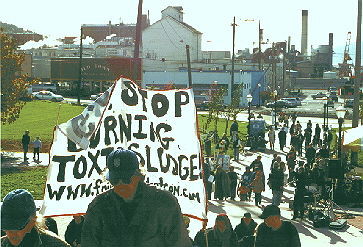
Photo credit Jayne Kim
A search of the assorted paper coffee filters at the local supermarket, in a forest industry town where the mill is always right, revealed four "choices" and only one of them the Melitta White filters. The others were Melitta Natural Brown, Western Family "natural unbleached paper" and VP "Oxygen cleansed paper" which explained: "VP Filters are specially manufactured using oxygen cleansed technology, thereby helping to minimize the release of unwanted by-products into the environment."
Whatever the pros and cons and to's and fro's of the pulp debate, it looks like people don't want to drink extra organochlorines with their morning brew any more. It's a bit early to proclaim victory over chlorine-based bleaching, but it's positive news. "What sells" in the grocery store is a great public opinion indicator.
* Delores Broten, November 2000
Louisiana-Pacific is selling its Samoa California TCF- capable mill to LaPointe Partners, Inc. for $46 million plus $33 million in stock. The sale includes a chip export facility. The Samoa mill was rebuilt to bleach Totally Chlorine Free after years of lawsuits from the Surfriders Foundation, but its products were never successfully marketed by LP, which is now exiting the pulp business to focus exclusively on building products.
* LP November 2000
A story from the Blethen Maine Newspapers reports that nineteen plaintiffs are suing for damages from a paper mill sludge dump site in Maine against Kimberly-Clark Corp. and S.D. Warren Co., now owned by Sappi Fine Paper North America.
The plaintiffs, represented by Baron & Budd, a Dallas law firm, are suing because of illness and death they claim was caused by exposure to dangerous chemicals dumped in several gravel pits from 1976 until the dump was closed in 1985.
Last summer, the state declared that a "cluster" of cancer cases exists in the area, where dozens of cases of cancer, lupus, non-Hodgkins lymphoma and other illnesses have been diagnosed. Government reports show the former dump contains petroleum waste, chemical drums, paper-mill sludge and caustic material. The potentially hazardous chemicals burned openly and continuously at the dump for more than three years.
However, the defendants challenge that exposure to particular chemicals must be linked to particular diseases in each individual.
* Doug Harlow, Blethen Maine Newspapers, July 2000
The Clean Water Action Council warns that the compounds Appleton Papers uses to make carbonless copy paper, chemicals substituted for PCBs, are accumulating in the Fox River's sediment and fish. The chemicals are the subject of another court action as workers try to gain access to papers which the company wants sealed as trade secrets. The workers claim the company knew for forty years that the chemicals caused health problems; the company says the workers lost their jobs for other reasons.
The potential health effects of carbonless copy paper are being reviewed by the National Institute for Occupational Safety and Health, which performed an inconclusive review of the data in 1987. Since 1997, the institute has collected 14,000 pages of information on carbonless copy paper and expects to release its findings by year's end, according to the Green Bay Press Gazette.
Appleton Papers says carbonless copy paper has been vigorously tested during the last 15 years. Of more than 120 studies of carbonless copy paper, the company said, the weight of the evidence to date fails to link the product to health problems. The Appleton-based company is the world's largest manufacturer of carbonless copy paper, producing about half of the estimated 800,000 tons sold annually.
The Clean Water Action Council cited a 1983 Masters thesis by Paul Peterman, now an environmental chemist, which identified chemicals used in the manufacture of carbonless copy paper and tracked them to the lower Fox River's sediment and fish. The thesis reported that some of these PCB substitutes became chlorinated during the paper-bleaching process, were stored in fat and had the ability to accumulate in fish, and were present in fish in the river and Green Bay.
A follow-up study, published in 1990 in Biomedical and Environmental Mass Spectrometry, again reached the same conclusions, calling for more study.
Not surprisingly, the state Department of Natural Resources has its hands full with the old PCBs and has no intention of using resources on the new chemicals until they are identified as a hazard with risk assessment levels.
Rebecca Katers of Clean Water Action, which is watch dogging the non-clean-up of tons of PCBs in river sediments from the paper mills, says the case points to an important lesson: "While we work to clean up old pollution, we need to keep an eye on new chemicals being discharged which may be the disasters of the future." She notes that the new chemicals will recontaminate the river even if the PCB clean up problems are solved.
* Green Bay Press Gazette, October 2000 at http//www.pressgazettenews.com/archive/biz/0010/1030carbon.html
* Rebecca Leighton Katers, Clean Water Action Council of N.E. Wisconsin; ph: (920)437-7304; fax: (920)437-7326, email: CleanWater@cwac.net
Mark Your Calendars
Bulk Office Paper Buying Club
Order dates: January 31, Apr 30, July 31 & Oct 31.
Minimum order: One case (5,000 sheets)
Pre-payment is crucial.
The Paper: Rolland New Life Dual Purpose
Buy Chlorine-free
SAVE MONEY AND THE ENVIRONMENT!
* Reach for Unbleached!, #708 - 207 W. Hastings, Vancouver V6B 1H7 Phone (604)879-2992
or (250)935-6992, email dbroten@rfu.org
At the hand over ceremony from Fletcher Challenge Canada to Norske Skog in late October, Norske Skog announced that they would be spending $65 million on capital improvements "next year" for the Vancouver Island Elk Falls mill. The local paper noted many townspeople had been voicing concern that Fletcher Challenge was "not putting profits back into Elk Falls."
Torbjorn Storsve, Elk Falls paper manager, said, "Our plans for capital spending have been approved, so now we can start preparing to get approval for different projects. We all want to be proud of Elk Falls. It is the start of a new day. Let us make the most of it."
Communications, Energy and Paperworkers Union local president Mike Adamschek said Norske Skog had made "a big change in the attitude towards safety" for the workers.
Storsve said the total capital spending had been approved, but specific projects had not. "It means we can start to find projects to use this amount of money, but each project has to be approved. (We have to show) that it has its pay back."
* Campbell River Courier-Islander, October 2000.
Evolution of Writing
"Papyrus ... parchment ... paper ... pixel."
* Robert Baensch, Director of the NYU Center for Publication